
From the Book:
Transcript:
Greetings, today we will hike Trail 5 at McCormick’s Creek State Park.
Before we start, I would like you to know that this episode is based upon my book, McCormick’s Creek State Park, available on my web site, http://www.mossyfeetbooks.com. While visiting the web site you can subscribe to it and receive email notifications of when I publish a new book or other content, like this video and podcast. You can also subscribe to the Mossy Feet Books You Tube Channel to ensure you don’t miss any of my content.
The trail is rated as a moderate hike, 2 mile hike. Hikers will find themselves in a deep forest populated by beech, maple, tulip poplar and many other hardwood trees native to Indiana. The trail connects via a short spur to the campground at McCormick’s Creek and to Trail 8 on the eastern and western parts of the trail.
For most of the way, the trail is wide and well marked. For a portion of the hike the trail skirts Litten Branch as it meanders through the Wolf’s Cave Nature Preserve.
Located on the northeastern corner of McCormick’s Creek State Park, the 214 acre Preserve includes Wolf Cave and nearby Twin Bridges. The Youth Camp is nearby, accessible from Trail 5, which is the only trail in the Preserve. The hilly slopes have a thick forest cover of red oak, white ash, tulip, sugar maple, and hackberry. The valleys contain mostly sycamore, red elm, and black walnut. Hikers will find mostly chinquapin, red, and white oak, as well as shagbark hickory on the higher elevations. Visitors will also find and abundance of mosses, liverworts, and ferns.
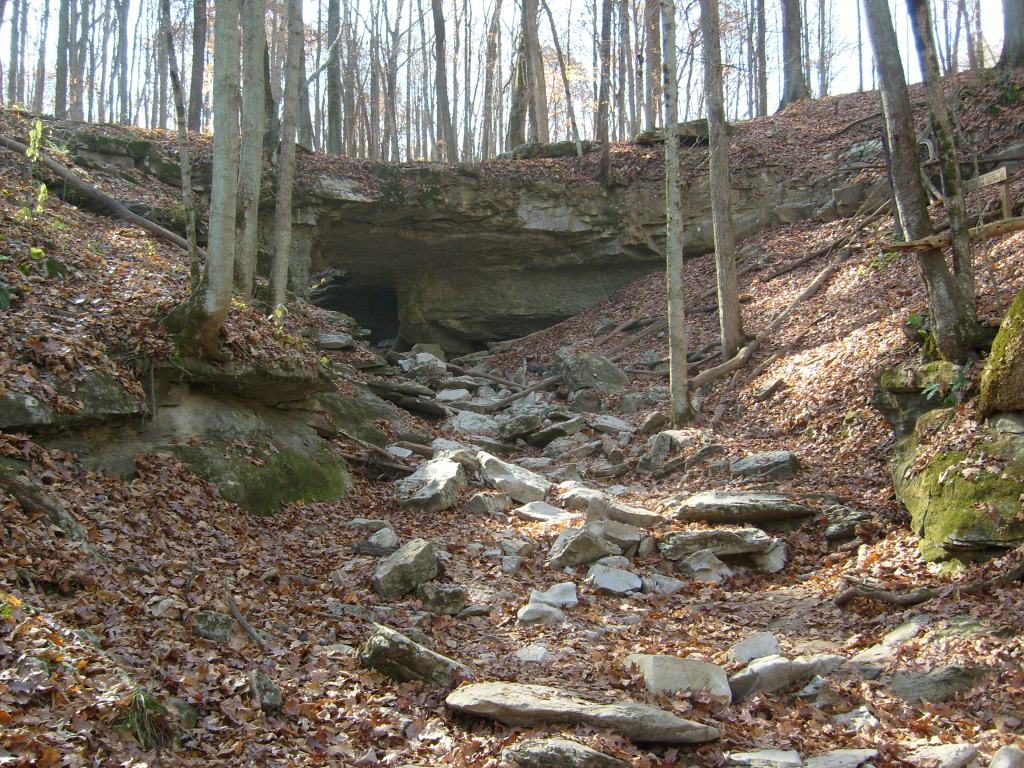
Located along the creek the hiker will pass Wolf Cave
Hikers will find Wolf Cave on the northern edge of the park in the Wolf Cave Nature Preserve on Trail 5 near Litten’s Brach. Though most Indiana State Park caves have been closed by the Department of Natural Resources, park staff has reopened the cave due to the lack of bats. A fungal disease called White Nose Syndrome has infected bats in Indiana and across the nation. The DNR has closed most caves to combat the spread of this fatal disease. Wolf Cave has no bats, thus there is no danger.
Carved by the erosion of water over the centuries, Wolf Cave has evolved into a dry cave, as the water has carved deeper passageways under this cave, draining the water. Wolf Cave is a small passage with a small, limestone natural bridge that has formed from the collapsed ceiling of the cave near the spot where water enters the cave.
The next natural feature found on the trail is called Twin Bridges, which is a collapsed cave visible from the trail.
The trail continues on as it follows the course of Litten Branch, coursing through a beautiful forested landscape. The heavily forested rolling hills provide a peaceful walk.
On the next episode we will walk along Trail 3 at McCormick’s Creek State Park. The episode is also based on my book, McCormick’s Creek State Park, available on the web site, http://www.mossyfeetbooks.com. The book is the first book in the 10 volume, for now, series called the Indiana State Park Travel Guide Series. The books contain interesting information about the history, geology and features of the parks as well as tons of information about day trip destinations in the area of the park. I encourage you to visit the web site and subscribe to it.
I hope you enjoyed this podcast and thank you for listening.

 Mossy Feet Books - Author Paul R. Wonning