
From the Book:
Turkey Run State Park
Transcript:
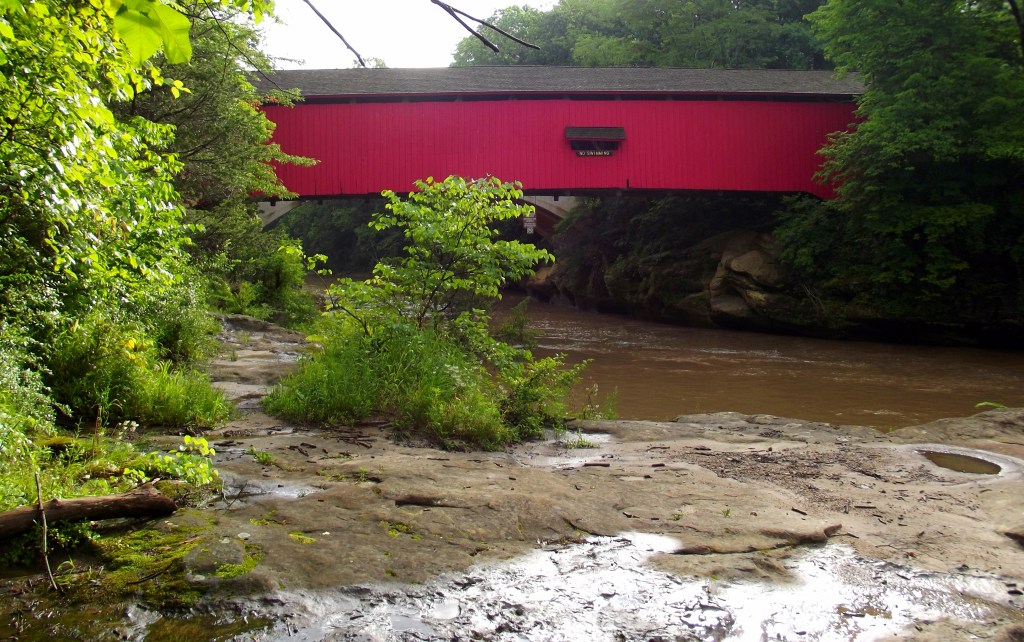
Greeting, today I will tell you about the Sugar Creek Trails in Turkey Run State Park.
Turkey Run State Park has some of the most challenging hiking in Indiana as well as some of the prettiest. On this hike we will walk along beautiful Sugar Creek on trails 1 and 4.
Before we start, I would like you to know that this episode is based upon my book, Turkey Run Creek State Park, available on my web site, http://www.mossyfeetbooks.com. While visiting the web site you can subscribe to it and receive email notifications of when I publish a new book or other content, like this video and podcast. You can also subscribe to the Mossy Feet Books You Tube Channel to ensure you don’t miss any of my content.
Originating in a farm field near Kempton, Indiana in Tipton County, Sugar Creek flows 93 miles to its junction with the Wabash River just north of Montezuma, Indiana. Sugar Creek flows through Crawfordsville, Shades State Park and Turkey Run State Park as it courses its way through west central Indiana. The creek’s size makes it a popular canoeist mecca. Visitors will find many canoe liveries in the area. Canoists will find several public access sites along this beautiful waterway. The name arises from the word, Pun-ge-se-co-ne, or Water-of-many-sugar-trees. Apparently the area had an abundance of sugar maple trees, a source of syrup and maple sugar for the natives and early settlers.
Sugar Creek’s length in Parke County is about fifteen miles. It enters Parke County on the north border of Shades State Park and continues on a southwesterly course. It passes through Turkey Run State Parke, crossing US Route 41 just west of the park. Sugar Creek joins the Wabash River about five miles north of Montezuma.
Trail 1 hugs the south shore of the creek. It is a 2 mile long trail rated as moderate.
Known as the big-tree trail, huge sycamores and black walnut trees reside in the Sugar Creek Valley along the trail. The trail head is a short distance from Turkey Run Inn as it branches off of Trail 6. The trail passes the Tennis Courts and the Middle Shelter. From there it descends into the Sugar Creek Valley and passes the entrance to the Suspension Bridge that crosses Sugar Creek. Trail 1 intersects Trail 2 at this point. The Suspension Bridge leads to Trails 3, 8 and 4 on the other side. From this point it proceeds along Sugar Creek and the tract of forest containing the aforementioned huge trees. Good views of the Narrows Covered Bridge are visible from different points along the trail, especially Goose Rock, which is a huge rock jutting out into the creek. Just before it reaches Narrows Road a spur trail leads up to Trail 2 covered bridge. Trail 1 ends at the Narrows Covered Bridge, however we will hike across the Narrows Covered Bridge and take Trail 4, which hugs the Sugar Creek shoreline.
Trail 4 hugs the north shore of the creek. It is 2 miles long and listed as a moderate to rugged trail.
Trail 4 is a loop trail that proceeds northwest past the Lusk home and continues on to a junction with Trail 3. On this hike we will focus on the section that goes along the creek. From the covered bridge the trail proceeds west and reaches the Coal Mine. Trail 4 branches off Trail 3 near the Punch Bowl. It proceeds northeast through a pretty valley, then loops south to an intersection with Trail 8. The two trails run together until they branch just before they reach the Lusk Home. Trail 4 proceeds past the Lusk home and turns to follow Sugar Creek at the Narrows Covered Bridge. Trail 4 intersects Trail 8 at the coal mine.
Coal Mine
Located at the junction of Trails 4 and 8, the Coal Mine is an abandoned mine probably used by the Lusk family as a fuel source. Mining began in this location sometime around 1800 and continued until 1920. The coal mined was used as fuel during the first years of Turkey Run State Park. Workers carved into the hill, following the horizontal coal seam, using timbers to support the roof of the mine. They used a small donkey pulling a cart that rolled on raised iron rails to haul the coal out of the mine. After removing the coal they raisied it up to the top of the hill and carted it to the Lusk home on a path that Trail 8 now follows.
Indiana’s Coal
300 Million years ago Portions of the region we know as Indiana was covered at one time by huge swamps. Indiana was much warmer at this time, an environment that was ideal for plants to grow. Vast quantities of dead vegetation accumulated over the centures to form a layer of brown, spongy peat at the bottom. Geologic and climatic changes over the centuries allowed soil and rock to form over this layer of peat. As time passed the heat and pressure of this buildup converted the peat, hardening it into the substance we know as coal. Each ten foot layer of peat will generate about one foot of coal from this pressure and heat buildup. The coal in Indiana is of a type called bituminous coal which is very low in moisture and is an ideal fuel for using in electricity generating plants and to make coke for the steel industry. The earliest records of commercial mining in Indiana date from the mid-Nineteenth Century. The vast majority of coal in Indiana is found in the southwestern part of the state. The Turkey Run deposit is near the northernmost part of this coal region. The Lusk mine was probably never a commercial mine, as the deposit was too small.
At the Coal Mine it intersects Trail 8, and the two run concurrently until Trail 8 branches off to the northwest. Trail 4 continues on, however we will cross the Suspension Bridge across Sugar Creek and return to Trail 1.
On the next episode we will hike Trail 3, called the “Ladders Trail,” at Turkey Run State Park. The episode is based upon my book, Turkey Run State Park, available on the web site, http://www.mossyfeetbooks.com. The book is the second book in the 10 volume, for now, series called the Indiana State Park Travel Guide Series. The books contain interesting information about the history, geology and features of the parks as well as tons of information about day trip destinations in the area of the park. I encourage you to visit the web site and subscribe to it.
I hope you enjoyed this podcast and thank you for listening.

 Mossy Feet Books - Author Paul R. Wonning