
Hickory Ridge Fire Tower
Today we will visit the Hickory Ridge Fire Tower in the Hoosier National Forest.
Based on the Book:
Camping Across Indiana
Transcript:
Greetings, today we will visit the Hickory Ridge Fire Tower in the Hoosier National Forest.
Before getting started, I would encourage you to subscribe to the Mossy Feet Books You Tube channel for more great content. If you like my videos, please hit the “Like,” button. The more likes I get the more You Tube will show it to other people, allowing me to grow the channel. I also entreat you to visit my website, http://www.mossyfeetbooks.com. There you will find sample chapters, podcasts, a slew of content and links to where you can buy my books. While visiting the web site you can subscribe to it and receive email notifications of when I publish a new book or other content, like this video and podcast. This episode is based on my book, Camping Across Indiana.
Hickory Ridge Fire Tower
While on a camping trip to Brown County State Park, we took the opportunity to use our camping sticker to inspect the campground and facilities in the Paynetown Recreation Area on the northern shore of the lake. Paynetown has an electric and a non-electric campground, hiking trails, boat docks, boat rental and picnic shelters.
State Road 446 crosses a bridge that carries the highway over the lake. We crossed this and turned right into the Cutright Recreation Area, which consists mostly of another boat ramp.
We continued south on State Road 446 until we reached Tower Ridge Road.
We passed the parking lot, on the left, of the Charles Deam Wilderness.r.
I pulled over into the parking lot. There is a small log cabin here, the Brooks Cabin. A man named John S. Brooks built this cabin in the 1890’s. The cabin originally stood on a bend in the Little Blue River in Crawford County, about 60 miles to the south. The cabin was deteriorating when the United States Forest Service acquired it. A work crew numbered and disassembled the structure and moved it to this location. After reassembling it, the cabin now serves as a welcome center for the Charles C. Deam Wilderness. Even though it is not originally from this area, it represents the type of cabin constructed by the first pioneers to inhabit the region. The cabin has some informational signage displayed outside and a large millstone that was found in the Wilderness.
Charles C. Deam Wilderness
The Charles C. Deam Wilderness area was designated a wilderness in 1982 and encompasses nearly 13,000 acres of the Hoosier NF. Wilderness designation places this area in a special legal status (subject to the 1964 Wilderness Act). It is managed to preserve a natural condition and provide opportunities for solitude.
Approximate Length of Trails: 37 miles
Type: Hiking and horse riding.
Special Features:
Long distance loop trails in a scenic hardwood forest with a variety of terrain.
Named for the first Indiana State Forester, the Charles C. Deam Wilderness is bordered on the north by the watery Middle Fork State Wildlife Refuge.
Tower Ridge Road
Bloomington, IN
https://www.fs.usda.gov/recarea/hoosier/recarea/?recid=41554
Charles Deam (August 30, 1865 – May 29, 1953)
Charles Deam entered life on a farm near Bluffton in Wells County, Indiana. His father, John Henry Deam, taught him about plants as he grew up, spurring his lifelong interest in botany. His father was an avid farmer and gardener, growing vegetable and fruit plants and concocted various remedies using them. As a boy he attended local country school and the new Bluffton High School. He also earned money by taking odd jobs on the farms in the area. When he was sixteen he and his mother, Martha Marsh Deam, both caught typhoid fever, an often fatal disease. Both took a medicine which consisted of old field balsams or cudweed, and milk boiled together. He survived; however his mother passed away.
After graduation he took jobs as a teacher at local public schools. He attended DePauw University in 1885, but had to leave after his second year because he could not afford the tuition. After selling his books, he returned home to work odd jobs for a time.
He got a job as clerk in a pharmacy, first in Marion and later in Kokomo. In 1888 he acquired his own pharmacy in Blufton. As a pharmacist he worked 110 hours a week, leading to exhaustion and stress. After overhearing him snap at a customer, a visiting perfume salesman recommended that he see a doctor. The doctor recommended long walks in the forest to relieve the stress.
On these walks, Deam studied the plants and collected specimens. His interest in plants and botany grew on these walks. In 1893 he and Stella Mullin married. The couple shared similar interests. She sometimes accompanied him on his walks, helping him collect plants.
In 1896 he met a zoologist named Bruce Williamson. He and Stella met with him periodically to discuss botany and have Williamson help him identify plants. Williamson taught him the scientific method of studying and identifying plants. After he and Stella made a particularly interesting discovery, Williamson just loaned him his copy of Gray’s Manual of Botany. He and Stella used the book to identify a particularly unusual plant, Verbascum blattaria, moth mullein.
Williamson introduced Deam to the Indiana Academy of Sciences, an organization held meetings of educated people in the state where they discussed the latest scientific findings and share knowledge. Deam submitted an article to their journal, Proceedings, as well as submitting an annual report called the “Plants Rare or New in Indiana.”
In 1909 the State of Indiana asked him to become Indiana’s first State Forester. The state had created Clark State Forest in 1903 and needed someone to supervise it. If he took the job, he would have to live part time at the facility to manage it. The rest of the time he would have to live in Indianapolis. Deam was reluctant to take the job, as his pharmacy in Blufton was still thriving and he felt he was needed there. He eventually took it because he felt the job would give him a platform to voice his opinions on botany and forestry in the state. As forester, the state would fund his travels around the state, he would also have an identification badge he could use to visit private properties that would otherwise be off limits.
By 1900 only about 7% of Indiana’s once vast forest system remained. Clark State Forest was an attempt by the state to restore some of that vast, lost treasure. Deam would play an important role in that effort. During his two stints as State Forester, 1909 – 1913 and 1917 to 1928. He performed many experimental tasks, many at Clark State Forest. These experiments mostly involved reforestation. His finding dispelled many erroneous beliefs and led to the successful reforestation of much of Indiana’s forest. He initiated many educational programs helped determine what trees would best suit Indiana’s soil, topography and climate. It was at his insistence that the State add an additional 2000 acres to the park. His work had lasting consequences on forestry in Indiana and visitors can still see many of his experimental plantings.
Deam focused his interests on vascular plants native to Indiana. He acquired a plant library and in 1910 began field work around the state. His specimen collection reached 78,000 plants and he cataloged plants in every one of Indiana’s 1008 townships. In 1915 he acquired a Ford Model-T touring car. He made some modifications to the car that included adding a wooden sleeping frame and a canvas tarp to ward off the rain. Dubbing his vehicle the “Weed Wagon,” he used it to tour the state on extensive field trips.
His educational initiatives consisted of a created a forestry exhibit for the Indiana State Fair, an annual forestry essay for students and hosted Visitor Days at Clark State Forest. He wrote several books including Trees of Indiana (1912), Shrubs of Indiana (1924) Grasses of Indiana (1929), and Flora of Indiana. He also influenced legislation in the assembly to encourage farmers to grow more forests on their land.
Death and Legacy
Deam continued, though at a slower pace, collecting plants until his death in 1953. During his life he collected over 78,000 plants, discovered 25 new plants and has 48 plants named after him. Indiana University maintains his plant collection, which can be viewed by the public. The number of acres of forested land has grown in Indiana from 1.5 million acres in 1900 to over 4.5 million today. Deam Lake State Recreation Area and the Charles C. Deam Wilderness are named in his honor. He has received honorary degrees from a number of state colleges and received the Mary Soper Pope Memorial Award in 1947. His books are still used as reference books. After his death he was interred, with his wife Stella, at Six Mile Cemetery Bluffton, Wells County, Indiana. An historical marker at Triangle Park, intersection of Wayne & Market near Wabash River, River Road & Washington, Bluffton, Indiana honors his legacy.
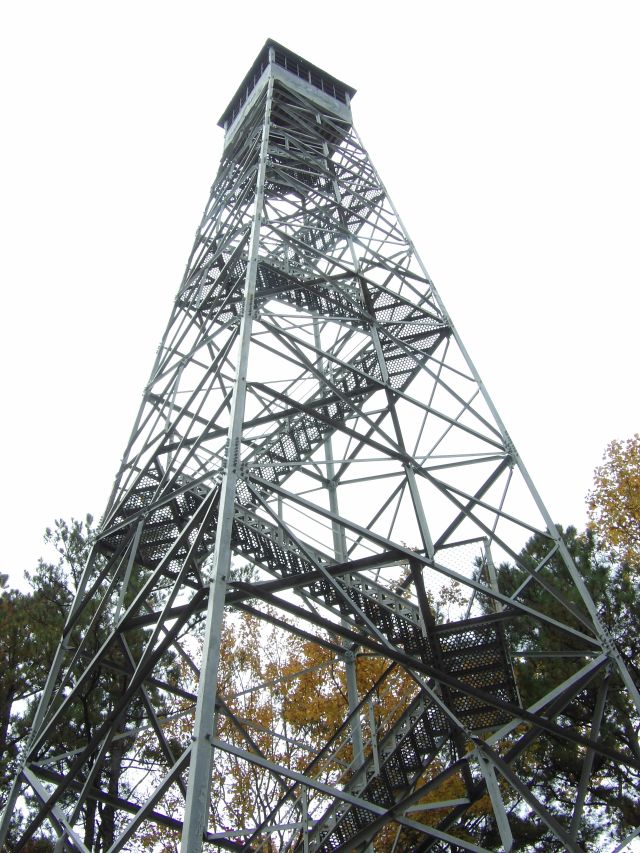
About five miles east of the highway we reached the Hickory Ridge Lookout Tower.
Built in 1936 by Civilian Conservation Corps workers, the 110-foot tower rests at an elevation of 895 feet above sea level. Located on Tower Ridge Road near the trailhead for Sycamore Ridge Trail, Hickory Ridge Fire Tower provides a commanding view of the surrounding Hoosier National Forest. the tower is a few miles southeast of Bloomington and southwest of Nashville. Tower men, or women, staffed the fire towers during periods of high fire danger. Tower men were subject to lightning strikes during thunderstorms and high winds which could topple the towers. One tower man at Hickory Ridge recounts that during one storm, he grew afraid of the winds and attempted to descend the tower. The winds threatened to blow him off the steps, so he just wrapped his arms and legs around the stairway and held on until the storm died down.
This is a gravel road maintained in pretty good condition. There are no houses or farms along its length, it is pretty much unbroken forest. The light green, orange, yellow hues of the autumn leaves create a pleasing visual spectacle as you drive along it.
We continued our pleasant drive until we reached Berry Ridge Road, which we turned left on. Berry Ridge Road continues through the heavily forested terrain to Mt. Nebo Road. A left turn on this road, after many hooks and crooks, leads to Indiana State Road 135. A left turn onto the highway took us back to Brown County State Park.
These roads are narrow and mostly gravel but very pretty. the forest borders the road the entire length. The roads ride a high ridge and on both sides the land falls away quickly on heavily forested slopes. We had hit the height of the colors.
The episode is based upon my book, Camping Across Indiana, available on the web site, http://www.mossyfeetbooks.com. The book relates our experiences during our first year of camping in Indiana. The book includes the places we visited and the mistakes we made in our initial season. I encourage you to visit the web site and subscribe to it.
You can find my books locally at the Walnut Street Variety Shop in Batesville, Indiana.
I hope you enjoyed this podcast and thank you for listening.

 Mossy Feet Books - Author Paul R. Wonning