
Prince Henry the Navigator, Christopher Columbus and the Age of Discovery
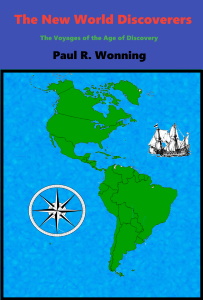
The Age of Discovery took place from the 15th through the 17th Century and featured a vast expansion of the European’s knowledge of the world. Two men played a crucial role in that era, Prince Henry the Navigator and Christopher Columbus. This episode discusses those two men, which form the opening chapters of the author’s book, The New World Discoverers. Learn about the explorers that led the exodus of settlers that flooded into the New World.
New World Discoverers
Transcript:
Prince Henry the Navigator, Christopher Columbus and the Age of Discovery
Greetings, in this episode I will talk about the first two men mentioned in my book, the The New World Discoverers. These two men launched the Age of Discovery.
During the Age of Discovery many explorers voyaged from Europe in the quest for a shortcut to Asia. Christopher Columbus, the first of these men, thought he had accomplished the goal, little knowing he had encountered a new continent. His exploits launched the voyages of discoveries that featured men like John Cabot, Henry Hudson and John White. The New World Discoverers tells the stories of many of these explorers of the new world in what would become Colonial America. History remembers these men as they engaged in their quest of New World Exploration.
A Portuguese Prince named Dom Henrique of Portugal, Duke of Viseu launched the Age of Discovery, even though he did not undertake any exploratory voyages himself. His father, King John I had established a naval base by capturing the Moorish port of Ceuta. The port had served as a haven for pirates that preyed on shipping in the Mediterranean Sea. Prince Henry used the port to sponsor voyages that would skirt the African coast on exploratory voyages.
Henry also played an integral role in developing a new type of sailing ship, the caravel. These ships were constructed in a way that made them lighter and more maneuverable than other ships of that day. These ships could travel faster and further than previous ships.
Prince Henry sponsored voyages that traveled as far south as Sierra Leone, a distance of over 3,000 miles. Though most of his ships stayed close to the shore, some did venture further out. In this way his sailors discovered the pattern of trade winds that would allow ships to sail west and then return using the opposing trade winds. This information would be valuable to a later man named Christopher Columbus, who was the first of the great explorers of the Age of Discovery.
Historians regard the era between the 15th and 17th Century as the Age of Discovery. Prince Henry the Navigator helped spur this flurry of exploration, however it was Christopher Columbus who used Prince Henry’s discovery of the Equatorial Trade Winds and the development of the caravel to discover the New World and change the maps. Over the next two centuries European explorers from Spain, Portugal, France, England and Holland set out on voyages of discovery all over the world. These European powers built huge overseas empires in far reaching places, not just in the New World but in the Pacific Ocean, Asia and Africa.
The marriage of Isabella I of Castile and Ferdinand II of Aragon proved to be a fateful union of sovereigns. The two presented a united front that finally eliminated the Muslim presence on the Iberian peninsula when they completed the Reconquista in 1492. This would free up the funds needed for them to sponsor the man that would become the greatest of the European explorers, Christopher Columbus.
Columbus had worked long and hard to obtain his goal of undertaking a voyage that would find a sea passage to China and Asia. The expanding Ottoman Turkish empire in Eurasia had made the old route, the Silk Road, hazardous and a new way was needed. Columbus had lobbied the Spanish monarchs for 6 long years before they approved his voyage. He undertook the first of his four voyages on August 3, 1492 from a fishing village called Palos os de la Frontera.
During his four voyages he discovered many important crops like maize, potato and tobacco. His discoveries sparked a movement called the Columbian Exchange in which agricultural crops from the New World were introduced to the Old World and vice versa.
Columbus undertook 4 voyages over a span of 12 years. He died still thinking he had found a way to Asia and had no inkling he had opened up two vast continents to European exploration and eventually doomed millions of native inhabitants to lose their lands to the expanding empires from the east.
You can find out much more about Christopher Columbus in my book, The Discoverers. The book also includes a biography of the American continents namesake, Amerigo Vespucci. You will also meet many other explorers like Ponce De Leon, John Hawkins, Jaques Cartier and Edwin Sandys. The book is available on Amazon, Apple, Barnes and Noble and many other online book sellers. You can also purchase it direct from me on my web site http://www.mossyfeetbooks.com.
Residents of southeastern Indiana can find it, as well as many of my other 130+ titles at the Walnut Street Variety Shoppe on George Street in Batesville.
I hope you enjoyed this podcast and thank you for listening.

 Mossy Feet Books - Author Paul R. Wonning