
The Weber Grill – Buoy Oh Buoy
As I have mentioned before in this space, one of the books I am currently researching and writing is a camping hand book. This book will include a history of camping and camping equipment as well as a guide to the equipment campers use to pursue their hobby. I am currently working on the section that will include grilling, barbecuing and the charcoal grill. Henry Ford, the automobile tycoon, and a man named Edward Kingsford, played a key role in the development of charcoal, but that is a topic for another blog post. This one revolves around the iconic Weber charcoal grill and how buoys floating in the Great Lakes played a role in their invention.
Up until World War II, the only type of grill available was the brazier style grill. These grills are the simplest type of grill, consisting of a bed of coals, a metal or ceramic pan to hold them in and a grate placed over the top on which the food in grilled. The only temperature control is possibly a mechanism that allows the grate to be raised or lowered. A common problem with these grills is that frequently the food is charred on the outside and raw on the inside. Being open to the elements, they offer no protection against wind and rain.
Enter George Stephen. Mr. Stephen had been a cook in the army during World War II. After the war he married and took employment with the Weber Brothers Metal Works in Arlington Heights, Illinois. Following the American Dream, he purchased a house where he and his wife had several children. He had developed a love of cooking while in the army and liked to grill food outside during the summer months. The house he lived in had an open fireplace grill, a common fixture in many suburban back yards in the post war era. Using this grill frustrated him for the reasons listed above.

He determined to find a better way. He had learned some metal working skills at Weber Brothers and used his skills to craft a new brick grill that had a metal frame to hold the coals. This was not much better than the grill he was already using.
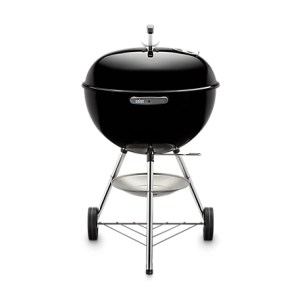
Weber Brothers main product was manufacturing metal buoys, which they sold to the Coast Guard and the Chicago Yacht Club. The spherical shape of the buoys captured his imagination. He cut one in half and drilled three holes in the bottom of one half. He installed a metal grate to hold the charcoals and cut a hole in both the top and bottom half. He devised slotted, circular fins which could rotate on the holes. He could spin the fins to have them either all the way open or close them. This would allow him to control the temperature.
He took the contraption home and tried it out. It worked perfectly. He grilled food for his neighbors, who dubbed the grill, “Sputnik,” as it resembled the Russian satellite. They liked it, though and some of them purchased grills that Stephen made. He began demonstrating the grills at public events, and people began purchasing them. In a short time, the grills became the Weber Company’s best selling item. Stephen would purchase the company and become its president, changing its name to the Weber-Stephen Company. The company would become the leading grill manufacturer in the United States.
Buoy oh Buoy.
Of course there is more to this tale than I have here. The full story will be in the book, as well as the story of charcoal and how the Vagabonds, Henry Ford, John Burroughs, Harvey Firestone and Thomas Ediscon became friends and spurred the idea of the Great American Road Trip.
If you want notification of when I publish a new book, about 12 a year, subscribe to my web site, my Substack page or my email list. Links to all of these are on my web site, http://www.mossyfeetbooks.com

 Mossy Feet Books - Author Paul R. Wonning