
Transcript:

Located near Prophetstown State Park, the Tippecanoe Battlefield Memorial marks the site of an important battle prior to the War of 1812 that pitted troops led by Indiana Territorial Governor William Henry Harrison and warriors led by the Shawnee brother of Tecumseh, the Prophet. The battle took place near the town established on the Wabash River at the mouth of the Tippecanoe River.
sometime in the spring of 1808 the brothers moved their village in Ohio to the banks of the Wabash River at the mouth of the Tippecanoe River. The town acquired the name Prophetstown, and eventually had between 3,000 – 6,000 residents and over 200 houses. All the trees around the town were removed so any invading army would not have any place to conceal themselves.
Tecumseh had begun establishing a confederacy of tribes to oppose White encroachment into native lands. He had embarked on a journey in 1809 to unite the tribes and had had some success. Early in 1811 he had once again left Prophetstown, traveling south to meet with the Cherokee and other southern tribes. He had left his brother, the Prophet, in charge of the town, admonishing him not to fight Harrison, as Tecumseh’s plans had not come into fruition.
In late October 1811, William Henry Harrison had assembled an army and begun to march north along the Wabash River to oppose the natives gathered there. He arrived near the town in the late afternoon November 6, 1811. After a brief meeting with some chiefs representing the Prophet, Harrison moved his troops to a site about 2 miles north of Prophetstown. He ordered his men to sleep wearing their weapons and battle gear.
Spurred on by the Prophet, native warriors attacked Harrison’s army in the last hours before dawn on November 7.
The plan of attack was for the Amerindian force of between 500 – 600 warriors to surround Harrison’s force with a crescent shaped formation, with each end of the crescent anchored at the creek. The Kickapoos would take the right position of the horn of the crescent and the Winnebago’s the left. The center of the crescent was occupied by the Potawatomi’s and a scattering of other tribes. The plan called for a band of Kickapoos to enter the camp, find Harrison and kill him. This band had been told to look for a man riding a white horse, which was Harrison’s standard mount. They would use whistles made from bone fragments and rattles made from dried deer hooves to communicate across the extended battlefield. A cold, hard rain driven by a sharp wind chilled the warriors as they took their positions. The flickering campfires in the camp allowed the warriors some limited visibility of the camp’s interior.
The Prophet had assured his warriors that his magic would ward off the bullets fired by the Americans. His assurances were false, as many warriors fell when the soldiers returned their opening volleys.
As the warriors began their attack, Harrison ordered the campfires extinguished. He had not mounted his customary white horse, instead riding a gray one, thus foiling the planned assassination.
The battle raged for about an hour, with warriors swarming around the entire camp. The American line held, however, and inflicted heavy casualties on the attackers.
As dawn approached, the discouraged warriors began their retreat and by the time daylight was full, the battle was over.
68 soldiers had died in the attack and another 126 wounded. The soldiers found 36 dead warriors, however many of the dead were carried from the battleground by their companions. The number of warriors wounded during the battle will never be known.
Tippecanoe Battlefield
Operated by the Tippecanoe County Historical Association in the 16-acre Tippecanoe Battlefield Park. The park interprets the history and events of the Battle of Tippecanoe. The park also includes a nature center as well as artifacts of European and Native American cultures
Tippecanoe Battlefield
1001 South Street
Lafayette, IN 47901
mail@tippecanoehistory.org
Prophetstown State Park
With the Wabash River forming its southern flank, Prophetstown State Park features 900 acres of restored prarie, hiking, camping, an aquatic center, the Museum at Prophetstown and the Farm at Prophetstown: A 1920s Living History Museum.
Prophetstown State Park
4112 E. State Road 225
West Lafayette, IN 47906
(765) 567-4919
Mapping address:
5545 Swisher Road
West Lafayette, IN 47906
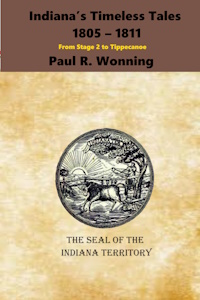
This selection is from my book, Indiana’s Timeless Tales – 1805 – 1811. The book includes an account of the battle as well as the events preceding and after the battle. It is the 6th book in my Indiana Timeless Tales series, which begins with pre-history Indiana up to, and including the battle. The next book in the series, The Algonquin Tribes of Indiana, is available as well. If you like the stories I am relating, please follow me on You Tube, where a video version of this podcast will be available.
The book, as well as the rest of my 130+ titles can be found on Amazon, Barnes and Noble, Apple and other online book sellers in ebook, audiobook and soft bound formats. My web site, http://www.mossyfeetbooks.com, has links to all of these vendors as well as a way to purchase the books direct from me. Residents of southeastern Indiana can purchase most of my books at the Walnut Street Variety Shoppe on George Street in Batesville.
I hope you enjoyed this podcast and thank you for listening.

 Mossy Feet Books - Author Paul R. Wonning