
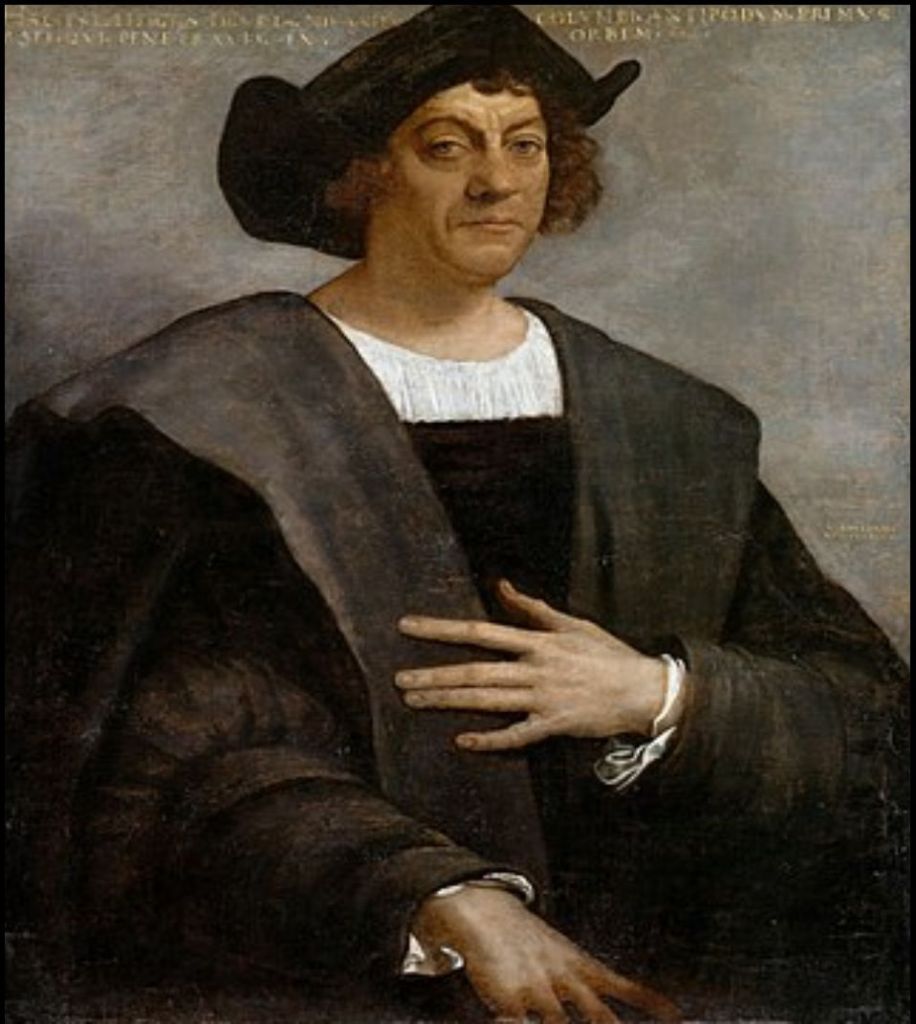
Columbus Meets with Queen Isabella
Greetings, today I will talk about the initial meeting between Christopher Columbus and Queen Isabella and tell a little bit about Columbus’ life up to this point.
From the Book
Colonial American History Stories – 1215 – 1664
Transcript:
Greetings, today I will talk about the initial meeting between Christopher Columbus and Queen Isabella and tell a little bit about Columbus’ life up to this point.
Columbus Meets with Queen Isabella
There were two key events that would place Christoper Columbus in position to become the most famous explorer of his age, indeed of all time. First, he would have to meet with Spanish Queen Isabella. The second would be the Spanish conquest of Grenada, on the southern shore of Spain, which would place the entire Iberian Peninsula along the Mediterranean Sea in Spanish possession.
First, though, we will examine a bit about the life of Christopher Columbus to this point.
The year of his birth is unclear, as is the exact location of his birth. His birth year is believed to be 1550 or 1551. It is thought that he is native to the Republic of Genoa, Italy. His Italian name is Cristoforo Colombo, which we have Anglicized to Christopher Columbus. His father, Domenico Colombo, was a wool merchant and ran a cheese stand. Christopher worked at this stand while a boy. His mother, Susanna of Fontanarossa, bore Christopher and three other sons, Bartolomeo, Giovanni, Giacomo as well as a daughter named Bianchinetta.
By 1473 Columbus had already entered the seafaring life. He later claimed he first went to sea at age 10, not an unusual claim during this era. The voyages he undertook apparent trips to the Aegean Island Chios as well as the Norse colony in Iceland. He also took part in an armed convoy to England and Ireland. He taught himself three languages, Latin, Portuguese, and Castilian. Somehow, he learned about the trade winds that rode through the equatorial regions. Whether he learned by personal experience or by conversations with sailors, no one really knows.
Columbus was well read. His reading list included works by Claudius Ptolemy, Marco Polo, Sir John Mandeville and Pliny the Elder. His study of these men led him to his theory of reaching the Eastern realms in Asia by sailing west on the Atlantic.
Reaching the Eastern realms of China, Japan and others were important. Europeans had grown used to the spices, silks and other goods available from these regions. Prior to the fall of Constantinople in 1453 the Silk Road that led from China to the Middle East. When the Ottoman Turks captured Constantinople, they closed the Silk Road and trade with China slowed dramatically. A new trade route with the east was necessary and any nation that developed one would be at a huge advantage.
American Author Washington Irving wrote a biography of Columbus that planted the idea that most people during Columbus’ lifetime believed that the Earth was flat. It is true that many people did. However, many scholars believed that it was round. The main point of discussion was on the circumference of the earth.
There were two competing theories at the time, that of Greek mathematician Eratosthenes and another by Arab astronomer Alfraganus. Eratosthenes had calculated a circumference of 24,854. Alfraganus had calculated a circumference of 18,765. Columbus believed that Alfraganus calculations were correct and that the Earth had a circumference was 18,765. What he did not realize is that Alfraganus used the Arab mile, which is longer than the European mile. If compared, the two measurements are surprisingly close. The modern measurement is 24,901. This fact is very important, as it would make a great deal of difference in the fate of any king that considered Columbus’ proposal.
Columbus first tried to sell his theory to King John II of Portugal in 1485. The king’s geographers studied Columbus’ plan and informed the king that the distance to Asia was too far. No ship in existence could carry enough supplies to allow a crew to survive that long of a voyage. King John rejected the proposal twice, once in 1485 and again in 1488.
He next traveled to Spain and petitioned Queen Isabella for an audience to present his theory. She granted him an audience, which he attended on May 1, 1486. After listening to his ideas, she consulted with her scientists, who agreed with their Portuguese counterparts. Isabella rejected his proposal, however, to keep him in Spain, she gave him a living allowance, which he accepted. He would spend the next 6 years waiting for his chance to meet with the Queen again.
This episode is based upon my book, Colonial American History Stories – 1215 – 1664. The articles in the book relate much more detail in the saga of Ferdinand and Isabella as well as the Spanish conquest of the Canary Islands. The book is the first in a 7-volume series. This book includes contains almost 300 history stories presented in a timeline that begins in 1215 with the signing of the Magna Carta to the printing of the first Bible in Colonial America in 1664. This journal of historical events marks the beginnings of the United States and serve as a wonderful guide of American history. A visit to my web site, http://www.mossyfeetbooks.com, will provide sample chapters excerpted from each of my 130 titles as well as links to purchase the books at Amazon, Barnes and Noble, Apple, and many other online book retailers. You can also purchase books direct from me. Residents of southeastern Indiana can find my books in Batesville at the Walnut Street Variety Shoppe on George. Street. This podcast will also appear in video format on You Tube on the Mossy Feet Books channel. Subscribe to the channel for more great content, or subscribe to my Facebook Page, Stories of American History.
I hope you enjoyed this podcast and thank you for listening.

 Mossy Feet Books - Author Paul R. Wonning