
Transcript:
From the book:
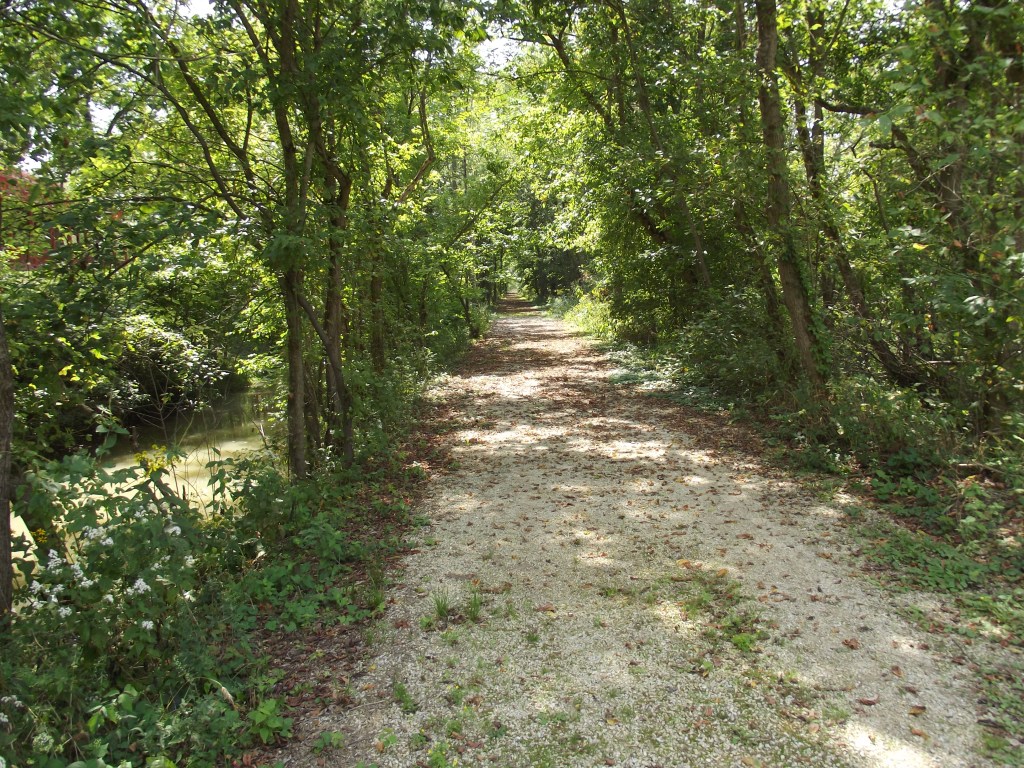
Greetings, today we will walk the Whitewater Canal Trail in historic Metamora, Indiana.
Whitewater Canal Trail
Established in 1992, the Whitewater Canal Trail currently consists of three sections, the Metamora Trail Head, the Yellow Bank Trailhead and the Tecumseh Landing trailhead in Brookville. As of October 2023 the trail heads between the Yellowbank Trail Head and a site about 2 miles east of the Laurel Feeder Damn are complete. The approximately 1 mile section leading from Yellow Bank to Tecumseh Landing in Brookville and a 2 mile section to the Laurel Feeder Dam are yet to be completed. The completed sections total about 8 miles. This is a point to point trail, not a loop, so you will have to hike to the end point and then return. Allow sufficient time to hike a total of 16 miles if you plan to hike the entire section. There is a handicap accessible parking lot just to the east of the Duck Creek Viaduct off of US 52 where hikers may enter the trail. There are other access points, as well.
Whitewater Canal
The entire trail parallels the 15 mile section of the Whitewater Canal, which was declared a National Historic site in 1973.
Whitewater Canal
The Whitewater Canal’s construction lasted from 1836 to 1847. During this time, there were many starts, pauses as the State of Indiana ran out of money, and the various private companies charged with completing also ran into financial difficulties. After completion, it connected Hagerstown, Indiana with Cincinnati, Ohio seventy-six miles to the south. The canal provided a quick, convenient way for farmers to transport their goods to market in the cities. Before the canal a farmer would need several days travel over deeply rutted roads to take his goods to Cincinnati. The canal proved a difficult construction project. It dropped 491 feet over the distance and needed fifty-six locks and seven dams. Several aqueducts to carry the canal over waterways also needed construction. Portions of the canal operated until 1862. The Whitewater Valley Railroad runs a part of the canal as a tourist attraction between Connersville and Metamora Indiana. The train runs alongside the canal and at Metamora visitors can ride a canal boat. The town of Metamora has many small shops and museums. The Indiana State Museum maintains an operating gristmill in the town as part of its network of Indiana State Historic Sites.
The Whitewater Canal’s construction lasted from 1836 to 1847. During this time, there were many starts, pauses as the State of Indiana ran out of money, and the various private companies charged with completing also ran into financial difficulties. After completion, it connected Hagerstown, Indiana with Cincinnati, Ohio seventy-six miles to the south. The canal provided a quick, convenient way for farmers to transport their goods to market in the cities. Before the canal a farmer would need several days travel over deeply rutted roads to take his goods to Cincinnati. The canal proved a difficult construction project. It dropped 491 feet over the distance and needed fifty-six locks and seven dams. Several aqueducts to carry the canal over waterways also needed construction. Portions of the canal operated until 1862. The Whitewater Valley Railroad runs a part of the canal as a tourist attraction between Connersville and Metamora Indiana. The train runs alongside the canal and at Metamora visitors can ride a canal boat. The town of Metamora has many small shops and museums. The Indiana State Museum maintains an operating gristmill in the town as part of its network of Indiana State Historic Sites.
Whitewater Railroad
The trail also runs along the route of the Whitewater Railroad
Whitewater Valley Railroad
The demise of the Whitewater Canal planted the seeds for the Whitewater Valley Railroad in the mid 1850’s when floods washed out large portions of the canals. Franklin County residents petitioned the State of Indiana, asking that the state sell the canal towpath route to use as a railroad. In 1863 the Indianapolis and Cincinnati Railroad purchased the rights to the towpath and built a line from Brookville to Hagerstown, Indiana. Portions of the canal remained open and became useful as power sources for gristmills like the one at Metamora. The Whitewater Canal remained open in Metamora until 1953. Western Avenue now covers it.
The First Whitewater Valley Railroad
The first Whitewater Valley Railroad was a subsidiary of the Indianapolis and Cincinnati Railroad. This subsidiary began construction of the rail line from Brookville, reaching Connersville in 1867. The line punched through to Hagerstown the next year. The Big Four, Cleveland, Cincinnati, Chicago & St. Louis, Railroad purchased the Indianapolis and Cincinnati Railroad in 1890. This line became the New York Central in later years. These lines operated both freight and passenger trains. The line discontinued passenger service in 1933. Freight service ground to a halt in the late 1970’s and early 1980’s.
The Second Whitewater Valley Railroad
Formed as a non-profit organization in 1972, the Whitewater Valley Railroad operates as a operating railroad museum. The all volunteer staff runs both historic diesel and steam engines on the eighteen mile line between Connersville and Metamora. For more information about train schedules, the history and other information, contact:
Whitewater Valley Railroad
455 Market St,
Connersville, IN 47331
(765) 825-2054

 Mossy Feet Books - Author Paul R. Wonning