
Sample Chapter
Lincoln State Park
Chapter title – Abraham Lincoln
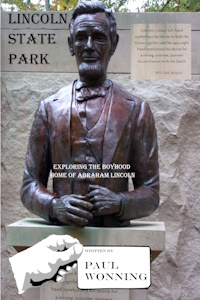
Abraham Lincoln (February 12, 1809 – April 15, 1865)
The son of Thomas Lincoln and Nancy Hanks Lincoln, Abraham was native to Sinking Spring Farm near Hodgenville, Kentucky. He entered the world on February 12, 1809.
Lincoln’s Boyhood in Indiana
The Lincoln family moved to Indiana in 1816 from Kentucky after Abraham’s father Thomas Lincoln lost his land due to faulty land titles. After learning that Indiana had better land title laws, Thomas moved the family north of the Ohio River to Indiana. The Lincolns were also strongly opposed to slavery. Kentucky was a slave state, Indiana a free state, so Thomas chose Indiana. The Lincoln’s squatted on public land in Spencer County while Thomas worked as a cabinet maker, carpenter and farmer. Eventually he acquired clear title to 80 acres of this land in Spencer County.
Death of Nancy Hanks Lincoln
Thomas Lincoln’s wife, Nancy, died on October 5, 1818, leaving Thomas Lincoln and his children Abraham and Sarah motherless. Sarah Bush Johnson’s husband, Daniel Johnston, died of cholera in 1816, leaving Sarah and her three children destitute. Hearing of her plight, Thomas Lincoln traveled to Kentucky, proposed to her and the two married on December 2, 1819.
Sarah Bush Johnson (December 13, 1788 – April 12, 1869)
The daughter of Christopher and Hannah Bush, Sarah was native to Hardin County, Kentucky. Thomas and Sarah had become acquainted while they both lived near Elizabethtown, Kentucky before Lincoln moved his family to Indiana in 1816. When Nancy died two years later, Thomas heard that Sarah was a widow. Sarah’s husband, Daniel, had accumulated some debts, which Sarah could not pay. Thomas reportedly traveled to Kentucky, arrived at her door and knocked. He proposed to Sarah and offered to pay her debts. She accepted the proposal, the two married on December 2, 1819, and Sarah traveled to Spencer County Indiana with her three children. She took over as mother to young Abraham and Sarah Lincoln. Sarah was illiterate, however, she encouraged young Abraham with his studies. Abraham would address Sarah as “mama,” right from the start. At her insistence, Thomas had wooden planks planed and installed them in the cabin to cover the dirt floor. He also installed greased paper windows. A greased paper window consisted of grease coated paper. Many frontier families used this inexpensive window in lieu of expensive glass to admit light to dimly lighted cabins and to keep birds, insects, wind and other unwanted intruders from the cabin. After Lincoln attained his law practice, and later the presidency, he continued to visit Sarah for the rest of his life as circumstances permitted.
Self-Educated
Abraham loved to read and write, a skill that Sarah, his new stepmother, encouraged. Lincolns received very little formal education. He would walk miles to borrow a neighbor’s book, which were in short supply in the frontier areas of Indiana. Thus, the education Lincoln received on the frontier was largely what he could learn by reading books.
Great Physical Strength
Lincoln grew to 6 foot, 4 inches tall and possessed great physical strength. He learned to wield an ax, becoming an expert rail splitter, an important skill on the frontier. His wrestling skills were also unmatched, as displayed when he bested the leader of a group of local ruffians known as the Clary’s Grove boys.
Abraham Lincoln’s Early Employment
At around fifteen years old Abraham Lincoln worked as a hired hand for local farmer James Taylor. The rough work included butchering and other farm chores. He also operated Taylor’s Ferry ferrying passengers across the Anderson River, which served as a key transportation link during that era. Inspired, young Abe built a rowboat, which he used to ferry passengers across the river. He earned a dollar on his first trip, which seemed almost a fortune to the boy.
Taylor’s Ferry
Taylor’s Ferry crossed the Anderson River, which is a fifty-mile-long river that forms the boundary of Perry and Spencer Counties. Lincoln greatly enjoyed ferrying people across the river. It gave him the opportunity to converse with many people as they went about their affairs. Lincoln Ferry Park, on Indiana State Road 66 just west of Troy, Indiana, is the location of an historical marker denoting the site of the ferry. Tradition also says that it was here that the Lincolns crossed the Ohio River from Kentucky in 1818. It is also the spot where Lincoln earned money ferrying passengers to and from the riverboats anchored offshore. His business angered local ferry owners, who tried to stop him. He decided to study law and went on to defend himself in court against the ferry owners. He won the case, sparking a lifelong quest for knowledge and fairness. His love affair with the law began with this case. It was his flatboat voyages to New Orleans that firmed up his revulsion against slavery.
Lincoln, New Orleans and Slavery
While a child in Kentucky, Lincoln was exposed to slavery, as there was dissention in the area the Lincoln’s lived in. The Lincoln’s were anti-slavery, but there were many slave owners in the area. The division created many conflicts. So many that the church the Lincolns attended had to close due to conflict over the practice. Thomas Lincoln had lost two farms in Kentucky due to land title confusion. He had bought the farms and established homesteads, then lost them when he found he did not hold a clear title to them. The Lincolns left Kentucky for Indiana because the new state had better land survey and title laws. They also wanted to live in a free state. The Northwest Ordinance had forbidden slavery in the Indiana Territory, but there were slaves in the Territory when Thomas came to the area in 1815 to locate a suitable farm. When the family moved in 1816, Indiana was on the way to Statehood and would be a free state. Though some slaves remained in Indiana for several years, there were probably few, if any, in the area in which the Lincoln’s settled. Thus, Lincoln’s first real exposure to slavery was on his flatboat trips to New Orleans. It was the second that firmed his stance against it. During that trip, he saw slaves whipped and beaten. It was a slave auction that revolted him the most. During the auction, a mulatto girl was examined like a buyer inspecting a horse. Revolted by the scene, he said to his companions, “By God, boys, let’s get away from this. If ever I get a chance to hit that thing (meaning slavery), I’ll hit it hard.”
Top of Page
Mossy Feet Books on Social Media
Twitter
Linkedin
YouTube
Pinterest
Online Sources for Mossy Feet Books
Paul Wonning’s Books on Amazon Page
Paul Wonning’s Books on Scribd Page
Paul Wonning’s Books on Apple
Paul Wonning’s Books on Kobo
Paul Wonning’s Books on Barnes and Noble
Paul Wonning’s Books on 24 Symbols
Paul Wonning’s Books on Google Play
Paul Wonning’s Books on Indigo
Paul Wonning’s Books on Playster
Paul Wonning’s Books on OverDrive
Search Paul Wonning on Ingrams
Table of Contents
© 2024 Paul Wonning

 Mossy Feet Books - Author Paul R. Wonning