Sample Chapter
Versailles State Park
Chapter title – Versailles State Park Geology
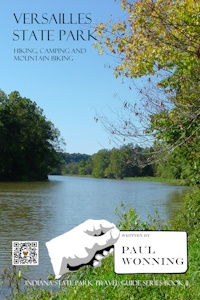
Versailles State Park Geology
The geology of Versailles State Park is interesting because Laughery Creek at this point is the dividing line between two geologic provinces, the Muscatatuck
Regional Slope and the Dearborn Upland. There are also two layers of fossils that originate from two separate geologic eras, the Silurian and the Ordovician ages. The park also has a cave, dubbed the Bat Cave. Laughery Creek forms the mid-section of the northern half of the park and flows along the western boundary of the southern half. Laughery Creek is the main feeder of Laughery Lake, though Fallen Timbers Creek, which flows into the lake from the east, also contributes. Cedar Creek flows into the lake on its western shore.
Muscatatuck Regional Slope
The Muscatatuck Regional Slope stretches from southern Shelby and Bartholomew Counties to the Ohio River. It encompasses most of Decatur and Jennings Counties, western Ripley County, western Jefferson County and eastern Clark County. The soil consists of a thin layer of glacial drift. The land gradually falls away from east to west. Elevations along the eastern edge range from 1000 feet above sea level to about 500 feet at the Ohio River. Where it meets the Scottsburg Lowland, it is about 700 feet. Most of the streams in this region flow through steep walled valleys. The land between the streams is mostly flat. Carbonate rocks, mostly limestone, form the bedrock of the region. The Laughery Escarpment forms the dividing line between the Slope and the Dearborn Upland to the east.
Laughery Escarpment
An escarpment is a long cliff or steep slope that separates two areas that have differing elevations. Erosion or faulting forms an escarpment. The Laughery escarpment formed because of erosion of Cincinnatian shales which overlay a layer of Niagara limestone.
Dearborn Upland
The Dearborn Upland region occupies the territory roughly east of Laughery Creek and south of the Whitewater River and proceeds to the Ohio River. The terrain is rugged with steep hills and valleys that have very little bottom land. The higher elevations have also been largely dissected by water erosion, leaving little flat land. Much of the land has glacial till leftover from glacial ice left over several ice ages.
Ice Ages
Climate change is a naturally occurring phenomenon, with periodic warming and cooling of the earth’s climate consisting of alternating warm periods as well as ice ages in which glacial ice covers large portions of the earth’s surface. There have been numerous ice ages in the earth’s 4.6-billion-year history as well as numerous times when the earth was warmer than it is now.
Ordovician Age
The Ordovician Age lasted from 485.4 million years ago until 443.8 years ago, about 41.6 million years. English geologist Charle Lapworth studied rocks from this period in the 1860’s and proposed that the period be named the Ordovician Age in 1879. A Welsh tribe, the Ordovice, lived near the region in which he studied the rocks. During this age continental drift forced several smaller ancient continents to form a large continent called Gondwana. Continental drift involves the theory of plate tectonics, a theory which postulates that the continents drift on tectonic plates and move, a process that takes millions of years. Gondwana moved to a position in the South Pole, which caused a period of intense global cooling. The entire age suffered from climate extremes during which there were periods of extremely warm temperatures and periods of extreme cold. The temperature extremes and sea level changes caused mass extinction events. The largest mass extinction event took place at the end of the Age in which about 85% of the species that lived during that era became extinct.
Top of Page
Mossy Feet Books on Social Media
Twitter
Linkedin
YouTube
Pinterest
Online Sources for Mossy Feet Books
Paul Wonning’s Books on Amazon Page
Paul Wonning’s Books on Scribd Page
Paul Wonning’s Books on Apple
Paul Wonning’s Books on Kobo
Paul Wonning’s Books on Barnes and Noble
Paul Wonning’s Books on 24 Symbols
Paul Wonning’s Books on Google Play
Paul Wonning’s Books on Indigo
Paul Wonning’s Books on Playster
Paul Wonning’s Books on OverDrive
Search Paul Wonning on Ingrams
Table of Contents
© 2024 Paul Wonning

 Mossy Feet Books - Author Paul R. Wonning