
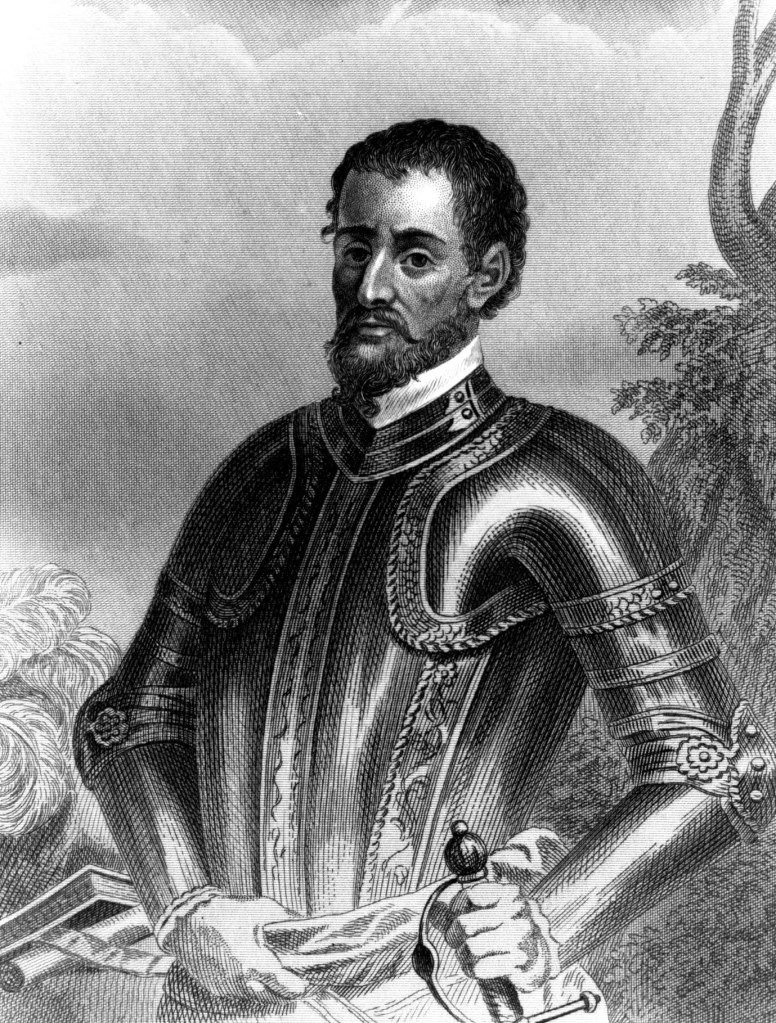
Hernando De Soto’s Expedition to the Mississippi River
Today you will hear about Hernando De Soto’s disastrous expedition from Florida to the Mississippi River on May 28, 1539.
From the Book
Colonial American History Stories – 1215 – 1664
Transcript
Hernando De Soto’s Expedition to the Mississippi River
Greetings, today you will hear about Hernando De Soto’s disastrous expedition from Florida to the Mississippi River on May 28, 1539.
Before getting started, I would encourage you to subscribe to the Mossy Feet Books You Tube channel for more great content. I also entreat you to visit my website, http://www.mossyfeetbooks.com. There you will find sample chapters, podcasts, a slew of content and links to where you can buy my books. While visiting the web site you can subscribe to it and receive email notifications of when I publish a new book or other content, like this video and podcast. You can also subscribe to the Mossy Feet Books You Tube Channel to ensure you do not miss any of my content. This episode is based on my book, Colonial American History Stories – 1215 – 1664. It is the first book in my 6 book Time Line of United States History Series.
You can find my books locally at the Walnut Street Variety Shop in Batesville, Indiana.
Hernando de Soto lived from October 21, 1496 until May 21, 1542. His parents were members of a minor Spanish nobility class called Hildagos. As nobility, they would pay no taxes, however they had little property. He spent his childhood migrating with his family between 3 towns in southwest Spain. As he matured, he attended the University of Salamanca, courtesy of a family friend’s generosity. During his early life tales of the adventures of the Spanish conquistadors circulated widely among the people. Intrigued by the possibility of wealth and fame, he decided to become one of these adventurers.
His first adventure came when Pedro Arias Dávila invited him to accompany him on a mission to the West Indies in 1514. His performance during the trek went well, as he proved to be an excellent explorer and leader. His trading skills led to large profits for his employer.
Gaspar de Espinosa took him along on his mission to conquer Nicaragua in 1520. He continued to create a favorable impression on this mission.
Francisco Pizarro appointed de Soto one of his top captains when he began his 1532 conquest of the Incan Empire in South America. His role in the capture of the Incan capital of Cuzco earned him accolades. He returned to Spain wealthy and a hero.
Upon his return to Spain he married Isabel de Bobadilla, who was in Queen Isabella’s confidence. He used the influence of his wife to petition for the governorship of Guatemala. Instead, she commissioned him as governor of Cuba with the expectation that he would establish more Spanish settlements in North American in 4 years.
He and his wife sailed for Cuba on April 6, 1538 with 10 ships and 700 crewmen. Upon his arrival he learned that French privateers had sacked the city. De Soto had repair work started before departing for Florida on May 18, 1539 with a fleet of 9 ships and 640 soldiers, priests, craftsmen, engineers, farmers, and merchants. They landed near Brandenton, Florida in late May 1539.
A memorial to the event is at:
De Soto National Memorial
P.O. Box 15390
Bradenton, FL 34280
The physical address is:
De Soto National Memorial
8300 De Soto Memorial Hwy.
Bradenton, FL 34209
(941)792-0458
Natives attacked the expedition almost as soon as they came ashore. De Soto and his men spent 4 years exploring the southeastern United States. There are 4 accounts written by survivors of the expedition that document their route as first they went north and then west in search of gold.
When they reached the current state of Alabama they came into conflict with the Mobilian tribe. They fought a pitched battle in which the Spanish killed a large number of the warriors, after which the natives fled. Spanish losses were severe, as they lost a quarter of their horses and most of their supplies.
They continued west and set up winter quarters near Tupelo, Mississippi. Before breaking winter camp, they demanded that the local Chickasaw tribe give them porters. The Chickasaw refused and attacked. De Soto lost about 40 more men. The Chickasaw could have wiped them all out, but relented and allowed the Spanish to depart. On May 8, 1541 the expedition reached the Mississippi River.
They crossed the river and continued exploring, becoming the first Europeans to reach Arkansas. Here, they came into contact with the Tula tribe when they crossed the Arkansas River. The Tula proved to be fierce warriors and De Soto’s men fought them most of the month of September. De Soto decided to stop traveling west and returned to the Arkansas River, which they crossed and took up winter quarters.
They continued exploring after breaking camp and penetrated deeper into Arkansas. They enjoyed the hot springs at Hot Springs, Arkansas, calling it Valley of the Vapors.
By this time the expedition was in poor shape. Their clothing had deteriorated, and they donned animal skins. Their interpreter had died, so they could no longer communicate with any tribes they encountered. They suffered through the bad winter of 1542. In the spring they returned to the Mississippi River. De Soto told the local natives that he was immortal to discourage them from attacking them. Here, on the banks of the river he became sick with a fever and died. His men, fearing the natives would learn the truth, took his body out in a boat at night and sank it so the natives would not learn of his death.
His men decided at this point to end the expedition. They decided that it was too dangerous to build boats and float down the river, so the struck out overland They reached Texas and then returned to the Mississippi. Here, they gathered most of the expedition’s iron to melt down to make nails. They constructed two ships and sailed to Vera Cruz, Mexico, arriving there in late 1543. Only 300 of the men survived. They found no gold, but had increased the knowledge of the interior of America greatly.
The next episode will relates Coronado’s search for the 7 cities of gold. The articles in the book contain much more detail about the topics discussed. Additionally, there are other topics not included in the podcast. I encourage you to subscribe to both my web site, mossyfeetbooks.com and this You Tube channel.
I hope you enjoyed this podcast and thank you for listening.

 Mossy Feet Books - Author Paul R. Wonning