
Indiana’s Second Capitol, Corydon, Indiana
Today we will visit Indiana’s second capitol, Corydon, Indiana.
From the Book:
South Central Indiana Day
Transcript:
Greetings, today we will visit Indiana’s second capitol, Corydon, Indiana
Corydon – Indiana’s Second Capital
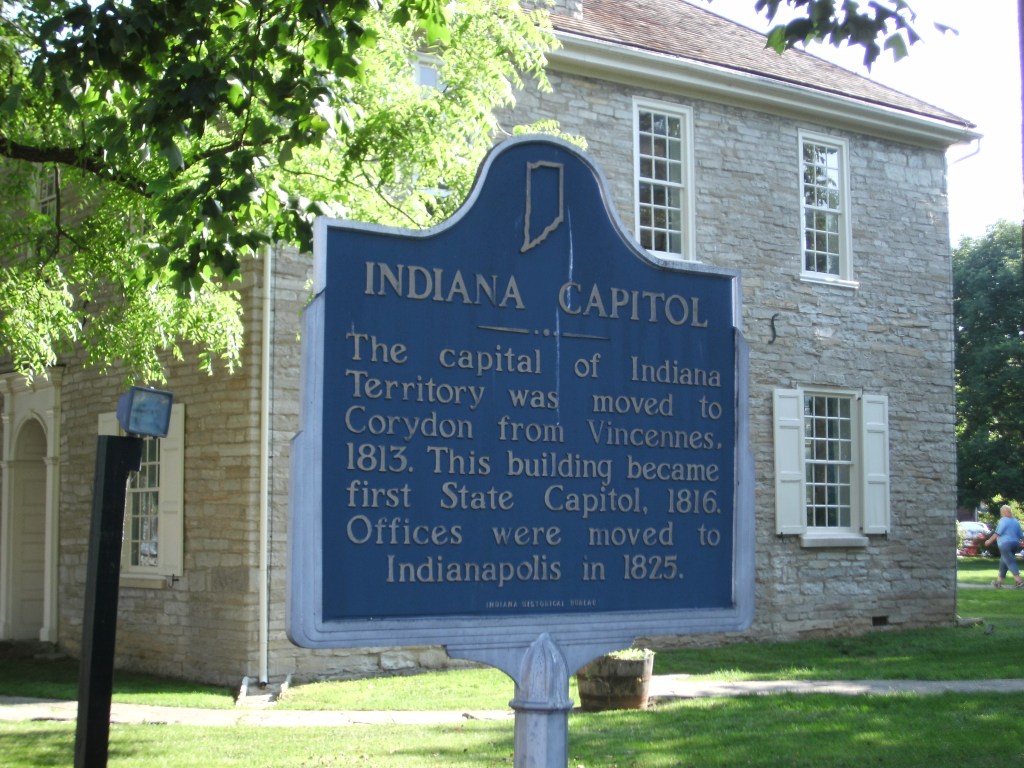
Corydon Indiana, in Harrison County, served as Indiana’s second Territorial capital and later as the first state capital. Vincennes had been the Territorial Capital from 1800 until 1813, when it moved to Corydon.
The original statehouse still stands in Corydon.
Before getting started, I would encourage you to subscribe to the Mossy Feet Books You Tube channel for more great content. I also entreat you to visit my website, http://www.mossyfeetbooks.com. There you will find sample chapters, podcasts, a slew of content and links to where you can buy my books. While visiting the web site you can subscribe to it and receive email notifications of when I publish a new book or other content, like this video and podcast. You can also subscribe to the Mossy Feet Books You Tube Channel to ensure you do not miss any of my content. This episode is based on my book, Southeast Indiana Road Trips. The book is the first book in the 9 volume Road Trip Indiana Series. The books include all the historical markers, as of 2022, in Indiana with the text and back story. The books also include a nearly complete listing of virtually every tourism destination in the state. The destinations include parks, museums, drive in theaters, bowling alleys, wineries and much, much more.
You can find my books locally at the Walnut Street Variety Shop in Batesville, Indiana.
The Indiana Territory Legislature contracted with Dennis Pennington to build the new Territorial capitol at Corydon. Pennington was a builder and prominent citizen of Corydon and served as Speaker of the House. He began construction of the building in either 1811 or 1812. The building would serve as the Harrison County Court House at first, then as the territorial capitol when it moved to Corydon. When the legislature did move in 1813, they met in the building.
The Capitol
Pennington used limestone quarried nearby to construct the building, which was two stories tall and forty feet square. The two and a half-foot thick stone foundation delved three feet into the earth and supported the two-foot-thick stone walls. The lower room had fifteen-foot ceilings, the upper floor ten feet. One large fireplace on each floor provided heat. The cost to build the capitol was $1500.
The First Legislature
The first General Assembly consisted of 29 representatives, 10 senators and the lieutenant governor met in the building in November 1816. Indiana received Statehood on December 16, 1816. Corydon remained the State Capital until 1825, when it moved to the new city of Indianapolis on the White River in the center of the state. After the capital moved to Indianapolis, the building became the Harrison County Courthouse. Harrison County renovated the building in 1873, covering the stone floors with wood and closing the fireplaces. In 1917, the State of Indiana purchased the building with the intent of preserving it. Harrison County built the current courthouse in 1929, and the State took over the building. The State renovated the building to its original condition.
Constitution Elm
During the summer of 1816, forty-three delegates gathered to write the first Indiana Constitution. The weather was hot and sultry. The delegates gathered under a massive elm tree to draft the Constitution in its cool shade. The tree outlasted that Constitution, which the State replaced with a new one in 1851. The tree died of Dutch Elm Disease in 1925. Workers removed the limbs and coated the trunk with tar to preserve it. It now resides in a sandstone monument a short distance from the first State House. Small pieces of this elm are still for sale in the gift shop.
The Posey House, built 1817, served as the home of Colonel Thomas Posey, son of Governor Thomas Posey. Posey served as Treasurer of Harrison County, Cashier of Corydon Branch of the Bank of Vincennes, U.S. Military Pension Agent in Indiana; Adjutant General of Indiana and as a Legislator representing Harrison County. He was an early Corydon merchant, an active Mason; and an ardent Methodist. Although he never married, he reared fourteen orphans in his home.
The house at one time was open to the public and had several of Colonel Posy’s personal items. It is no longer open to the public.
The Leora Brown School, located at 400 E. Summit Street near Hill Street, in Corydon.
Installed by:
The 1851 Constitution of Indiana provided that a free public education should be available to all Indiana residents. The legislature began passing laws in 1853 and 1857 that restricted access by black students. An 1869 act then passed the legislature that provided free, but separate, education, to black students across the state. This began the process of black schools appearing across the state. This segregation ended in 1949 when the legislature passed an act that integrated public schools. This process was supposed to be completed by 1954.
Corydon Colored School
After opening around 1891, the Corydon Colored School was both a primary and a secondary school. The first graduating class consisted of four students in 1897. The school remained open until 1950, when it closed, and the students transferred to other area public schools.
Leora Brown
Leora Brown graduated from the school in 1923. She returned to the school in 1924 to teach multiple grades at the school. Her niece, Leora Brown Farrow, purchased the school in 1987. She renovated the school and named it after her aunt. She has turned it into a cultural center to “continually educate people about the contributions of the African American community.”
Leora Brown School
400 East Summit Street
Corydon, Indiana 47112
812-738-3376
You can find it on Facebook by searcing for Leora Brown School.
South of Corydon the only Civil War battle to take place in Indiana, the Battle of Corydon, took place
A force of about 400 Indiana militia and citizen volunteers commanded by Col. Lewis Jordan, engaged John Hunt Morgan’s raiders, 2, 400 cavalry, along a wooded ridge a mile south of Corydon. The determined Hoosier defense caused General Duke, Morgan’s second in command, to comment, “They resolutely defended their rail piles.” Three Hoosiers and eight Confederates were killed. Morgan then brought up his cannon and flanked the militia forcing Jordan to retreat. After Morgan surrounded and began shelling Corydon, Jordan surrendered with 345 men.
The episode is based upon my book, Southeast Indiana Day Trips, available on the web site, http://www.mossyfeetbooks.com. The book is the first book in the 9 volume Road Trip Indiana Series. The books include information about the parks, museums, historic sites and many other day trip destination across the state. I encourage you to visit the web site and subscribe to it.
I hope you enjoyed this podcast and thank you for listening.

 Mossy Feet Books - Author Paul R. Wonning