
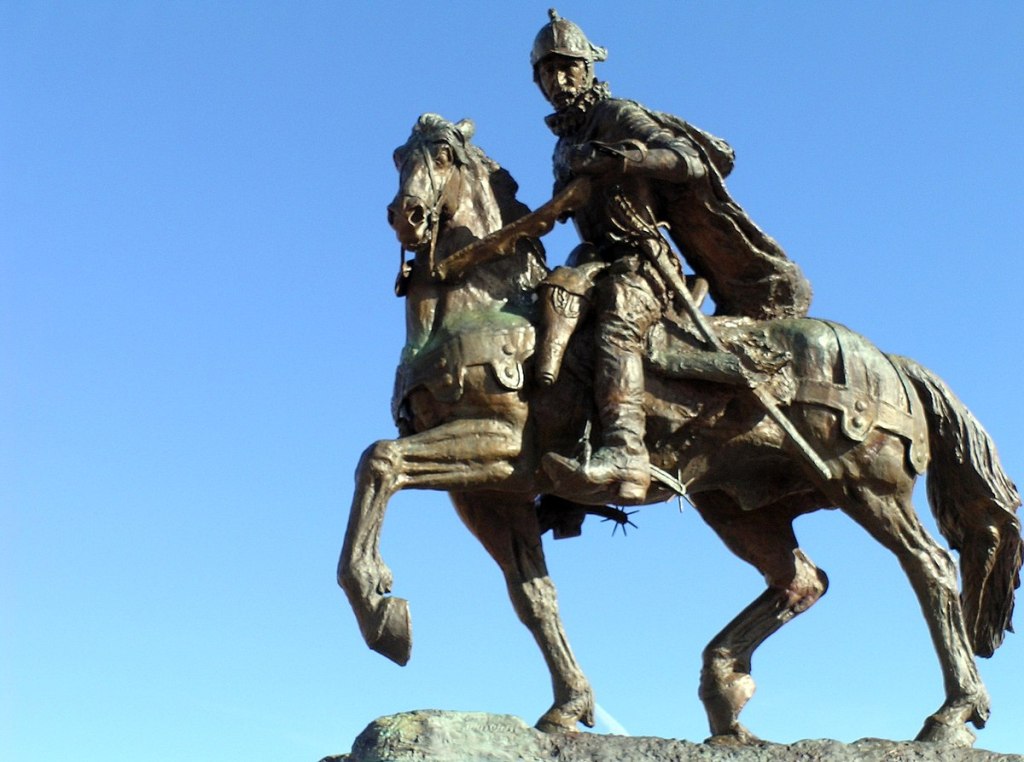
Juan de Oñate Expedition to the Great Plains
Today the author discusses the Juan de Oñate Expedition to the Great Plains.
From the Book:
Colonial American History Stories – 1215 – 1664
Transcript:
Francisco Vásquez de Coronado had explored large areas of what would become America’s Southwest in 1540 – 1542. Spain had never followed up on this great expedition. King Phillip II of Spain decided to end this neglect by charging explorer Juan de Oñate with the mission of exploring this region on September 21, 1595.
Before getting started, I would encourage you to subscribe to the Mossy Feet Books You Tube channel for more great content. I also entreat you to visit my website, http://www.mossyfeetbooks.com. There you will find sample chapters, podcasts, a slew of content and links to where you can buy my books. While visiting the web site you can subscribe to it and receive email notifications of when I publish a new book or other content, like this video and podcast. This episode is based on my book, Colonial American History Stories 1215 – 1665.
Juan de Oñate (1550–1626)
Juan was the son of Spanish aristocrats Cristóbal de Oñate and Catalina de Salazar and was native to Zacatecas, Spain. Upon maturity, he sought to expand and defend Spain’s New World Empire in Mexico. His father owned the lucrative silver mines in Zacatecas and was both rich and influential. Sometimes referred to as the “Last Conquistador,” his ancestors included Cadena Oñate. Cadena was a famous Spanish hero of the Battle of Las Navas de Tolosa in Al Andaluswith the Muslims in 1212.
After a series of delays the expedition set out with 100 families, 300 single men, wagons, horses and over 7000 cattle in early 1598. They crossed the Rio Grande in March. On April 30, 1598 he conducted a formal ceremony during which he claimed all of the regions drained by the Rio Grande for Spain. He then continued his exploration into what is now New Mexico. He founded Santa Fe de Nuevo México, which became the Spanish capital of the region. Oñate served as the governor of this territory from 1598 until 1610.
Coronado and other explorers had written about the vast stores of wealth reported to be found in the Sonoran Desert. The legendary Seven Cities of Gold were supposedly located there. Pursuing these legends, Orñate embarked on the second expedition on June 23, 1601. He had as a guide native Jusepe Gutierrez.
Jusepe Gutierrez
Jusepe Gutierrez was one of many natives that served as guides to the Conquistadores while they searched for gold. He had led the expedition of Antonio Gutierrez de Umana and Francisco Leyba de Bonilla in 1593. His is the only known survivor account of that ill-fated expedition into the Texas and Arizona region. It is probable that he took the last name of the Conquistador, Antonio Gutierrez that employed him. He later guided Vicente de Saldivar Mendoza on his expedition. This trek led into New Mexico and the southwestern Great Plains. Oñate recruited him because of his familiarity with the region. Jusepe also knew the languages spoken by many of the natives that lived there.
This expedition consisted of 130 soldiers and left Santa Fe on June 23, 1601. . It first proceeded east into the Texas panhandle until they reached the Canadian River. They followed this river into present Oklahoma, encountering Apache Indian bands along the way. When their ox carts mired down in the sandy soil, he left the river. The expedition left the desert and entered land that is more fertile. Here they encountered a tribe of natives he called the Escanjaques. The tribe depended upon hunting the buffalo that roamed freely in the region. The Escanjaques told him about a tribe called the Rayados that lived some distance away in a land they called the Etzanoa. The Rayados were enemies of the Escanjaques and the tribe entreated Oñate to ally with them to fight them. Oñate demurred. They led him to a river where he became the first European to see the tall grass prairie. Here the group encountered a band of Rayados who indicated they were ready to fight. Oñate did not wish to get into a war and made peace with them instead. When the two tribes seemed intent upon making war with each other, Oñate decided to return to Santa Fe de Nuevo México. The priests had asked the soldiers to kidnap several of the Escanjaques so they could instruct them in the Catholic faith. To get the captives back, the Escanjaques attacked the party. After two hours of battle, during which the Escanjaques managed to free many of the captives, Oñate retreated. After the battle, the expedition returned without further incident on November 24, 1601.
The episode is based upon my book, Colonial American History Stories – 1215 – 1664, available on the web site, http://www.mossyfeetbooks.com. The book is the first book in the 6 volume Timeline of United States History Series. Discover some of the famous and almost forgotten historic stories of America. The story begins with the signing of the Magna Carta in 1215 and the beginnings of the concept of limited government and ends, for now, with the beginning of the American Revolution in 1775. The articles in the book have much more detail as well as articles not included in this podcast series.

 Mossy Feet Books - Author Paul R. Wonning