
The Gristmill at Spring Mill State Park
Today we will visit Spring Mill State Park near Mitchell, Indiana and learn about the gristmill and sawmill in the Pioneer Village.
From the Book
Spring Mill State Park
Transcript:
Before getting started, I would encourage you to subscribe to the Mossy Feet Books You Tube channel for more great content. I also entreat you to visit my website, http://www.mossyfeetbooks.com. There you will find sample chapters, podcasts, a slew of content and links to where you can buy my books. While visiting the web site you can subscribe to it and receive email notifications of when I publish a new book or other content, like this video and podcast. You can also subscribe to the Mossy Feet Books You Tube Channel to ensure you do not miss any of my content. This episode is based on my book, Spring Mill State Park.
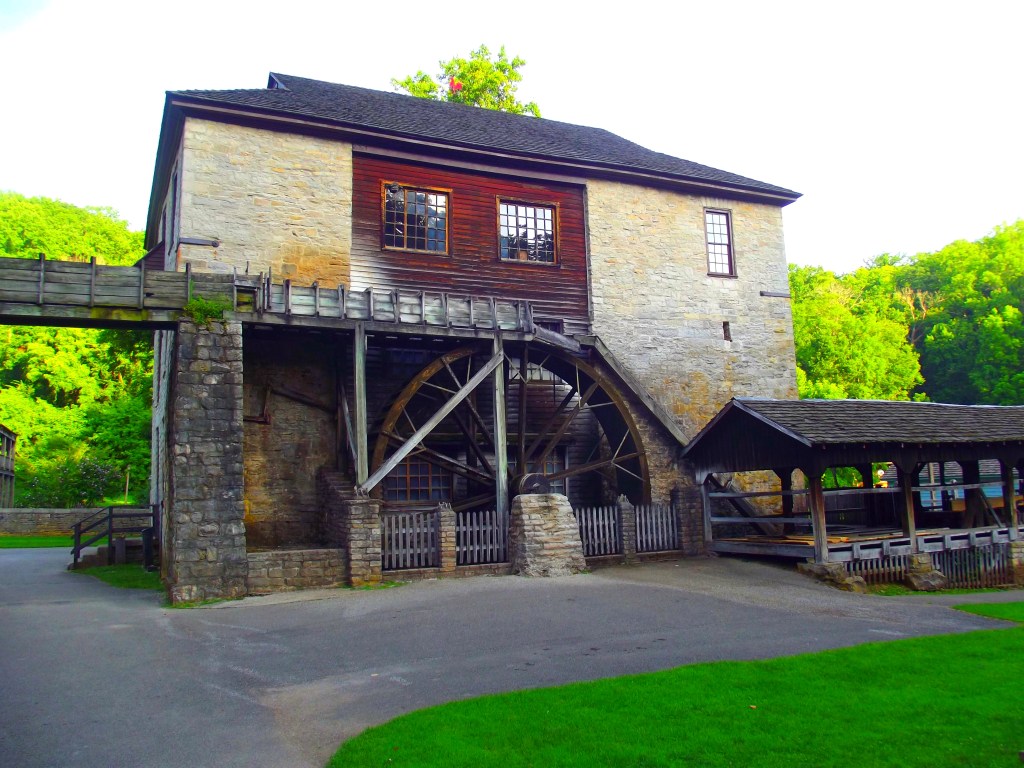
Early pioneers in Indiana founded the village of Spring Mill in 1814. The copious amounts of water that flowed from local caves encouraged them to build a gristmill using the water to power the mill. In 1817 Hugh Hamer, the mill’s owner, built a bigger mill on the site. This gristmill was a three-story limestone structure and is the mill that exists in the Pioneer Village today. Since farmers had to bring their grain to the mill for grinding, the mill became a place for neighbors to meet and gossip as the millstones converted their grain into meal and flour. A village developed around the mill and by 1850 Spring Mill was a bustling community. The mill operated from 1817 until 1892. Steam powered portable mills replaced the gristmills, and the need for a water-powered mill died away.
New ownership of the mill in 1824 brought the addition of the sawmill. This increased the usefulness and the revenue of the mill. Two developments brought about the decline of Spring Mill. The railroad bypassed the town, due to the steep hills making it difficult to build a rail line through the town. Steam power rose as a more portable power source. Steam powered gristmills and sawmills released the need to locate a mill near a water source. Two rail lines intersected at Mitchell, and Spring Mill went into a decline. By the late 1890’s the population of the village had abandoned it. The buildings and mill, neglected, deteriorated.
The State acquired the property in the late 1920’s. The property was to form a new State Park. Many of the structures had deteriorated beyond repair. the water wheel and sawmill had disappeared. Extensive research, renovation and educated guesses have resulted in the Pioneer Village visitors enjoy today. Many of the structures, including the Mill, Spring House, Nursery/School House and Summer Kitchen still occupy the ground on which they were built. Others have been dissembled and moved from other locations. During the summer months interpreter’s staff, the buildings dressed in period costumes, working at the tasks they would have performed in the nineteenth Century. The mill wheel grinds corn and the sawmill saws logs. Corn meal ground on the wheel is available for purchase inside the mill and at Spring Mill Inn.
Restoration
Restoration of the village commenced in 1928. The work would require an enormous amount of research, educated guess work and hours of manual labor. The gristmill was still standing, but it was in ruins. The huge waterwheel was lost, though a worker at the site discovered part of it. The Department of Conservation handed the task of recreating the wooden water wheel to the Indiana Division of Engineering.
Restoring the Mill Wheel
The Division of Engineering undertook a painstaking, methodical research project to determine the size, construction and appearance of the overshot mill wheel, beginning in 1931. Park director Colonel Richard Lieber insisted that the reproductio of the water wheel be authentic. By conducting interviews of area residents that had seen the wheel, comparing mill wheels built in the same era and using published construction techniques of other water wheels the Division began planning the replacement wheel at Spring Mill. Lawrence Lawyer, foreman of the CCC camp at Spring Mill found a section of the old wheel in a pile of drift downstream from the mill. A copy of a 1995 miller’s guide was found and provided further instrction on the reconstruction of the machinery inside the mill. Historical lore says that this was the book the original mill engineer used to build the mill in 1817. From all of this data they could plan and construct the mill wheel. They used a section of a thirty-six inch diameter, twenty four foot long white oak log cut at Henryville, Indiana. By counting the annual rings, this tree was determined to be about 195 years old. The engineers used locally sawn, rough cut lumber for the remainder of the wheel. They purchased the hardware from Marion Owen, the last owner/operator of the gristmill at Moscow, Indiana. Mr. Owen had salvaged the hardware when the mill was dismantled in 1913. After fashioning the parts, workers brought them to a location adjacent to the mill for assembly. They would assemble the wheel in place due to the great weight of the finished wheel. The wheel is twenty-four feet in diameter, five feet wide and weighs in at about 8,500 pounds when all of the buckets are full. The wheel delivers about twenty-five horsepower when in operation. The mill flume is 600 feet long and is designed to look like the original wooden flume. The flume is historically correct as much as possible.
Overshot Water Wheel
The water wheel at Spring Mill is called an overshot water wheel. In this type of gristmill a stream of water pours into the buckets at the top of the wheel causing it to turn, supplying power to the axel, which in turn powers the gears and cogs inside the mill. This machinery turns the millstone which grinds the wheat into flour or corn into cornmeal. Overshot wheels work best when the water flow allows them to turn slowly.
Restoring the Mill
Lawrence Lawyer, forman of the CCC camp at Spring Mill from 1931 – 1935, found a section of the original water wheel downstream in a pile of driftwood. He used the wheel to draft blueprints for a new wheel. He built the first reconstruction from white oak. He gave the state engineers his drawings, which they improved and used to build the current reconstructed wheel. Lawyer also constructed all of the machinery inside the mill, using native white oak. He also restored the sawmill, of which there were only a few iron pieces, the metal cogs that feed logs into the saw for cutting, some iron shafts and a wheel. He first saw the mill in 1924, when there was no floor in it. While rebuilding the various structures 12 – 15 man teams lifted the logs and put them into place. To chink the spaces between the logs they inserted small rocks into them and then plastered over them using a mortar mixture of on part lime, two parts sand. As time went by they began adding cement to the mix. This mixture set up fast. The original granite grinding stones that grind the grain were imported from France and wore out in 1962. The replacement stones came from North Carolina.
Saw Mill
The earliest sawmills in Indiana were either water powered or pit sawmills.
Pit Sawmills
To cut lumber with a pit saw, the sawyers first hewed a log square with a broad axe, then placed the hewn log over a pit. Two men then sawed planks from the hewn log using a crosscut saw. One man stood in the pit pulling the saw down while another man stood on top, pulling the saw up. The men used a chalked line as a guide to keep the plank to the desired thickness.
The Water Sawmill at Spring Mill
Originally constructed in 1824 at the direction of the Montgomery brothers, CCC workers restored the sawmill in 1932, led by Lawrence Lawyer. Only the cogs that moved the logs, one of the wheels and some iron parts remained when restoration began. A seperate under-shot flutter-waterwheel powers the saw, supplying the up and down sawing motion that mills the logs into lumber. Before powering up the sawmill, the water powering the gristmill water wheel is diverted to the smaller one that powers the saw mill. The water wheel supplies power to a flywheel, which in turn transfers that power to the reciprocating blade. A cog and gear system moves the logs forward into the blades, cutting the lumber which is then stacked nearby. In its heyday the sawmill could mill 2500 board feet of lumber a day. The water powered sawmill was a great improvement over the pit sawmills in use in the area and would remain dominate until the steam powered sawmills that came later. Portable steam powered sawmills came into use during the middle part of the Eighteenth Century. These saws could use the waste wood as fuel to fire the boiler that powered the saw. With the advent of these saws, loggers could, and did, log vast quantities of wood.
Mill Flume
The mill flume carries the water from the dam at the entrance of Hamer Cave and transports it to the mill wheel where it pours into the gristmill buckets, turning it and providing power to the gristmill and the sawmill. By the time the CCC moved into the park to work, the long wooden trough had completely rotted away, however the original limestone pillars remained. The CCC rebuilt the flume in 1931, once again restoring water flow to the gristmill.
Mill Office
The mill office, constructed in 1818 by the Bullit brothers, is an original structure that was repaired in 1931. The Bullits and Hamers would have conducted the mill’s business affairs in this office.
The episode is based upon my book, Spring Mill State Park, available on the web site, http://www.mossyfeetbooks.com. The book is the first book in the 11 Indiana State Park Travel Guide Series. The books include information about the parks, museums, historic sites and many other day trip destination across the state. I encourage you to visit the web site and subscribe to it.
You can find my books locally at the Walnut Street Variety Shop in Batesville, Indiana.
I hope you enjoyed this podcast and thank you for listening.

 Mossy Feet Books - Author Paul R. Wonning
Hi Paul,
Have/did you ever eat any of the corn meal produced at the gristmsill at Spring Mill State Park?
Donna
LikeLike
We have eaten at the Inn. They have several dishes in the restaurant that use the meal. They are delicious.
LikeLike