
The Mary Clark Decision Ended Slavery in Indiana
Today I will talk about the events surrounding a slave woman named Mary Clark.
From the Book
Southwest Indiana Day Trips
Transcript
Greetings, today I will talk about the events surrounding a slave woman named Mary Clark.
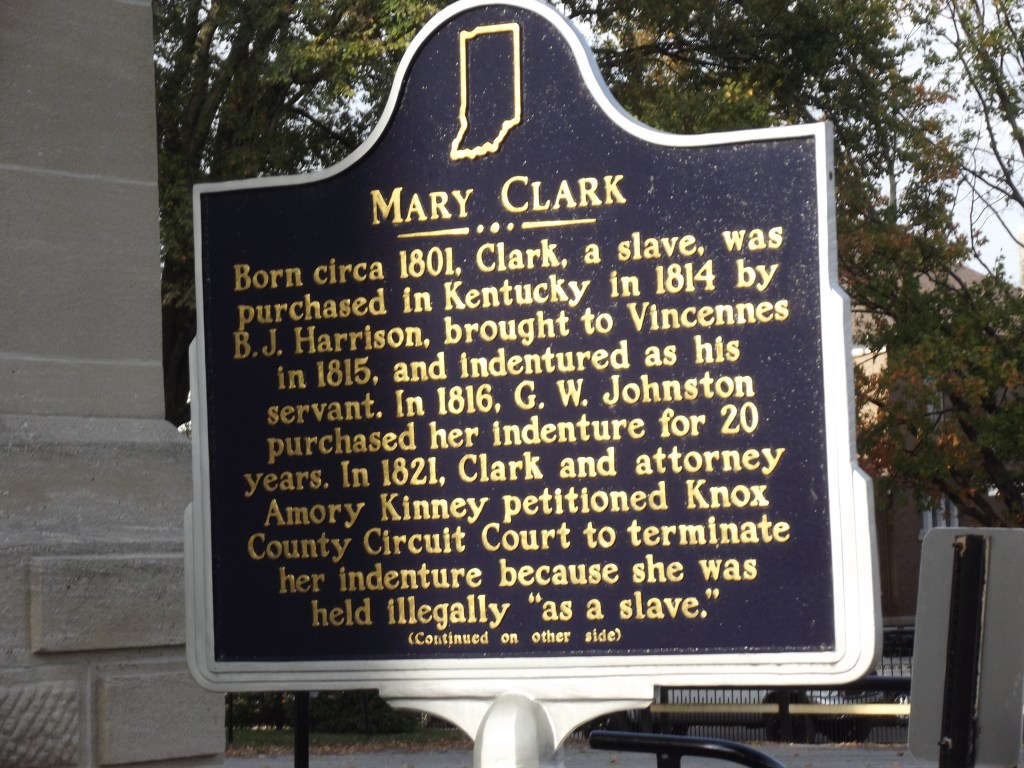
Near the Knox County Courthouse at 111 North 7th Street, Vincennes (Knox County) visitors will find an historical marker noting the events surrounding a slave woman named Mary Clark.
Text
Side one:
Born circa 1801, Clark, a slave, was purchased in Kentucky in 1814 by B. J. Harrison, brought to Vincennes in 1815, and indentured as his servant. In 1816, G.W. Johnston purchased her indenture for 20 years. In 1821, Clark and attorney Amory Kinney petitioned Knox County Circuit Court to terminate her indenture because she was held illegally “as a slave.”
Side two:
Circuit Court ruled Clark “freely” entered into her indenture and had to complete it. Upon appeal, Indiana Supreme Court ruled in November 1821 that Clark’s suit proved her service was involuntary, violating Indiana’s 1816 Constitution. Court discharged her from service. Ruling contributed to end of indentured servitude in Indiana. Clark died in 1840.
I have written a bit more about this incident, however Before getting started, I would encourage you to subscribe to the Mossy Feet Books You Tube channel for more great content. If you like my videos, please hit the “Like,” button. The more likes I get the more You Tube will show it to other people, allowing me to grow the channel. I also entreat you to visit my website, http://www.mossyfeetbooks.com. There you will find sample chapters, podcasts, a slew of content and links to where you can buy my books. While visiting the web site you can subscribe to it and receive email notifications of when I publish a new book or other content, like this video and podcast. This episode is based on my book, Southwest Indiana Road Trips.
The French brought slavery with them when they settled the area that is now Indiana in the early 1700’s. When the British took control after the French and Indian War, the practice continued. At the conclusion of the Revolutionary War, there were slaveholders in the area. When Congress passed the Northwest Ordinance in 1787, it specifically banned slavery. Since most of the early settlers in the Indiana Territory had come from slave holding states of Kentucky and Virginia, most of the residents favored slavery. Many brought slaves with them when they came to the territory. They assumed that the ban did not affect slaves already in their possession. Since the Territorial Governor, William Henry Harrison, approved of slavery and wanted it to exist in the territory, the institution continued to exist. Since Harrison appointed the legislature, he ensured that all the members he appointed were pro-slavery men. They evaded the law by using a form of indentured servitude to allow slavery to continue. Up until 1809, most of the Assembly also tolerated slavery.
Though Jefferson owned slaves, he did not want to see the institution spread to the Indiana Territory and any states that would form from it. He began working actively against slavery, reportedly sending abolitionist James Lemen into the territory in 1784 and again in 1804 to organize an anti-slavery movement. Many historians reject the idea that Jefferson sent Lemen to the territory, however he was a friend of Jefferson and certainly aware of Jefferson’s views.
James Lemen (1760 – January 8, 1823)
A native of Harper’s Ferry, Virginia, Lemen served two years in the Continental Army. He immigrated to the Indiana Territory and took up the anti-slavery cause. During his time there, he managed to organize several anti-slavery Baptist Churches. He encountered many of the citizens in the newly developing state of Indiana and helped organize them. He became involved later in Illinois, helping to institute the “Free State” Illinois Constitution.
Anti-Slavery Proponents Take Control
In 1809, Congress amended the Northwest Ordinance to authorize election of legislators. This ended Harrison’s ability to appoint members of the assembly. In 1810 during the ensuing elections, the anti-slavery proponents took control of the Indiana Territory’s assembly. Dennis Pennington, a former slave owner that had turned against the institution became speaker. He was one of the more outspoken opponents of slavery. When Indiana finally became a state in 1816, the anti-slavery proponents wrote the first state Constitution, banning it. However, the practice still survived under the guise of indentured servitude. An indentured servitude contract typically freed the servant after a period of time, stated in the contract. Many of these contracts were signed under duress. These contracts usually were for an extended period of time. The Mary Clark ruling in 1821 helped end the practice.
The episode is based upon my book, South Central Indiana Road Trips, available on the web site, http://www.mossyfeetbooks.com. The book is the first book in the 9 volume Road Trip Indiana Series. The books include all the historical markers, as of 2022, in Indiana with the text and back story. The books also include a nearly complete listing of virtually every tourism destination in the state. The destinations include parks, museums, drive in theaters, bowling alleys, wineries and much, much more. I encourage you to visit the web site and subscribe to it.
You can find my books locally at the Walnut Street Variety Shop in Batesville, Indiana.
I hope you enjoyed this podcast and thank you for listening.

 Mossy Feet Books - Author Paul R. Wonning