
First Blacks Land at Jamestown Virginia
Today I will talk about the arrival of the first blacks at Jamestown, Virginia in late August, 1619.
From the Book:
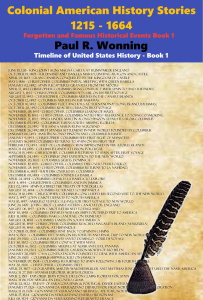
Colonial American History Stories – 1215 – 1664
Transcript
Greetings, today I will talk about the arrival of the first blacks at Jamestown, Virginia in late August, 1619.
Before getting started, I would encourage you to subscribe to the Mossy Feet Books You Tube channel for more great content. If you like my videos, please hit the “Like,” button. The more likes I get the more You Tube will show it to other people, allowing me to grow the channel. I I also entreat you to visit my website, http://www.mossyfeetbooks.com. There you will find sample chapters, podcasts, a slew of content and links to where you can buy my books. While visiting the web site you can subscribe to it and receive email notifications of when I publish a new book or other content, like this video and podcast. This episode is based on my book, Colonial American History Stories 1215 – 1665.
August 29, 1619 ? – First Blacks Land at Jamestown Virginia
Sometime in late August, 1619 a ship docked at Jamestown bearing a cargo of blacks. The probable origin of these people was Angola, Africa. Thus, the first blacks had arrived in the New World. The status of these people is unknown. The institution of slavery did not exist yet. Many historians feel that these blacks served as indentured servants for a period. There are records that blacks received awards of land in later years, lending credence to that theory.
Date Uncertain
The date of the ship’s arrival is uncertain; we only know that it was in late August. The author has assigned a date because the format of this book requires one. It was an historic event and deserves inclusion in this history. Of the black’s arrival, John Rolfe wrote, “About the latter end of August, a Dutch man of Warr of the burden of a 160 tunes arrived at Point-Comfort, the Comandors name Capt Jope, his Pilott for the West Indies one Mr Marmaduke an Englishman. … He brought not any thing but 20. and odd Negroes, w[hich] the Governo[r] and Cape Merchant bought for victuall[s].”
Ruse by Rolfe
The blacks had not arrived on a Dutch man of war, as Rolfe reports. Research reveals that these unfortunates arrived on an English warship called the White Lion. The White Lion possessed letters of marquee that allowed it to operate as a privateer, a sort of legalized pirate. The White Lion had license to attack any Spanish or Portuguese ship. It had captured the blacks from a Portuguese slave trading ship called the San Juan Bautista. The White Lion and another ship called the Treasurer, had attacked the ship in the Gulf of Campeche off the Mexican coast. The ships had then taken the human cargo and sailed first to the West Indies, then on to Virginia. Rolf’s deception was to hide the fact that they had been taken by an English ship by piracy.
Fate Uncertain
These first blacks probably suffered different fates. Some blacks the English treated as indentured servants, releasing them to freedom after a period. Others found ways to extend the servitude into a lifetime of service. Slavery as an institution had not yet evolved, so it is doubtful if most were considered slaves. There are records of some blacks receiving land grants by the mid 1600’s. Some of these blacks were probably included in that first shipment of blacks. Some established plantations and later acquired slaves to work them. At any rate, the population of blacks in the colonies remained small until after 1700. After that time, the system of slavery began to evolve as the growing numbers of cotton plantations of the south needed laborers.
The episode is based upon my book, Colonial American History Stories – 1215 – 1664, available on the web site, http://www.mossyfeetbooks.com. The book is the first book in the 6 volume Timeline of United States History Series . Discover some of the famous and almost forgotten historic stories of America. The story begins with the signing of the Magna Carta in 1215 and the beginnings of the concept of limited government and ends, for now, with the beginning of the American Revolution in 1775. The articles in the book have much more detail as well as articles not included in this podcast series.
I hope you enjoyed this podcast and thank you for listening

 Mossy Feet Books - Author Paul R. Wonning