
The Pilgrims – Part 2
Today we will follow the Pilgrims on their journey from England to the New World.
From the Book:
Colonial American History Stories – 1215 – 1664
The Pilgrims – Part 2
Greetings, today we will follow the Pilgrims on their journey from England to the New World.
Greetings, today we will follow the Pilgrims on their journey from England to the New World.
Before getting started, I would encourage you to subscribe to the Mossy Feet Books You Tube channel for more great content. If you like my videos, please hit the “Like,” button. The more likes I get the more You Tube will show it to other people, allowing me to grow the channel. I I also entreat you to visit my website, http://www.mossyfeetbooks.com. There you will find sample chapters, podcasts, a slew of content and links to where you can buy my books. While visiting the web site you can subscribe to it and receive email notifications of when I publish a new book or other content, like this video and podcast. This episode is based on my book, Colonial American History Stories 1215 – 1665
The Pilgrims arrived in Southampton on the Speedwell from their refuge in Leiden, Holland. In Southampton, they were to rendezvous with the Mayflower and some other settlers. The Pilgrims planned to sail to the New World on the two ships. These two ships departed Southampton, England around August 5. The Speedwell created the first of what were many problems by springing a leak. The ships put in at Dartmouth to repair the ship.
Speedwell
By 1620, the Speedwell was forty-three years old. It was a ship called a full rigged pinnace and was a smaller ship than the Mayflower. The Speedwell was about sixty tons and would have carried around ten guns. The ship’s construction in 1577 was in response to the threat of a war with Spain. Her name at the time of construction was Swiftsure. The ship saw service against the Spanish Armada in 1588. Then it served as Sir Gelli Meyrick’s ship during Earl of Essex’s Azores expedition in 1596. When the Spanish threat ended in 1605, the Swiftsure was decommissioned.
The Pilgrims purchased the Swiftsure in 1620 and renamed it Speedwell. They refitted the ship in Leiden, Holland before departure with two new masts. Shipbuilding experts theorize that the crew using a mast that was too big for the ship caused the ship’s problems. After the Pilgrims abandoned the ship, the owner refitted it and sent it on several profitable voyages afterwards.
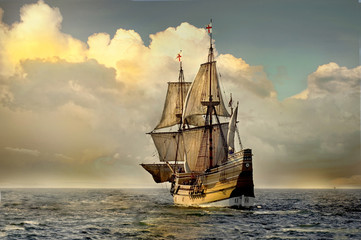
Because of the name’s popularity, historians know little about the Mayflower’s early history. There were over twenty ships registered with that name during that period. She likely saw her maiden voyage before 1609 and was near the end of its useful life by the time the Pilgrims departed for the New World on her. Historians know little about her construction and layout. They can surmise that she was about 102 feet long with a beam of about twenty-five feet and drew about eighteen feet of water. She was a cargo ship with a capacity of about 180 tons. She was square rigged and had three masts and three main levels. These levels were the main deck, the gun deck and the cargo hold. There was also a poop deck, formed by the roof of a cabin in the rear of the ship. The poop cabin resided on the poop deck and provided the crew with an observation area during the voyage. Her construction would have made her passage against the westerlies difficult. This played a key role in the length of the voyage across the ocean. Mostly the ship had transported casks of wine and carried about ten cannon as protection against piracy. The cargo holds would have stored the tools, clothing, bedding, food and weapons. They settlers would need these essential items in their new home. The cargo hold did not have windows, to prevent water seeping in and ruining the cargo. The holds had low ceilings and were dark, cold and damp.
The Captain of the ship had the best quarters, in the rear of the ship, the driest part. The crew, about thirty, lived in the forecastle, at the front of the ship. Since it was at the front, the forecastle was the wettest and coldest, as the waves constantly beat against it. The Pilgrims would have slept in the poop house and gun deck with some possibly sleeping in the hold. There was no latrine, so people mostly did their business in a bucket secured by ropes or over the side of the ship.
The ships departed Dartmouth on August 15, 1620. They did not get far. The Speedwell developed more problems with leaks. After traveling between two to three hundred miles out to sea, the ships turned around and sailed to Plymouth, England. Now they had to decide whether to go on, or go back to their homes.
They did decide to go on and left on September 16, minus the problem plagued Speedwell. It was a stormy, long passage.
The stormy passage had caused the Mayflower to reach the New World well south of their intended target of the Hudson Valley. Continued storms prevented them from reaching their destination, which is present-day Provincetown Harbor in Massachusetts. With supplies running low and the season much later than originally intended, they decided to settle their colony there, instead of trying to go to their original destination.
Outside the Charter
A new problem arose to vex the leader of the colony, William Bradford. Their group contained some settlers that were not part of the Pilgrim sect. Since their location was outside the charter that governed them, many of these colonists felt that they owed no one allegiance and could do as they pleased. This was a dangerous situation for the colonists to have as they faced a hostile New World. In an attempt to solve the problem, Bradford drew up a document that became the first framework of government established in the New World. The Mayflower Compact established a government based on majority vote in which allegiance to the King of England was assumed. Women and children were exempted from voting. By signing the document, the settlers agreed to follow the rules it established to assure survival of the colony. The document remained in effect until they received a new patent in 1621.
Original Document Lost
The original Mayflower Compact has been lost to the mysteries of time, but there are three copies in existence. The earliest is Edward Winslow’s Mourt’s Relation, published in 1622. This booklet contains a detailed account of the settlers first months at “New Plimoth.” This copy was reprinted in 1625 as Purchas his Pilgrimes. William Bradford wrote a copy of that he included in his journal, Of Plimoth Plantation in 1646. these three are the only copies in existence today and Bradford’s handwritten copy rests in a vault at the State Library of Massachusetts.
The episode is based upon my book, Colonial American History Stories – 1215 – 1664, available on the web site, http://www.mossyfeetbooks.com. The book is the first book in the 6 volume Timeline of United States History Series . Discover some of the famous and almost forgotten historic stories of America. The story begins with the signing of the Magna Carta in 1215 and the beginnings of the concept of limited government and ends, for now, with the beginning of the American Revolution in 1775. The articles in the book have much more detail as well as articles not included in this podcast series.
I hope you enjoyed this podcast and thank you for listening

 Mossy Feet Books - Author Paul R. Wonning