Vincennes State Historic Sites
Today the author talks about some of the State Historic Sites found in Indiana that mark the early, territorial phase of the state.
From the Book
Southwest Indiana Day Trips
Transcript:
Greetings, today I will talk about some of the State Historic Sites found in Indiana that mark the early, territorial phase of the state.
Before getting started, I would encourage you to subscribe to the Mossy Feet Books You Tube channel for more great content. If you like my videos, please hit the “Like,” button. The more likes I get the more You Tube will show it to other people, allowing me to grow the channel. I also entreat you to visit my website, http://www.mossyfeetbooks.com. There you will find sample chapters, podcasts, a slew of content and links to where you can buy my books. While visiting the web site you can subscribe to it and receive email notifications of when I publish a new book or other content, like this video and podcast. This episode is based on my book, Southwest Indiana Road Trips.
The buildings in the State Historic Site include a log barn that serves as a visitor center, a schoolhouse, the old Territorial Capitol and the Eli Stout Print Shop. The State of Indiana has moved all the buildings here from other locations and all are Indiana State Historic Sites. The tour costs a nominal fee and includes all four buildings. It will take about half an hour and is well worth the investment.
Log Barn
The log barn serves as a small museum and visitor’s center. The tours also begin there. It contains a military uniform from the War of 1812, as well as other military paraphernalia.
Schoolhouse
The schoolhouse was the first public schools in the Indiana Territory. Subjects taught included reading and writing, Latin, geography and geometry. Geometry was important to the early settlers because it provided the basis for surveyor training, an important skill.
Territorial Capitol Building
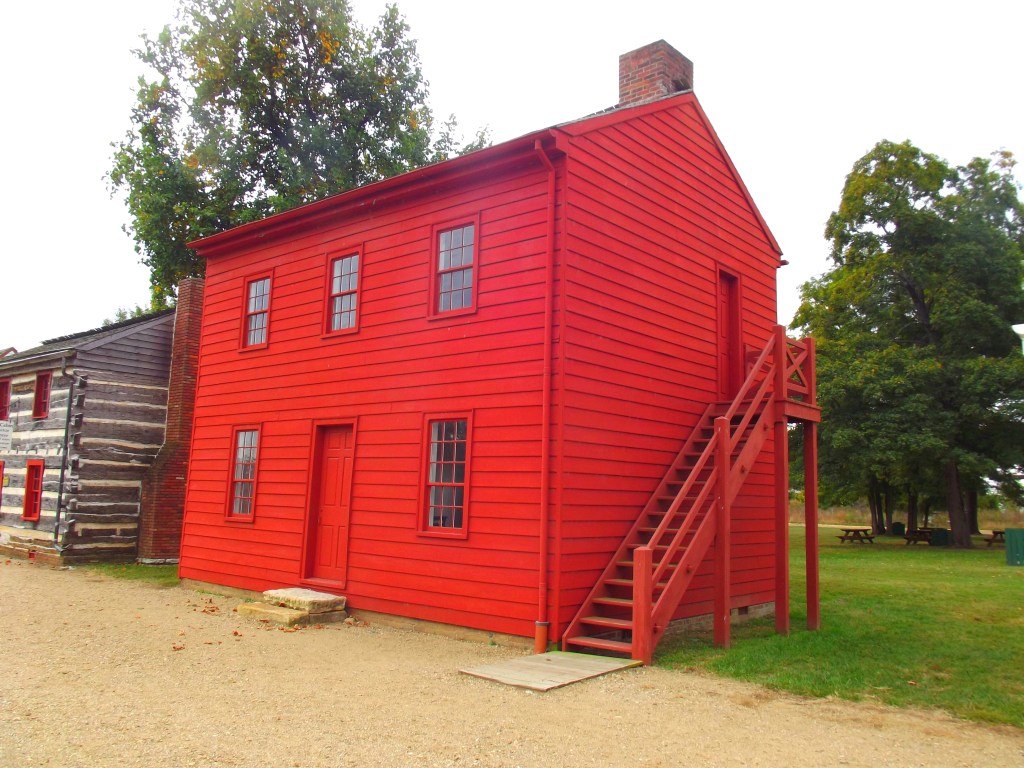
The Territorial Capitol Building served as the meeting place for the Indiana Territorial Assembly. The Senate (Commissioners) met upstairs and the House of Representatives downstairs. There were nine representatives in the Indiana Territorial Assembly and five commissioners. The Spartan interior testifies to the simplicity of life on the frontier. Laws passed by the House went upstairs to the Commissioners. If the Commissioners approved, they sent the bill over to Grouseland for Governor Harrison to either sign or veto.
November 22, 1811 – Legislature Meets First Time in Red House
The Red House in Vincennes is the only surviving house in which the Indiana Territorial Legislature met. At its inception the Indiana legislature consisted of Governor Harrison and three judges appointed by the President of the United States. It is not known where these men met, however speculation centers on a house owned by Colonel Francis Vigo. This house stood at the corner of Second and Busseron Streets. This house burned down in 1855. When the Territory entered its second stage of governmental developement in 1805 the Assembly expanded to a seven to nine man House of Representatives and a five man Legislative Council. This council met at a two room house owned by Antoine Marchal on the corner of Second and Broadway Streets. They used this house in conjunction with Knox County using it for a court house from 1805 until 1810. The Assembly did not meet at all in 1810 due to the confused state of government when Congress separated the Illinois Territory from the Indiana Territory. The Assembly sublet the building from Knox County, paying the county $50 per year rent. The assembly apparently had problems paying this amount, as in 1811 Knox County billed the assembly $120 for unpaid rent. When the Assembly met on November 11, 1811 the treasury contained $3.00. The assembly moved to the Red House, opening its session on November 22, 1811. It occupied this house from November 22 until December 19, 1811. They only used this house once, during this session. The house originally stood on Main Street between Second and Third Streets. Daniel Black had the house constructed for use as his tailor shop. The house was constructed with the frame lying on the ground. The workers built the frame using heavy wooden timbers pinned together with wooden pegs. After assembly the workers used long poles to raise the framework to an upright position. After raising, they jammed wooden stakes between the upright timbers at six inch intervals. They mixed an insulation material the local French builders called “bousillage,” using mud and prairie grass, and smeared it into the gaps of the stakes. They plastered the walls with lime made by burning mussel shells obtained from the river. The house was then apparently painted red, leading to the name. Fur trader Thomas Jones purchased the house in 1806. After Jones was killed in a duel, the house passed through several owners and had many purposes including use as a tavern, tinsmith’s shop and grocery store. In 1856 the mud insulation was apparently removed and the house moved to North Third Street where it remained until the new owners, the Women’s Fortnightly Club, moved it to Harrison Park for use as a museum. The building was moved for a third time its current location at First and Harrison streets, next to Grouseland. The Indiana State Museum owns it currently as a state historic site open to the public. This was the only session that took place in the Red House. It did not meet in 1812 due to the War of 1812. In 1813 it met at the February 1 to March 12, 1813 at Mark Barnett’s tavern, after which the Territorial Capital moved to Corydon.
Next weeks episode will cover the Eli Stout Print Shop and the territory’s first newspaper.
The episode is based upon my book, South Central Indiana Road Trips, available on the web site, http://www.mossyfeetbooks.com. The book is the first book in the 9 volume Road Trip Indiana Series. The books include all the historical markers, as of 2022, in Indiana with the text and back story. The books also include a nearly complete listing of virtually every tourism destination in the state. The destinations include parks, museums, drive in theaters, bowling alleys, wineries and much, much more. I encourage you to visit the web site and subscribe to it.
You can find my books locally at the Walnut Street Variety Shop in Batesville, Indiana.
I hope you enjoyed this podcast and thank you for listening.

 Mossy Feet Books - Author Paul R. Wonning