The Pilgrims – Part 3
Today we will continue our story of the Pilgrims and their beginning in the New World.
From the Book:
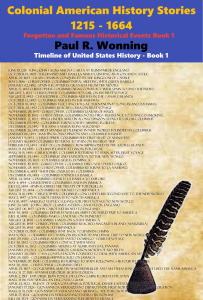
Colonial American History Stories – 1215 – 1664
Transcript:
The Pilgrims – Part 3
Greetings, today we will continue our story of the Pilgrims and their beginning in the New World.
Before getting started, I would encourage you to subscribe to the Mossy Feet Books You Tube channel for more great content. If you like my videos, please hit the “Like,” button. The more likes I get the more You Tube will show it to other people, allowing me to grow the channel. I I also entreat you to visit my website, http://www.mossyfeetbooks.com. There you will find sample chapters, podcasts, a slew of content and links to where you can buy my books. While visiting the web site you can subscribe to it and receive email notifications of when I publish a new book or other content, like this video and podcast. This episode is based on my book, Colonial American History Stories 1215 – 1665
Peregrine White, the first English child born in New England, entered the world while the Mayflower lay at anchor off Cape Cod, Massachusetts.
Pilgrim women gave birth to two children on board the Mayflower. The first, Oceanus Hopkins, was born during the voyage. His parents, Stephen Hopkins and his wife, Elizabeth, named him Oceanus because he was born on the ocean. Peregrine’s parents, William White and wife Susanna named him Peregrine because he came into the world during the peregrination, or journey. The word “peregrinus” means “pilgrim” in Latin. Naming children for important events was common in the Seventeenth Century.
Peregrine White (c. late November 1620 – July 20, 1704)
The birth date of Peregrine is uncertain, we just know it happened in November. Peregrine’s father died during the first winter, on February 21, 1621. His mother later married Edward Winslow and had five more children with him. White settled in Marshfield and became a freeman in 1644. He served as an assessor and deputy to the general court in1659 and 1673. During his lifetime, he held many other offices in the colony.
Oceanus Hopkins died sometime before the Pilgrims left the ship in late December.
The Mayflower arrived in Plymouth Harbor on December 16, 1630. For three days, they explored the area, searching for a suitable site to establish their colony. They decided on two hills, Fort Hill and Cole’s Hill. Native tribes had cleared much of this area already so they could raise their crops.
Building the Settlement
Harsh weather delayed construction. The first landing party did not come ashore until December 20; legend has it at Plymouth Rock. They parceled out lots about fifty feet deep. Family size determined the lot’s width. They would receive eight feet of width for each family member. The settlers had to build their own cabin, and supply work on the common houses, forts, fences and storage houses. They built the settlement on Cole’s Hill. Fort Hill would contain the cannon they would use to defend the town. While building the structures the colonists continued to live on the ship, leaving a permanent presence of about twenty men ashore to defend their work against native depredation. Inclement weather, sickness among the colonists and a shortage of tools and supplies only allowed them to build four common houses and seven cabins that first winter. They had planned to build nineteen during the winter.
Provisioning and Defense
The colonists finally were able to begin bringing provisions from the ship to the colony by the end of January. During this time, they had some encounters with the natives, adding to their apprehension. By the end of February, they had appointed Miles Standish commander and organized themselves into military companies. They had installed several cannon on Fort Hill. By March, they had formed the structure of the colony and elected John Carver governor to replace Christopher Martin, who had died in January.
Death and Disease
During this first winter, the colonists underwent many hardships. Most had lived on the ship, as there were not sufficient shelters or provisions ashore. Diseases like scurvy took their toll. Many of the men were incapacitated by disease and forty-five of the 102 colonists died. However, the remainder persisted and the colony grew.
By early January, the Plymouth colonists had chosen a spot of land to build their new settlement and on December 21, they had divided the land into nineteen plots of ground. They next divided the colonists into families on January 9. Single people were required to choose a family with whom they would live. The purpose of this was to reduce the number of houses the colonists needed to build. Then, they begin to build their city.
The episode is based upon my book, Colonial American History Stories – 1215 – 1664, available on the web site, http://www.mossyfeetbooks.com. The book is the first book in the 6 volume Timeline of United States History Series . Discover some of the famous and almost forgotten historic stories of America. The story begins with the signing of the Magna Carta in 1215 and the beginnings of the concept of limited government and ends, for now, with the beginning of the American Revolution in 1775. The articles in the book have much more detail as well as articles not included in this podcast series.
I hope you enjoyed this podcast and thank you for listening

 Mossy Feet Books - Author Paul R. Wonning