
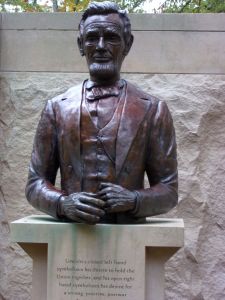
Abraham Lincoln
The nation’s 16th President, Abraham Lincoln, spent his formative years in Spencer County, Indiana. His life there is celebrated at Lincoln State Park and the Lincoln Boyhood National Memorial.
From the Book
Southwest Indiana Day Trips
Transcript:
Greetings
The nation’s 16th President, Abraham Lincoln, spent his formative years in Spencer County, Indiana. His life there is celebrated at Lincoln State Park and the Lincoln Boyhood National Memorial.
Before getting started, I would encourage you to subscribe to the Mossy Feet Books You Tube channel for more great content. If you like my videos, please hit the “Like,” button. The more likes I get the more You Tube will show it to other people, allowing me to grow the channel. I also entreat you to visit my website, http://www.mossyfeetbooks.com. There you will find sample chapters, podcasts, a slew of content and links to where you can buy my books. While visiting the web site you can subscribe to it and receive email notifications of when I publish a new book or other content, like this video and podcast. This episode is based on my book, Southwest Indiana Road Trips. My book, Lincoln State Park, goes into much more detail about Lincoln’s presence in the area and the history of the park. If you like what I am doing, please purchase a book, as it helps fund my work.
Abraham Lincoln Biography
Abraham Lincoln (February 12, 1809 April 15, 1865)
The son of Thomas Lincoln and Nancy Hanks Lincoln, Abraham was native to Sinking Spring Farm near Hodgenville, Kentucky.
Lincoln’s Boyhood in Indiana
The Lincoln family moved to Indiana in 1816 from Kentucky after Abraham’s father Thomas Lincoln lost his land due to faulty land titles. After learning that Indiana had better land title laws, Thomas moved the family north of the Ohio River to Indiana. The Lincolns were also strongly opposed to slavery. Kentucky was a slave state, Indiana a free state, so Thomas chose Indiana. The Lincoln’s squatted on public land in Spencer County while Thomas worked as a cabinet maker, carpenter and farmer. Eventually he acquired clear title to 80 acres of this land in Spencer County.
Death of Nancy Hanks Lincoln
Thomas Lincoln’s wife, Nancy, died of milk fever on October 5, 1818, leaving Thomas Lincoln and his children Abraham and Sarah motherless.
Milk Sickness
The milk sickness was caused by drinking milk contaminated by a poison from the plant, white snakeroot. Cattle that eat the plant transmit it through their flesh and milk, poisoning any that consumes it. No one knew the cause of the disease during this time. It was not until Anna Pierce Hobbs Bixby, known as Dr. Anne, discovered the source of the disease in the 1860’s. She discovered the cause after conversations with an old Cherokee woman. After her research, preventative measures were possible.
Sarah Bush Johnson’s husband, Daniel Johnston, died of cholera in 1816, leaving Sarah and her three children destitute. Hearing of her plight, Thomas Lincoln traveled to Kentucky, proposed to her and the two married on December 2, 1819.
Sarah Bush Johnson (December 13, 1788 April 12, 1869)
The daughter of Christopher and Hannah Bush, Sarah was native to Hardin County, Kentucky. Thomas and Sarah had become acquainted while they both lived near Elizabethtown, Kentucky before Lincoln moved his family to Indiana in 1816. When Nancy died two years later, Thomas heard that Sarah was a widow. Sarah’s husband, Daniel, had accumulated some debts, which Sarah could not pay. Thomas reportedly traveled to Kentucky, arrived at her door and knocked. He proposed to Sarah and offered to pay her debts. She accepted to proposal, the two married on December 2, 1819 and Sarah traveled to Spencer County Indiana with her three children. She took over as mother to young Abraham and Sarah Lincoln. Sarah was illiterate, however, she encouraged young Abraham with his studies. Abraham would address Sarah as “mama,” right from the start. At her insistence, Thomas had wooden planks planed and installed them in the cabin to cover the dirt floor. He also installed a greased paper window. A greased paper window consisted of grease coated paper. Many frontier families used this inexpensive window in lieu of expensive glass to admit light to dimly lighted cabins and to keep birds, insects, wind and other unwanted intruders from the cabin. After Lincoln attained his law practice, and later the presidency, he continued to visit Sarah for the rest of his life as circumstances permitted.
Self Educated
Abraham loved to read and write, a skill that Sarah, his new stepmother, encouraged. Lincoln s received very little formal education. He would walk miles to borrow a neighbor’s book, which were in short supply in the frontier areas of Indiana. Thus, the education Lincoln received on the frontier was largely what he could learn by reading books.
Great Physical Strength
Lincoln grew to 6 foot, 4 inches tall and possessed great physical strength. He learned to wield an ax, becoming an expert rail splitter, an important skill on the frontier. His wrestling skills were also unmatched, as displayed when he bested the leader of a group of local ruffians known as the Clary’s Grove boys.
Abraham Lincoln’s Early Employment
At around fifteen years old Abraham Lincoln worked as a hired hand for local farmer James Taylor. The rough work included butchering and other farm chores. He also operated Taylor’s Ferry ferrying passengers across the Anderson River, which served as a key transportation link during that era. Inspired, young Abe built a rowboat, which he used to ferry passengers across the river. He earned a dollar on his first trip, which seemed almost a fortune to the boy.
Taylor’s Ferry
Taylor’s Ferry crossed the Anderson River, which is a fifty-mile long river that forms the boundary of Perry and Spencer Counties. Lincoln greatly enjoyed ferrying people across the river. It gave him opportunity to converse with many people as they went about their affairs. The Lincoln Ferry Park, on Indiana State Road 66 just west of Troy, Indiana, is the location of an historical marker denoting the site of the ferry. Tradition also says that it was here that the Lincolns crossed the Ohio from Kentucky in 1818. It is also the spot where Lincoln earned money ferrying passengers to and from from the riverboats anchored offshore. His business angered local ferry owners, who tried to stop him. He decided to study law and went on to defend himself in court against the ferry owners. He won the case, sparking a lifelong quest for knowledge and fairness. His love affair with the law began with this case. It was his flatboat voyages to New Orleans that firmed up his revulsion against slavery.
Flatboats
The flatboat was the primary means farmers in the Mississippi Valley watershed used to transport goods to the ports at New Orleans for sale. A flatboat was a rectangular, flat-bottomed boat that was used to transport both passengers and freight. The flatboat operators used two long paddles, called broad horns, to navigate downstream. A canopy usually covered part, or all, of the flatboat as protection for the crew and cargo. A farmer unskilled in boat building could build a flat boat using coarse timbers and fill it with his excess harvest. Building a boat was somewhat expensive, costing about seventy-five dollars to build. A boat could hold about three thousand dollars worth of crops, so the investment was worthwhile. The agricultural products transported included corn, wheat, potatoes, flour, hay, tobacco, cotton, and whiskey. Farmers also transported livestock like chickens, cows, and pigs. At the end of the voyage, the boat was sold. It would usually bring around fifteen dollars. The men during Lincoln’s time usually returned to their farm by steamboat.
Lincoln, New Orleans and Slavery
While a child in Kentucky, Lincoln was exposed to slavery, as there was dissention in the area the Lincoln’s lived in. The Lincoln’s were anti-slavery, but there were many slave owners in the area. The division created many conflicts, so many, in fact, that the church the Lincolns attended had to close due to conflict over the practice. Thomas Lincoln had lost two farms in Kentucky due to land title confusion. He had bought the farms and established homesteads, then lost them when he found he did not hold clear title to them. The Lincolns left Kentucky for Indiana because the new state had better land survey and title laws. They also wanted to live in a free state. The Northwest Ordinance had forbidden slavery in the Indiana Territory, but there were slaves in the Territory when Thomas came to the area in 1815 to locate a suitable farm. When the family moved in 1816, Indiana was on the way to Statehood and would be a free state. Though some slaves remained in Indiana for several years, there were probably few, if any, in the area in which the Lincoln’s settled. Thus, Lincoln’s first real exposure to slavery was on his flatboat trips to New Orleans. It was the second that firmed his stance against it. During that trip, he saw slaves whipped and beaten. It was a slave auction that revolted him the most. During the auction, a mulatto girl was examined like a buyer inspecting a horse. Revolted by the scene, he said to his companions, “By God, boys, let’s get away from this. If ever I get a chance to hit that thing (meaning slavery), I’ll hit it hard.”
Lincoln Departs Rockport
Few experiences defined Abraham Lincoln’s outlook on slavery than his 1828 trip to New Orleans as an employee of merchant James Gentry. Historians have determined that the date for his departure from Rockport, Indiana for New Orleans as April 18 or the 19, 1828.
The Trip
They began their 1300-mile journey from Rockport, Indiana. The flatboat, powered by the river s current, traveled at a speed somewhat under five miles per hours. The flatboat would cover around sixty-five miles per day. The boat was approximately fifteen feet by forty feet and filled with a cargo of pork, flour, meal, and potatoes. Allen Gentry, Thomas Gentry s son, accompanied Abraham on the journey. As the sun went down each day the young men, would find a suitable spot along the bank and tie up to sleep for the night. As they approached the end of their journey, near Convent, Louisiana, a gang of seven men attacked them with sticks. The gang, probably escaped slaves, only retreated when young Gentry yelled at Abraham, imploring him to get the guns and shoot their attackers. The men retreated, not knowing that Gentry and Lincoln had no guns. Both men received injuries during the struggle. The scar, noticeable on later photographs of him, bore testament to one of them. They would arrive in New Orleans on either May 14 or the 17th. Lincoln would have observed a slice of plantation life along the Mississippi as the flatboat made its silent journey downriver.
Selling the Cargo
James Gentry had authorized Lincoln to sell the cargo for cash or trade it for cotton, tobacco, and sugar, which he could also sell. The flatboat docking area on the Mississippi River was between Notre Dame St. Peters and Orleans Parish. South Peters Street runs parallel to the river at this point. Steamboat and sailing ship docks were located north of the flatboat area. After disposing of the cargo, Lincoln and Gentry probably used money belts to stow the cash on their persons for safekeeping.
The Slave Market
New Orleans had the largest slave market in the United States. Many slave selling firms had markets in the city. Most of these markets were close to the river. Slave dealers had found that they could buy slaves cheap in the northern regions of the south and sell them for a profit to plantation owners in the deep south. Since Congress had banned slave importation after 1808, the slave market in the United States consisted of domestic slaves. Well over a half million slaves were traded in the years between 1820 and 1860. In New Orleans the slaves were kept in slave pens, which were basically jails. Men and women were kept in separate sections. Many were sold while still on the boats in transit downriver, but most ended up in these pens. The slave traders fed these people well and allowed them to exercise. This kept the slaves in good condition, thus assuring a higher price when sold. Lincoln and Gentry would have seen these pens, and the nearby markets, while they sold their flatboat cargo. The sight of slaves being auctioned repulsed him.
The Return
Once they had sold their cargo, Lincoln and Gentry would have stowed the cash on themselves and taken passage on a steamboat. The return voyage would have taken about two weeks, putting them back in Rockville sometime in early June.
Fearing another outbreak of “milk sickness,” the Lincoln family migrated to Illinois in 1830.
New Salem, Illinois
Lincoln migrated to New Salem, Illinois in 1832. He joined in partnership with Denton Offutt to purchase a general store. He also served as the postmaster for a time. It was during these years that Lincoln honed the story telling skills that would serve him in politics later on. The store, however, faltered and Lincoln sold his share after a few years.
Black Hawk War
The Black Hawk War broke out in 1832. Lincoln enlisted in a volunteer militia unit. The members of the militia elected him as captain. Lincoln’s company did not see any combat during the short war, however his experiences of seeing slain combatants at the Stillman’s Run and Kellogg’s Grove battlefields deeply disturbed him.
Black Hawk War
Indiana Territory Governor William Henry Harrison had concluded the first treaty with the Sauk and Fox tribes in current Illinois had resulted in the cessation of about fifty million acres of ground to the whites. The treaty created dissention among the Sauk leaders, who contended that the Sauk and Fox councils that concluded the treaty had not authority to cede the land. Sauk war chief Black Hawk was the main critic of the treaty. Black Hawk and the Sauks had sided with the British during the War of 1812. As settlers continued pouring into Illinois and Wisconsin after the war, Black Hawk began an active resistance in 1832 when he attempted to resettle his tribe on land previously ceded to the United States. The United States Government, convinced that the Sauk were hostile, organized a militia to pursue the natives and drive them out.
Battle of Bad Axe
Black Hawk’s warriors lost heavily at the Battle of Wisconsin Heights on July 21, 1832. Pursued by the militia troops, the natives retreated towards the Mississippi River. The militia caught the Sauk as they were attempting to cross to the western side of the river on August 1. The battle was more of a massacre than it was a fight. Caught at a disadvantage, starving and outnumbered, the natives attempted resistance. On August 2, 1832 the fighting ended when Black Hawk and several of his followers escaped. Hundreds of his tribe had died in the battle, which marked the end of native resistance to white settlement in the old Northwest Territory. Settlers soon began moving into northern Indiana, Illinois and Wisconsin in greater numbers now that the native threat had ended.
Law and Entering Politics
Lincoln’s stint with the militia had interrupted his first campaign for office, his attempt to win a seat on the Illinois State Legislature in 1832. In the election he placed eighth out of thirteen candidates. Since the top four finishers won the seats, Lincoln was eliminated. Afterward this election, he decided to become a lawyer. He achieved this by reading the Commentaries on the Laws of England, gaining admittance to the Illinois bar in 1837. He won his next campaign as a member of the Whig party in 1834. Upon his admittance to the bar in 1836 he moved to Springfield in 1837 to partner with John T. Stuart. Lincoln found that to make a living as a lawyer he had to travel, so he migrated with the court’s movements. During these years Lincoln developed the reputation as a tough trial lawyer. He also met his future wife, Mary Todd, Stuart’s cousin, at a social function.
Marriage
Lincoln and Mary Todd became engaged in 1840 and had a wedding date set for January 1, 1841, however Lincoln canceled it. The couple once again became engaged and married on November 4, 1842. The Lincoln s would have four sons, three of which would die young.
U.S. House of Representatives
Lincoln focused on his growing law practice during the years from 1837 until 1847. He mounted an unsuccessful campaign for the House of Representatives in 1843, however in 1847 he won a seat as a Whig. Promising to serve only one term, he opposed the policies of Andrew Jackson and supported the Whigs. He co-sponsored a bill that would have abolished slavery in Washington, DC. Additionally, the bill would have compensated their owners. The Whig party refused to support the bill, so he dropped it. True to his word, he declined to run for reelection in 1849 and returned to his law practice.
Prairie Lawyer
During the years between 1849 and 1857 Lincoln returned his focus to his legal practice. His reputation as a lawyer led to his nickname, “Honest Abe.” He appeared in front of the Illinois Supreme Court in 175 cases, 51 times as the sole counsel. He won 31 of those cases. Congress’ passage of the 1854 Kansas-Nebraska Act reignited his interest in politics.
1854 Kansas-Nebraska Act
The Kansas Nebraska Act repealed the earlier 1820 Missouri Compromise, which had banned slavery in areas north of the 36 30′ parallel. The Missouri Compromise had been integral to the Union staying intact in the years before the Civil War. The Kansas Nebraska Act repealed the Missouri Compromise and allowed territories north of that parallel to submit the question of slavery to the people for a vote. The passage of the act led to the formation of the Republican Party.
Republican Party
The Republican Party has its roots in political factions opposed to the 1854 Kansas-Nebraska Act. Anti-slavery people began holding small meetings in Ripon, Wisconsin in March 1854. The movement began growing until a mass meeting of people opposed to the act and slavery on July 6, 1854 attracted over 10,000 people to Ripon, Wisconsin. Dubbed the Under the Oaks Convention,” because the heat of the July summer forced the people to move their meeting to a nearby oak grove, the group vowed that we will cooperate and be known as REPUBLICANS
The movement grew to include African-Americans, northern white Protestants, businessmen, professionals, factory workers, and farmers. Many Whigs, Free Soil party members and disaffected Democrats joined the movement. The party held its first convention in Pittsburgh, Pennsylvania on February 22, 1856. At this convention the fledgling party elected a governing committee, passed resolutions calling for an end to slavery and vowed to use every Constitutional means at their disposal to end the practice. They held their first presidential nominating convention in the summer of 1756, nominating John C. Fr mont as their first candidate. In 1860 they would nominate Abraham Lincoln as their Presidential standard bearer.
1858 Senate Race
The Republican Party nominated Abraham Lincoln for the Senate in 1858 in hopes of winning the seat from incumbent Stephen Douglas. They hoped to use Lincoln s candidacy to capture the Illinois legislature and give them the opportunity of electing Lincoln to the United States Senate. It was during his acceptance of the nomination speech that he delivered his House Divided speech in which he said, “A house divided against itself cannot stand. I believe this government cannot endure permanently half slave and half free. I do not expect the Union to be dissolved I do not expect the house to fall but I do expect it will cease to be divided. It will become all one thing, or all the other.” After the speech, Lincoln and Douglas held seven debates, which have become immortalized as the Lincoln-Douglas Debates. These debates garnered national attention and helped vault Lincoln onto the nationals stage. The Republicans received more popular votes, however the Democrats won more seats in the legislature and returned Douglas to the Senate.
During the 1860 election the Republican Party nominated him to be their candidate for President of the United States.
1860 Election To President
The Republicans nominated Lincoln for President in 1860, an election he won. His election enraged the southern states, which had voted against him en masse. Secession, which had surfaced several times in the years prior to this, once again became an issue. South Carolina was the first state to secede from the Union before Lincoln even took office.
Whistle Stop Tour
Lincoln
Lincoln’s Whistle Stop Tour in Indiana
Lincoln Home
At approximately 7:30 a.m., on Monday, February 11, 1861, President-elect Abraham Lincoln leaves for the railway station without his wife, who will join him later.
Springfield Train Station
As Lincoln boards the train at Springfield’s Great Western Railroad depot, he says to the crowd, To this place, and the kindness of these people, I owe everything… I now leave.. with a task before me greater than that which rested upon [George] Washington.
Decatur Train Depot
Tolono Train Station
Vermilion Country Train Depot
State Line City, Indiana
Lafayette, Indiana
After being joined by a committee of Indiana politicians in State Line City, Lincoln speaks before a crowd in Lafayette, While some of us may differ in political opinions, still we are all united in one feeling for the Union. We all believe in the maintenance of the Union, of every star and every stripe of the glorious flag, and permit me to express the sentiment that upon the union of the States, there shall be between us no difference.
Thorntown, Indiana
Lebanon, Indiana
Zionsville, Indiana
Indianapolis, Indiana
Lincoln arrives at 5 p.m., welcomed by Gov. Oliver Morton and a 34-gun salute. He joins a procession of 20,000 state legislators, public employees, soldiers, firemen and others. For the first time in his journey, he temporarily loses his copies of his Inaugural address.
With Mrs. Lincoln alongside him, he boards the train en route to Cincinnati at 11 a.m.
Tuesday, February 12, 1861
Shelbyville, Indiana
Greensburg, Indiana
Morris, Indiana
Lawrenceburg, Indiana
Cincinnati, Ohio
At a public reception held by the German Industrial Association, Lincoln says, I deem it my duty…that I should wait until the last moment, for a development of the present national difficulties before I express myself decidedly what course I shall pursue.
His reluctance to make definitive public statements on the secession crisis was an ongoing theme in his remarks on this journey.
the following morning, bound for Milford, Ohio. The tour would cross Ohio, Pennsylvania, New York, New Jersey, and Maryland. He would arrive in Washington, DC on Saturday, February 23, 1861 at the President Street Station. He entered the capital quietly, breakfasting with Sen. Seward. He then telegraphed his wife with news of his safe arrival, and sat for Mathew Brady, photographer. The President-elect was widely ridiculed for his secretive entrance into Washington. Both newspapers and the general public were worried they had once again elected a weak, indecisive commander-in-chief. Fortunately for the Union, the fears were unfounded.
By the time he took the oath of office Florida, Mississippi, Alabama, Georgia, Louisiana, and Texas had followed. These states declared themselves unified and formed the Confederate States of America.
Civil War
The Confederates initiated the fighting by firing on Fort Sumpter, off the coast of Charleston, South Carolina, on April 12, 1861. The war and its accompanying carnage intensified to a war that would last until April 1, 1865, when General Ulysses S. Grant defeated Confederate General Robert E. Lee at Appomattox Court House in Virginia. Lincoln had won reelection in 1864, however he would not live long after the war’s end.
March 17, 1865 – Lincoln Presents Captured Confederate Flag to Indiana Goveror Morton
Union troops, including the 140th Indiana Regiment, captured Fort Anderson in North Carolina on February 19,1865. Advancing Union troops compelled the Confederates to abandon their posts quickly. As the Confederates retreated, they dropped their battle flag. A soldier of the 140th Indiana Regiment picked up the flag and gave it to his commanding officer, Colonel Thomas Brady. Brady expressed a desire to present the flag to the Governor of Indiana, Oliver P. Morton. The battle, ceremony, and events leading to the ceremony include a number of interesting occurances.
US Army Surrenders to the US Navy
In the confusion surrounding the capure of the fort, the United States Navy ships positioned off the shore of Fort Anderson thought that the Union troops that were advancing into the fort were Confederates and opened fire. Union troop, thinking fast, began waving white sheets to signal surrender, marking the only time the United States Army has surrendered to the United States Navy.
A Foiled Kidnapping
The 140th Indiana regiment went to Washington, D. C. for the scheduled flag presentation that was scheduled for March 17, 1865 at the National Hotel. The flag presentation created a decision for President Abraham Lincoln. He was supposed to attend a play during the time of the presentation . Because he and Governor Morton were friends and political allies, Lincoln decided to forgo the play and attend the flag presentation. This decision angered a certain actor named John Wilkes Booth, who had planned to kidnap Lincoln during the play. Lincoln, of course, did not materialize at the theatre so Booth returned to his hotel room in the National Hotel. As he returned to his room, he caught a glimpse of Lincoln on the balcony, standing over the flag.
The Ceremony
During the ceremony, Lincoln delivered one of his more famous speeches. He began:
“Fellow-citizens: It will be but a very few words that I shall undertake to say. I was born in Kentucky, raised in Indiana, and lived in Illinois; and now I am here, where it is my business to care equally for the good people of all the States. I am glad to see an Indiana regiment on this day able to present the captured flag to the Governor of Indiana. I am not disposed, in saying this, to make a distinction between the States, for all have done equally well.”
The speech went on to speak about a bill under consideration by the Confederacy that would allow slaves to fight in the Confederate Army. His felt that if the Confederacy was ready to take this desperate step, the end of the war must be near.
Lincoln’s prophecy rang correct. The bill to draft slaves passed. Less than a month later Robert E. Lee’s Army of Northern Virginian surrendered. And of course, John Wilkes Booth did not kidnap President Lincoln. Instead, he shattered the nation by assassinating him on April 14, 1865.
Assassination
Southern sympathizer and actor John Wilkes Booth assassinated President Abraham Lincoln at Ford’s Theatre on April 15, 1865.
Lincoln died at 7:22am on April 15, 1865
It was just six days after General Robert E. Lee had surrendered the Army of Northern Virginia to Union General Ulysses S. Grant. The surrender effectively ended the Civil War that had raged across the nation for four years. After funeral services in the White House on April 19, 1865 after lying in state in the East Room of the White house on April 18. After the funeral, an honor guard transported the casket holding the body to the Rotunda at the United States Capitol for a ceremonial service. The body lay in state on April 20. At 7:00 AM, an honor guard escorted the President to a waiting funeral train that would transport the President to Springfield, Illinois for burial. The funeral procession for President Lincoln began at 8:00 AM with around 10,000 people observing. The route the train would take would mirror the route he took on his journey to Washington DC from Springfield, Illinois on his inauguration journey in 1861. Before reaching Indiana, the train would travel through Maryland, Pennsylvania, New York, and Ohio. The President’s son, Todd, who had died in the White House was disinterred and placed in the train for burial with his father.
Last Time in Indiana
The President reached the state he spent his boyhood in, crossing the Ohio Border into Richmond, Indiana at 7:00 AM, April 30, 1865. Indiana Governor Oliver P. Morton got on the train and accompanied the fallen President to Indianapolis, where Lincoln lay in state in the Capitol Rotunda. Thousands gathered to pay their last respects to the fallen President. Along the way, the train passed through various Indiana towns, including Centreville, Germantown, Cambridge, Knightstown and Charlottesville. Church bells tolled and crowds gathered to watch the solemn procession stream by. A heavy rain had accompanied Lincoln along the route. The rain prevented Governor Morton from delivering his public address. The train departed Indianapolis late in the evening and arrived at Michigan City, Indiana. At Michigan City, the train delayed while Chicago dignitaries gathered to board the train to accompany the President to Chicago. Local officials conducted an unscheduled funeral as they waited. The train departed Michigan City May 1, 1865 at 8:35 AM. Lincoln left Indiana, the place of his boyhood, for the last time.
The episode is based upon my book, South Central Indiana Road Trips, available on the web site, http://www.mossyfeetbooks.com. The book is the first book in the 9 volume Road Trip Indiana Series. The books include all the historical markers, as of 2022, in Indiana with the text and back story. The books also include a nearly complete listing of virtually every tourism destination in the state. The destinations include parks, museums, drive in theaters, bowling alleys, wineries and much, much more. I encourage you to visit the web site and subscribe to it.
You can find my books locally at the at the Romweber Marketplace in downtown Batesville, Indiana.
I hope you enjoyed this podcast and thank you for listening.

 Mossy Feet Books - Author Paul R. Wonning