
The First Recorded Celebration Of St. Patrick’s Day In Boston
Greetings, today I will talk about the first recorded celebration of St. Patrick’s Day in the British colonies.
From the Book:
Colonial American History Stories – 1215 – 1664
Transcript:
Before getting started, I would encourage you to subscribe to the Mossy Feet Books You Tube channel for more great content. If you like my videos, please hit the “Like,” button. The more likes I get the more You Tube will show it to other people, allowing me to grow the channel. I I also entreat you to visit my website, http://www.mossyfeetbooks.com. There you will find sample chapters, podcasts, a slew of content and links to where you can buy my books. While visiting the web site you can subscribe to it and receive email notifications of when I publish a new book or other content, like this video and podcast. This episode is based on my book, Colonial American History Stories 1215 – 1665.
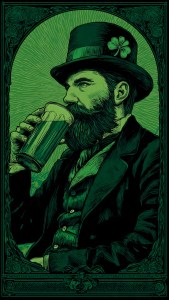
People celebrate St. Patrick’s Day by wearing green, displaying shamrocks and drinking green beer. The origins of St. Patrick’s Day celebrations and parades date back to almost the beginning of colonization.
St. Patrick (AD 385–461 ?)
The mysteries of the ages cloud much of what we know about St. Patrick. Historians even dispute the years of his birth and death. We do know that the Patron Saint of Ireland had humble beginnings in Great Britain. From his writings, we can conclude that in his early years he was not a Christian. When he was sixteen, Irish raiders captured him and carried him back to Ireland where they enslaved him. It was during these years of slavery that his conversion began. His masters used him as a shepherd and he used the hours spent watching the flocks praying and developing a relationship with God. For six years he lived as a slave. After a vision that promised him that he would soon be going home, he escaped. He managed to convince a ship’s captain to take him back home. After a period of hard travel, he returned home, now in his early twenties.
He continued to study the Bible and Christianity. After another vision, he returned to Ireland. He worked as a missionary, baptizing thousands of people during his time there. He converted many women, many of whom became nuns and managed to convert many king’s sons to the faith. He used the shamrock, a three leaved plant, to illustrate the concept of the Trinity. Thus, the shamrock has become a symbol of his and thus, his holiday. The sacredness of the shamrock predated Christian times. The pagans considered it a sacred plant. They also believed the number three was sacred. The rich green color of the shamrock represented rebirth and eternal life. Thus, the color green also became associated with celebrations of his day.
The First St. Patrick’s Day
The first recorded St. Patrick’s Day celebration in the colonies took place on March 17, 1637 in Boston. Apparently, it was a spontaneous affair. Members of the newly formed Charitable Irish Society of Boston held a meeting in a tavern. According to accounts, the meeting was on March 17, the day their countrymen in Ireland celebrated the holiday. They decided to celebrate and walked out in the street in a mass. They formed an impromptu parade as they encouraged everyone they met to join them.
Origins of the Holiday
The date of St. Patrick’s Day is on the legendary date of his death. However, he may not really have died on March 17, as many historians dispute this. This begs the question, why do the Irish celebrate the holiday on this date. The reason probably lies in the time of the year. Mid-March lies at a pivotal period of the calendar. The Irish saying, “February kills the sheep and March the people,” possibly explains it. It referred to the difficult weather that occurred during February and March. They had another saying about anyone in declining health “Would never go up the March hill.” Thus, anyone that made it through this difficult time had a reason to celebrate. Spring was now fast approaching and the grueling time was past. It could have been the day he died. Or the Irish might celebrate it for the other reasons. While pondering this question, go have a green beer.
The episode is based upon my book, Colonial American History Stories – 1215 – 1664, available on the web site, http://www.mossyfeetbooks.com. The book is the first book in the 6 volume Timeline of United States History Series . Discover some of the famous and almost forgotten historic stories of America. The story begins with the signing of the Magna Carta in 1215 and the beginnings of the concept of limited government and ends, for now, with the beginning of the American Revolution in 1775. The articles in the book have much more detail as well as articles not included in this podcast series.

 Mossy Feet Books - Author Paul R. Wonning