
Birthplace of Wilbur Wright and Museum
Today we will visit the birthplace of Wilbur Wright and the wonderful museum next to the restored Wright home.
From the Book
From the Book
East Central Indiana Day Trips
Transcript:
The third of seven children born to Milton Wright and Susan Catherine Koerner Wright, Wilbur was born near Millville, Indiana. The family would remain in Indiana until 1869, when Milton Wright, a Bishop in the United Brethren Church, moved to Dayton, Ohio. The Wrights would return to Indiana in 1881, where Wilbur and his younger brother Orville took up kite flying.
Before getting started, I would encourage you to subscribe to the Mossy Feet Books You Tube channel for more great content. If you like my videos, please hit the “Like,” button. The more likes I get the more You Tube will show it to other people, allowing me to grow the channel. I also entreat you to visit my website, http://www.mossyfeetbooks.com. There you will find sample chapters, podcasts, a slew of content and links to where you can buy my books. While visiting the web site you can subscribe to it and receive email notifications of when I publish a new book or other content, like this video and podcast. This episode is based on my book, East Central Indiana Day Trips . If you like what I am doing, please purchase a book, as it helps fund my work.
Milton Wright (November 17, 1828 April 3, 1917)
Milton, son of Dan and Catherine Reeder Wright, entered life on a farm in Rush County, Indiana. In 1840 the family moved to Fayette County, Indiana. At fifteen he had a religious conversion. After investigating several churches, Milton joined the United Brethern Church in 1847. His rise in the church was swift, to deacon in 1849. After purchasing a farm in Grant County, Indiana he rented it out after his appointment as Supervisor of the Preparatory Department at Hartsville College in Bartholamew County. He met his future wife, Susan Koerner, while in this position in 1853. Thus began a six year long courtship that ended with their marriage in 1859. During this long stretch, he had become ill and returned to his Grant County farm. He taught school for two years in Decatur County while he studied for the ministry. After graduating, the Church appointed him to be a circuit preacher, traveling from church to church. His circuit included Hartsville, where he kept company with Susan. The church then appointed him as a missionary to go to Oregon and he asked her to marry him. She said yes, when he returned to Indiana. He did return in 1859 and the two married on Thanksgiving Day. The couple had their first three children, Reuchlin, Lorin, and Wilbur in Indina.
Wilbur Wright (April 16, 1867 May 30, 1912)
His father Milton and mother Susan moved a lot while Wilbur was a child due to Milton’s job. When Wilbur was two the family moved from Indiana to Dayton, Ohio. Here, in 1871, Orville Wright was born. It was during thier stay at Dayton that Milton brought home a toy helicopter in 1878 that enthralled the two boys. This toy helicopter spurred the boys interest in their quest to fly. In 1881 the family moved to Richmond, Indiana where Wilbur attended high school. During this time the boys had tried to build flying helicopters from the model their father had given them. These did not fly well, so the brothers began building kites. Wilbur had accrued enough credits to graduate, but their sudden move back to Dayton prevented him receiving his diploma. He planned on going to college at Yale, but his mother became sick with tuberculosis and he stayed home to care for her.
Orville and Wilbur Wright were successful businessmen, printers by trade, in Dayton, Ohio. There they published the West Side News, which was edited by Wilbur. They followed this success by opening a bicycle shop in 1892. In this shop they began selling bicycles made by tools which they had invented. the bicycle shop provided them with a place to design and build gliders, which they began testing at Kitty Hawk, North Carolina in 1900. The location was a place called Kill Devil Hill, the first test flight coming in September of that year. Kitty Hawk was chosen because of the winds off the ocean.
They studied Lilienthal’s designs and decided to base their initial designs on his. Using a biplane box kite they designed in 1899, they tested their theories on aircraft control. The kite framework of this kite was hinged, allowing it to twist. It was controlled from the ground, using four lines, one tied to each corner of the frame. They learned to control the kite using this system, and could make it bank, dive and climb.
The following year they constructed a glider, using the kite as a guide. This glider had enough lifting capacity to lift a man, but they decided fly it like a kite at first, using the same ground control system they had devised for the kite. The brothers learned of Octave Chanute’s glider experiments on the shore of Lake Michigan near Miller Beach, Indiana. The Wrights revised their design on Chanute’s biplane glider he tested there as well as findings from a wind tunnel they constructed of their own design.. Their experiments with this craft led to the design, construction, and eventual success with the flight of the Wright Flyer at Kitty Hawk in 1903.
They continued constructing gliders for the next two years, the final tests coming in 1902. The design of the glider flown that year was the direct ancestor of the Wright Flyer airplane to be successfully flown the next year.
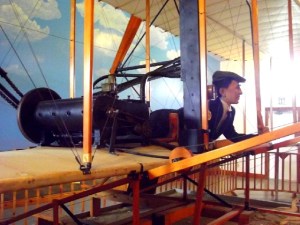
By 1903 Flyer I was ready and so were the Wright brothers. The Wright Flyer was of a design called a Canard. The pilot flew the airplane lying on his belly on the bottom wing, his head facing forward. The plane was steered by a cradle attached to the pilots hips. The cradle was attached to cables which warped the wings, steering the plane. On the first flights on December 17, 1903, no steering was attempted. The Wright Flyer only flew in straight lines that day. The Flyer weighed 750 pounds and used a twelve horsepower engine built specially for the airplane by Charlie Taylor, an employee. Mr Taylor built the engine in six weeks from scratch, working without a drawing.
The Wright Flyers first airplane flight was made by Orville. They had tossed a coin, won by Wilbur, three days earlier, had resulted in a crash which took three days to repair. So on December 17, 1903 the Wright Flyer stood on its 2 X 4 track, nicknamed the “Junction Railroad” by the Wrights, and after Orville spun the propellor and started the motor, Wilbur took off for the very first powered aircraft flight, which lasted twelve seconds and went 120 feet. The propeller, by the way, was also a Wright brother design.
There were three more flights that day, one of which had two very bumpy landings when the airplane bounced off the ground and finally settled. The last flight the Wright Flyer’s the front elevator supports were damaged.
The Wrights crated the Flyer up after the test flights that year and placed it in storage. It was damaged in a flood, and repaired by Orville in 1916 and placed on display. The airplane is still on public display, having been restored in 1985 to repair damage sustained by years of exposure.
For more information on the Wright Brothers, visit:
Wilbur Wright Birthplace & Museum
1525 N. 750 E.
Hagerstown, IN 47346
(765) 332-2495
wilbur@nltc.net
http://www.wwbirthplace.com/
The episode is based upon my book, East Central Indiana Day Trips , available on the web site, http://www.mossyfeetbooks.com. The book is the first book in the 9 volume Road Trip Indiana Series. The books include all the historical markers, as of 2022, in Indiana with the text and back story. The books also include a nearly complete listing of virtually every tourism destination in the state. The destinations include parks, museums, drive in theaters, bowling alleys, wineries and much, much more. I encourage you to visit the web site and subscribe to it.
You can find my books locally at the at the Romweber Marketplace in downtown Batesville, Indiana.
I hope you enjoyed this podcast and thank you for listening.

 Mossy Feet Books - Author Paul R. Wonning