
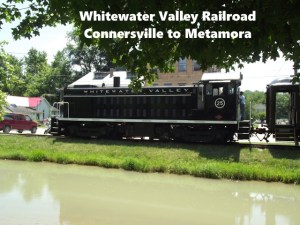
Whitewater Valley Railroad
Today we well take a ride on the Whitewater Valley Railroad. Rail fans and train enthusiasts will enjoy the history and scenery as the glide along on the rails of the Whitewater Valley Railroad. A Fayette and Franklin County road trip is a great way to take a dip in Indiana history and enjoy a visit to an historic canal town, Metamora.
From the Book
East Central Indiana Day Trips
Transcript:
Greetings, today we well take a ride on the Whitewater Valley Railroad.
Before getting started, I would encourage you to subscribe to the Mossy Feet Books You Tube channel for more great content. If you like my videos, please hit the “Like,” button. The more likes I get the more You Tube will show it to other people, allowing me to grow the channel. I also entreat you to visit my website, http://www.mossyfeetbooks.com. There you will find sample chapters, podcasts, a slew of content and links to where you can buy my books. While visiting the web site you can subscribe to it and receive email notifications of when I publish a new book or other content, like this video and podcast. This episode is based on my book, East Central Indiana Day Trips . If you like what I am doing, please purchase a book, as it helps fund my work.
Constructed as part of the Indiana Mammoth Internal Improvement Act of 1836 signed by Governor Noah Noble on January 27, 1836, the Whitewater Canal was to form an integral part of southeastern and eastern Indiana’s transportation system. The ambitious act, in concert with the Panic of 1837, bankrupted the state and brought a major political party to its knees.
The Whitewater Canal’s construction lasted from 1836 to 1847. During this time, there were many starts, pauses as the State of Indiana ran out of money, and the various private companies charged with completing also ran into financial difficulties. After completion, it connected Hagerstown, Indiana with Cincinnati, Ohio seventy-six miles to the south. The canal provided a quick, convenient way for farmers to transport their goods to market in the cities. Before the canal a farmer would need several days travel over deeply rutted roads to take his goods to Cincinnati. The canal proved a difficult construction project. It dropped 491 feet over the distance and needed fifty-six locks and seven dams. Several aqueducts to carry the canal over waterways also needed construction. Portions of the canal operated until 1862.
The demise of the Whitewater Canal planted the seeds for the Whitewater Valley Railroad in the mid 1850’s when floods washed out large portions of the canals. Franklin County residents petitioned the State of Indiana, asking that the state sell the canal towpath route to use as a railroad. In 1863 the Indianapolis and Cincinnati Railroad purchased the rights to the towpath and built a line from Brookville to Hagerstown, Indiana. Portions of the canal remained open and became useful as power sources for gristmills like the one at Metamora.
The First Whitewater Valley Railroad
The first Whitewater Valley Railroad was a subsidiary of the Indianapolis and Cincinnati Railroad. This subsidiary began construction of the rail line from Brookville, reaching Connersville in 1867. The line punched through to Hagerstown the next year. The Big Four, Cleveland, Cincinnati, Chicago & St. Louis, Railroad purchased the Indianapolis and Cincinnati Railroad in 1890. This line became the New York Central in later years. These lines operated both freight and passenger trains. The line discontinued passenger service in 1933. Freight service ground to a halt in the late 1970’s and early 1980’s.
The Second Whitewater Valley Railroad
Formed as a non-profit organization in 1972, the Whitewater Valley Railroad operates as a operating railroad museum. The all volunteer staff runs both historic diesel and steam engines on the eighteen mile line between Connersville and Metamora.
The train ride begins in Connersville at the train station located on Market Street. The train proceeds south along the Whitewater Canal, past 8 locks until it arrives in Laurel, Indiana. Here is the Laurel Feeder Dam which feeds water from the East Fork of the Whitewater River to the Whitewater Canal, which runs parallel to the train ride.
After passing 3 more locks, the train arrives at Metamora. The train has a 2 hour layover allowing passengers to explore the town.
General Anthony Wayne defeated a consortium of Amerindian tribes at the Battle of Fallen Timbers in northern Ohio. The Greenville Treaty signed in 1795 established new boundaries between the Amerindian tribes and the encroaching whites. The treaty opened up a large area for settlement in the future states of southern Ohio and southeastern Indiana. Settlers purchased a twelve mile wide strip of land parellel to the Greenville Treaty line in 1809 from the local Amerindian tribes. This strip became known as the Twelve mile purchase and included the area that includes the present town of Metamora.
Platted on March 20, 1838 by David Mount and William Holland, the town derives its name from a play written by American actor and playwright John Augustus Stone (1801 – 1834). His play, Metamora; or, The Last of the Wampanoags, first performed on December 15, 1829, in New York City. A local woman, Mrs. John Watson, chose the name. The play became successful and soon became popular throughout the United States. Surveyors had already determined the course of the Whitewater Canal and the enterprising men planned their town near the site of the canal. The original plat contained forty two lots, with the canal running directly down Main Street, an intentional location chosen by Mount and Holland. Two other local towns, Cedar Grove and Laurel, owe their existence to the Whitewater Canal.
David Mount February 3, 1778 – May 18, 1850)
The son of William Mount and Rebekah Cox, David was native to Pennington, New Jersey. He married Rhoda Hunt, with whom he would have two children. He is interred in Metamora Cemetery. Mount migrated to Franklin County in 1811, settling along the Whitewater River. Mount would serve as an associate judge, gain election to the state legislature and serve on the commission that drafted Indiana’s Constitution. He built a gristmill along the Whitewater River, near the site of the town he would found. The completed canal would deprive his mill of its water source. The mill fell into disuse and no longer exists.
Metamora Today
Metamora offers an eclectic mix of shopping, dining, lodging and history within the confines of a historic small town. Visitors will find a delightful mix of craft, artist and other types of shops lining its streets. Several bed and breakfasts, restaurants and cafes also make their home in Metamora. The scenic Whitewater Valley Railroad ends here, completing its journey down the scenic Whitewater River valley from Connersville. The State of Indiana operates the Whitewater Canal State Historic Site. An operating gristmill using the power of the Whitewater River grinds corn meal and offers it for sale.
The railroad runs on weekends from May through October. The gift shop and museum in Connersville is open seven days a week.
For more information about Metamora visit:
Metamora, Indiana Visitors Information
P.O. Box 117
Metamora, IN 47030
Whitewater Canal State Historic Site
19083 Clayborne St.
Metamora, In 47030, Usa
765-647-6512
For more information about train schedules, the history and other information, contact:
Whitewater Valley Railroad
455 Market St,
Connersville, IN 47331
(765) 825-2054
The episode is based upon my book, East Central Indiana Day Trips , available on the web site, http://www.mossyfeetbooks.com. The book is the first book in the 9 volume Road Trip Indiana Series. The books include all the historical markers, as of 2022, in Indiana with the text and back story. The books also include a nearly complete listing of virtually every tourism destination in the state. The destinations include parks, museums, drive in theaters, bowling alleys, wineries and much, much more. I encourage you to visit the web site and subscribe to it.
You can find my books locally at the at the Romweber Marketplace in downtown Batesville, Indiana.
I hope you enjoyed this podcast and thank you for listening.

 Mossy Feet Books - Author Paul R. Wonning