
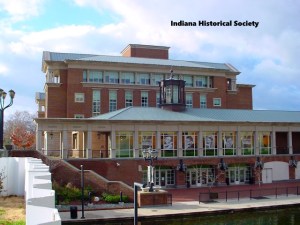
The Indiana Historical Society
Established on December 11, 1830, the Indiana Historical Society is the oldest state historical society west of the Allegheny Mountain and one of the oldest in the United States. The principal founder of the Society was a man named John Hay Farnham.
A native of Massachusetts, Farnham migrated to Jeffersonville, Indiana in 1819. He became one of the state’s most prominent men and led the establishment of the Indiana Historical Society on December 11, 1830. The society elected War of 1812 hero Benjamin Parke as the Organization’s first President.
The Society moved into its current home in 1999 where it showcases the wealth of Indiana’s history.
From the Book
East Central Indiana Day Trips
Transcript:
Greetings, today I will talk about the Indiana Historical Society.
Established on December 11, 1830, the Indiana Historical Society is the oldest state historical society west of the Allegheny Mountain and one of the oldest in the United States. The principal founder of the Society was a man named John Hay Farnham.
John Hay Farnham (July 22, 1779 – July 11, 1833)
The son of William Farnham, his mother’s name unknown, was native to Newberryport, Massachusetts. Farnham attended Yale University, working his way through school. He had suffered some type of injury early life that left him partly disabled. In 1818 he migrated to Frankfort, Kentucky where he was the editor of a newspaper. In 1819 he moved to Jeffersonville, Indiana. Somewhere along the way he attained a law degree, as he opened a law office there in 1820. At this time he was associated with the American Antiquarian Society Worcester, Massachusetts. He authored a description of Mammoth Cave for the society. He spent his winters in Corydon, which was the state capitol at this time. In Corydon he wrote speeches for members of the assembly and helped draft legislation. He and Evelyn Marie Leonard married in 1821. The couple would have 5 children, only two of which would live to adulthood. Between 1822 and 1833 he served as the clerk of the Indiana Senate. He also maintained a successful law office and became quite wealthy. Sometime around 1824 he moved his family to Salem, Indiana. Farnham apparently was opinionated, tactless and a very hard worker. The people of Salem apparently felt he was a person of some important, but he was widely disliked. Asked to give the Independence Day speech on July 4, 1826, he gave a speech that advocated for the citizens to establish free public schools, which was stipulated in the 1816 Constitution. The speech deeply offended the citizens of the town, who ostracized him and his family for a long time. He also advocated for education of women, alcohol temperance laws and humane treatment of the poor. All of these views were counter to those of most Hoosiers of the time. In 1830 he led the group of influential Hoosiers in organizing the Indiana Historical Society on December , 1830. He and most of his family died in a cholera epidemic in 1833 in Salem. His body is buried at Crown Hill Cemetery in Indianapolis, Indiana.
Benjamin Parke was elected as the first president of the society.
Benjamin Parke (September 2, 1777 – July 12, 1835)
The son of Benjamin and Anne Larison Park, Benjamin was native to New Jersey. Parke’s education was scanty as a child. At twenty years old, he moved to Lexington, Kentucky where he studied law with local attorney James Brown. Two years later, in 1799, he moved to Vincennes, Indiana. A supporter of Indiana Territorial Governor William Henry Harrison, he received an appointment as Attorney General of the Indiana Territory, a post he held from 1804 through 1808.
Delegate to Congress
The Indidna Territory, after entering Stage 2, was entitled to seat one non-voting member to the United States House of Representatives. On December 12 the legislature elected Benjamin Parke to serve as its first congressional delegate. He held this seat until 1808.
This coincided with his service as Territorial Delegate to Congress from 1805 to 1808. Parke commanded an Indiana Light Dragoons at the 1811 Battle of Tippecanoe. Harrison included him on his staff during the War of 1812. During his service, he rose to the rank of colonel. After the war, he attended the state constitutional convention in 1816 as a representative of Knox County. After statehood, Parke represented the United States at the Treaty of St. Mary’s in 1818. He also served as the first president of the Indiana Historical Society when it formed on December 11, 1830. President James Monroe appointed him to the United States District Court for the District of Indiana. He held that position until his death in 1835.
The board of the society included many influential men of Indiana. The list includes a Supreme Court Justice, governors and wealthy businessmen. After Farnhams death the Society almost fell apart, however Farnham had bequeathed the Society many valuable books, housed in a large bookcase.
After becoming dormant during the difficult financial times of the mid 1830’s, the Society survived to become the showcase of Indiana history it is today. Until 1999 the Society had maintained its headquarters in the Indiana State Library and Historical Building. During that year the Society moved to its current location along the Canal in downtown Indianapolis. The headquarters is called the Eugene and Marilyn Glick History Center.
Eugene and Marilyn Glick
Eugene Glick (August 29, 1921 – October 2, 2013) made his fortune as the founder of the Gene B. Glick Company. The company was a multifamily housing development and property management company. Glick established the company in 1947. The company grew to a multi-state concern. Glick became a major philanthropist in the city. He donated significant funds for numerous organizations in the city. His $8,000,000 donation towards the construction of the Society’s headquarters is reflected in the name of the building.
Eugene and Marilyn Glick Indiana History Center
The Indiana Historical Society maintains changing exhibits throughout the year. These temporary exhibitions reflect the rich culture of the Hoosier State by showing photos, music, and other materials of Indiana history. In addition to the current exhibits, you may visit the William Henry Smith Memorial Library, the Basile History Market Gift Shop, Eli Lily Hall and the Cole Porter room. No admission is charged to visit the Indiana History Center.
The William Henry Smith Memorial Library has the largest collection of archival material about Indiana and the Old Northwest Territory. The library includes 1.6 million photographs (25,000 digital), 14,000 pieces of sheet music, 3300 artifacts, and 5,000 manuscript collections.
The Indiana Historical Society makes educational materials and programs available for teachers, students, and genealogy. IHS also has small collections of materials available for use as traveling exhibits. Local historical societies, libraries, schools, and government agencies may borrow these exhibitions.
At the Indiana History Center are classrooms, a 290-seat theatre, an outdoor plaza, a boardroom, conference room, the Eli Lily Hall and the Stardust Terrace available for rental for use. The Eugene and Marilyn Glick Indiana History Center is also on site. During the Christmas Season the center holds an event called the Festival of Trees in which dozens of decorated Christmas trees are on display. An Annual Author’s fair featuring authors with books about Indiana takes place during the event.
Eugene and Marilyn Glick Indiana History Center
450 W. Ohio St.
Indianapolis, IN 46202
https://indianahistory.org/
The episode is based upon my book, Central Indiana Day Trips , available on the web site, http://www.mossyfeetbooks.com. The book is the fifth book in the 9 volume Road Trip Indiana Series. The books include all the historical markers, as of 2022, in Indiana with the text and back story. The books also include a nearly complete listing of virtually every tourism destination in the state. The destinations include parks, museums, drive in theaters, bowling alleys, wineries and much, much more. I encourage you to visit the web site and subscribe to it. If you like what I am doing, please purchase a book, as it helps fund my work.
You can find my books locally at the at the Romweber Marketplace in downtown Batesville, Indiana.
I hope you enjoyed this podcast and thank you for listening.

 Mossy Feet Books - Author Paul R. Wonning