
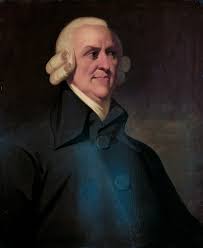
Adam Smith Publishes the Wealth of Nations
Adam Smith’s publication of the Wealth of Nations highlights the events for this week.
Adam Smith completed seventeen years of note taking and ten years of writing by publishing The Wealth of Nations on March 9, 1776. Regarded as the leading book on economics even today, The Wealth of Nations helped establish the free enterprise system.
Other events include
Richard Henderson began laying the foundation of Kentucky when he began organizing the Transylvania Colony on the same day.
On March 10 General Howe issued a proclamation that British soldiers in Boston confiscate anything that could be of use by the Colonials.
On March 12 the French King Louis XVI approved an alliance with the American colonies that would provide secret aid to the rebels.
Listen to the full video to learn all of the details of these events as well as several others that happened during this busy week at this link:
This an excerpt from my book, 1776.
I am still writing this book, which I hope to release in April or May of this year. It will be part of the
Timeline of United States History Series
Meanwhile, you can enjoy the book 1775, which is available on the website, http://www.mossyfeetbooks.com. Just click the “Timeline of United States History” on the lower left-hand side of the home page.
A box set that includes all six volumes of the series is available at that link at an economical price.
Transcript:
Greetings, today I will talk about the events of March 8 – 14
Adam Smith completed seventeen years of note taking and ten years of writing by publishing The Wealth of Nations on March 9, 1776. Regarded as the leading book on economics even today, The Wealth of Nations helped establish the free enterprise system.
This is an excerpt from my book, 1776.
I am still writing this book, which I hope to release in April or May of this year. It will be part of the
Timeline of United States History Series
Meanwhile, you can enjoy the book 1775, which is available on the website, http://www.mossyfeetbooks.com. Just click the “Timeline of United States History” on the lower left-hand side of the home page.
A box set that includes all six volumes of the series is available at that link at an economical price.
Adam Smith (June 16, 1723 – July 17, 1790)
The son of Adam Smith and Margaret Douglas Smith was a native of Kirkcaldy, Scotland. Two months after his birth, his father died leaving the widow to raise her son alone. Historians know little about his early life, other than that he attended the Burgh School of Kirkcaldy and then, at fourteen, the University of Glasgow. In 1740 he attended Balliol College, Oxford. In 1748 he began delivering public lectures and in 1751 he earned a professorship at Glasgow University. He became a popular teacher and by 1763 Charles Townsend offered him a post to tutor his stepson Henry Scott, the young Duke of Buccleuch. He took the post and spent several years traveling with the boy around Europe. During these travels Smith met many of the leading European philosophers of his time. His acquaintances included Benjamin Franklin.
Writing the Wealth of Nations
For his services the duke bequeathed Smith a lifetime pension. His financial security assured, Smith retired to his hometown, Kirkcaldy, to write, in 1766. His work of ten years culminated in the book Inquiry into the Nature and Causes of the Wealth of Nations on March 9, 1776.
The Wealth of Nations
Smith achieved two things with his book. One was an examination of economic science. The other thing he accomplished was a policy guide for nations wishing to attain prosperity. He developed the theory that economic prosperity was achieved best under a system of free competition between people. His ideas included the topics of division of labor, productivity, and free markets. Most economists still consider it the classic book on economic theory.
Many other important events occurred during the week of Mark 8 through the 14.
Ordered by the New York Provincial Congress to render the Sandy Hook Lighthouse useless, Major William Malcolm attacked the lighthouse and dismantled it.
General Washington attempted to place a battery of cannons on Nook’s Hill. British General Howe detected the operation and ordered his men to cannonade the colonials on March 9, preventing the colonials from installing the cannon.
With Washington’s cannons poised on the hills above the city and the British troops occupying it, the leaders of the city feared that any ensuing battle would destroy it. They contacted British General Howe on March 8, who assured them he was going to abandon the city. The officials then contacted Washington and informed him that the British were leaving, sparing the city a devastating battle.
Richard Henderson began laying the foundation of Kentucky when he began organizing the Transylvania Colony on the same day.
On March 10 General Howe issued a proclamation that British soldiers in Boston confiscate anything that could be of use by the Colonials.
In a skirmish on March 11 a skirmish in Georgia on Hutchinson’s Island colonial troops attacked a company of British soldiers, who scattered. The Colonials captured two cannons.
On March 12 the French King Louis XVI approved an alliance with the American colonies that would provide secret aid to the rebels.
The same day General Henry Clinton arrived off Cape Fear, North Carolina with his flotilla in to mount an invasion of the colony.
In other events on the 12th the Continental Congress authorized the formation of a Commander-in-Chief’s Guard. This 180-man guard was composed of men from each of the 13 colonies.
On March 13 General Washington issued orders to prevent his soldiers from pillaging Boston after the took possession of the city.
March 14, 1776 – Alexander Hamilton Appointed Captain of Provincial Company
On March 14 Mohawk Chief Joseph Brandt spoke before George Germaine, 1st Viscount Sackville with an appeal for the British government to give them compensation for lands taken from them by the American colonists prior to the conflict.
On March 14 Anticipating that General Howe would sail for New York when he abandoned Boston, Congress resolved to send 8,000 soldiers to New York to defend the city against attack.
I would encourage you to visit and subscribe to the Mossy Feet Books You Tube channel for more great content. If you like my videos, please hit the “Like,” button. The more likes I get the more You Tube will show it to other people, allowing me to grow the channel. I also invite you to visit my website, http://www.mossyfeetbooks.com. There you will find sample chapters, podcasts, a slew of content and links to where you can buy my books. While visiting the web site you can subscribe to it and receive email notifications of when I publish a new book or other content, like this video and podcast. If you like what I am doing, please purchase a book, as it helps fund my work.
You can find my books locally at the at the Romweber Marketplace in downtown Batesville, Indiana.
I hope you enjoyed this podcast and thank you for listening.

 Mossy Feet Books - Author Paul R. Wonning