First Continental Congress assembles in Philadelphia
Today I will talk about the First Continental Congress and its first meeting in September 1774.
From the Book
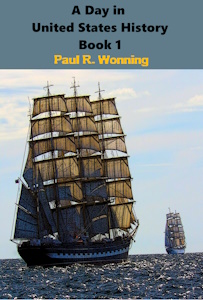
A Day in United States History – Book 1
September 05, 1774 – First Continental Congress assembles in Philadelphia
Transcript:
Greetings, today I will talk about the First Continental Congress and its first meeting in September 1774.
Before getting started, I would encourage you to subscribe to the Mossy Feet Books You Tube channel for more great content. If you like my videos, please hit the “Like,” button. The more likes I get the more You Tube will show it to other people, allowing me to grow the channel. I I also entreat you to visit my website, http://www.mossyfeetbooks.com. There you will find sample chapters, podcasts, a slew of content and links to where you can buy my books. While visiting the web site you can subscribe to it and receive email notifications of when I publish a new book or other content, like this video and podcast. This episode is based on my book, A Day in United States History – Book 1. If you like what I am doing, please purchase a book, as it helps fund my work.
The crises with England had grown after Parliament passed the so-called Intolerable Acts. In an attempt to provide a united response to Parliament and get the Acts repealed, delegates from twelve of the thirteen colonies on the Atlantic seaboard assembled in Philadelphia at Carpenter’s Hall. The last inter-colonial meeting had been the Stamp Act Congress of 1765. Organized by the colonial letter writing network known as Committees of Correspondence, the delegates me in early September 1774.
Committees of Correspondence
These Committees formed a sort of shadow government among the colonists. They shared plans and coordinated responses to Britain. Around 8000 colonists participated in these committees during the period from 1764 through 1775. Colonial assemblies eventually superseded and replaced them during the Revolution. The Committees oversaw the first elections for the assemblies and other functions. These committees were instrumental in the dissemination of ideas and news. They organized boycotts of British goods and toppled the British colonial system.
Intolerable Acts
The term Intolerable Acts refers to five acts passed by Parliament during 1774. These Acts punished the colonies for their intransient behavior since the first of the taxes levied in 1765. Tensions had increased between the Colonies and the British during the nine-year period after the French and Indian War. These tensions came to a disastrous head during the years of 1774 and 1775. The colonists referred to these five acts as the Intolerable Acts, the British the Coercive acts. They included the Boston Port Act, the Massachusetts Government Act, the Administration of Justice Act, the Quartering Act and the Quebec Act.
Stamp Act Congress
Delegates from nine of the thirteen colonies that would eventually form into a nation met in New York to protest the Stamp Act passed by Parliament. The Congress met from October 7 through 25, 1765. The delegates met in Federal Hall. During the proceedings, the delegates passed a Declaration of Rights and Grievances. In this document, the representatives declared that, because none of the colonies had representation in Parliament, that body had no right to pass laws taxing the colonists.
Choosing the Delegates to the First Continental Congress
Choosing the delegates to a meeting that was essentially illegal had been a tricky business. The governors of two of the colonies, Massachusetts and Virginia, had dissolved the assembly. Both assemblies met in secret and chose delegates to send to Philadelphia. The assemblies in Rhode Island and Pennsylvania had also chosen the delegates. The delegates from New York had been elected in a special election. Charleston, South Carolina had chosen its delegates at an open meeting. The assemblies of most of the other colonies had called special conventions to choose the delegates. Most, if not all, of these various meetings, conventions and elections were illegal under British law.
Carpenter’s Hall
Built by the Carpenters’ Company of the City and County of Philadelphia, the building served as a meeting place for the carpenter’s guild, construction of the Hall began in 1770. The structure hosted many meetings for other organizations and events over the years. Visitors may still stage events or visit the building to enjoy its rich history.
Carpenter’s Hall
320 Chestnut Street
Philadelphia, PA 19106
Assembling the First Continental Congress
Fifty-six delegates traveled to Philadelphia in the late summer of 1774 to meet in Carpenter’s Hall in Philadelphia. Only Georgia, who had demurred so as not to incur the wrath of a British government when it needed help with a native problem, did not attend. As the delegates convened on September 5, 1774, a common question among the delegates had to be, “Where do we go from here?”
Written in a “this day in history,” format, each of the two books in this collection of North American colonial history events includes 366 history stories. The historical collection of tales includes many well-known as well as some little-known events in the saga of the United States. The easy to follow “this day in history,” format covers a wide range of the people, places and events of early American history. I is the first book in my series, 366 Days in History Series. Each book includes 366 stories of American history. It is availble, with many of my other titles on gardening, Indiana places and history and United States History, at the Romweber Marketplace in downtown Batesville, Indiana.
I hope you enjoyed this podcast and thank you for listening

 Mossy Feet Books - Author Paul R. Wonning