Beginning of the Boston Impressments – Sparked the Knowles Riots
Today I will talk about the British practice of impressments in Boston that led to a series of riots.
From the Book
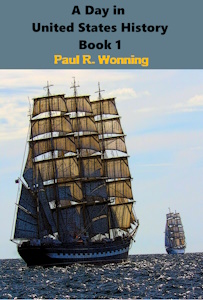
A Day in United States History – Book 1
Transcript:
November 16, 1747 – Beginning of the Boston Impressments – Sparked the Knowles Riots
Greetings, today I will talk about the British practice of impressments in Boston that led to a series of riots.
Before getting started, I would encourage you to subscribe to the Mossy Feet Books You Tube channel for more great content. If you like my videos, please hit the “Like,” button. The more likes I get the more You Tube will show it to other people, allowing me to grow the channel. I I also entreat you to visit my website, http://www.mossyfeetbooks.com. There you will find sample chapters, podcasts, a slew of content and links to where you can buy my books. While visiting the web site you can subscribe to it and receive email notifications of when I publish a new book or other content, like this video and podcast. This episode is based on my book, A Day in United States History – Book 1. If you like what I am doing, please purchase a book, as it helps fund my work.
Commodore Charles Knowles anchored his ship, the HMS Cornwall, in Boston Harbor in mid-November 1747 to retrofit and re-supply it. British seamen worked under harsh discipline, thus many of the crew deserted while the ship lay at anchor. When the ship prepared to depart, the ship was short of crew, so Commodore Knowles sought to replenish his crew by impressing Bostonians into naval service.
Commodore Charles Knowles (c.1704 – 9 December 1777)
His parentage is uncertain, rumored to be the illegitimate son of Charles Knollys, the fourth Earl of Banbury. He entered the Royal Navy in 1718 and rose through the ranks to become Commodore. His commands included the HMS Diamond, HMS Success, HMS Litchfield, HMS Weymouth and HMS Suffolk. The battles he participated in were the Battle of Cape Passaro, Battle of Cartagena de Indias, Battle of La Guaira, Battle of Puerto Cabello, Battle of Havana. He served as the Governor of Louisbourg after the British took that port during King George’s War. It was his massive impressments at Boston that triggered the riots. These were the most serious disturbances against the British Crown in pre-revolutionary America.
Impressments
British impressments of random citizens were a common practice in the Eighteenth Century. Royal Navy sea captains would send impressment gangs along the piers and into the town, kidnapping men off the streets and pubs. They would carry these impressed men back to the ship and force them into naval service. Knowles was notorious for the large numbers of men he would impress. Knowles began impressing the usual lot of tradesmen, laborers and seamen in the town.
The Riots Begin
On the morning of November 17, the Boston citizenry had had enough. A crowd of around 300 citizens gathered and captured one of Knowles’ officers. The Boston sheriff managed to free him, but the mob then turned on the sheriff. They captured him and some other officials. Governor William Shirley arrived and managed to free the hostages, but the mob, which was growing, chased Shirley into his house. The crowd had now swelled to thousands. They threw bricks, breaking windows and beat one of their hostages in front of the governor’s house. They then put him in the stocks. Shirley called up the militia as the crises worsened. Many in the mob were armed and some of Shirley’s guards prepared to fire on the mob. One of Shirley’s companions managed to stop what could have been an early version of the Boston Massacre. To add to Shirley’s predicament, Commodore Knowles threatened to shell the town. He loaded the cannon on the Cornwall and waited. The militia Shirley had ordered up refused to appear. Shirley was on the verge of calamity.
Resolving the Crises
Shirley managed to persuade the crowd to calm down. He also soothed Knowles with a series of letters. The crises averted when Knowles agreed to release the men he had impressed and the mob agreed to release their hostages. After the exchange, Knowles sailed off, no doubt to impress the men he needed for his ship at some other hapless port.
Written in a “this day in history,” format, each of the two books in this collection of North American colonial history events includes 366 history stories. The historical collection of tales includes many well-known as well as some little-known events in the saga of the United States. The easy to follow “this day in history,” format covers a wide range of the people, places and events of early American history. I is the first book in my series, 366 Days in History Series. Each book includes 366 stories of American history. It is availble, with many of my other titles on gardening, Indiana places and history and United States History, at the Romweber Marketplace in downtown Batesville, Indiana.
I hope you enjoyed this podcast and thank you for listening

 Mossy Feet Books - Author Paul R. Wonning