
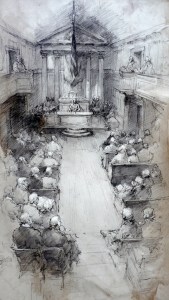
Congress Invites Canadians to Join the Struggle
The members of the Continental Congress received a messenger on February 14, 1776, who had traveled from Quebec to inform the members that Canadians had at first been sympathetic to their cause. However, a propaganda campaign by Anglican church and government officials had lessened this support. The messenger felt that a delegation of members to Canada would change their minds. On February 14, 1776, the Continental Congress appointed a committee of three men to travel to Canada and try to enlist Canadians in their cause as the 14th Colony. The three men were Benjamin Franklin, Samuel Chase and Charles Carroll.
This story will be included in the author’s book, 1776
The book 1776, still in process, will be part of the
Timeline of United States History Series
The book 1776, still in process, will be part of the
Timeline of United States History Series
Colonial American History Stories – 1215 – 1664
Colonial American History Stories – 1215 – 1664
Colonial American History Stories – 1753 – 1763
Colonial American History Stories – 1763 – 1769
Colonial American History Stories – 1770 – 1774
An American Revolution Time Line – 1775
Transcript:
Greetings, today I will talk about Congress’ attempts to bring Canada into the struggle.
One of Congress’ main goals of launching the Canada invasion in June 1775 was to bring the Canadians into their cause as the 14th colony. This effort had failed, but their efforts continued. On February 14 a messenger arrived from Canada, authorized by General Wooster, to carry a message to the members of Congress. The Committee of Correspondence conferred with the man on February 14 and relayed their report on the meeting.
The man related that in the beginning of the conflict between the American colonies and the British the people of Canada generally sided with the Americans. The Clergy and the Nobles in Canada had worked in unison to try to change that sentiment by continually speaking against the American cause. Since most Canadians could not read, they depended upon those in charge to read newspapers and dispatches to them, which they continuously slanted in favor of the British. The clergy and British officials said that the Americans wanted to suppress their religion and enslave them. The continued onslaught of information from the nobles and clergy had put the general populace into a state of confusion, and they did not know who to believe. The messenger said that the letters the Congress had dispatched had had little influence, due to the influence of the British and the clergy. He entreated Congress to send a delegation to Canada to explain the situation to the populace and possibly swing the Canadians into the American cause.
The man, who had left Quebec on January 20, also related that Quebec was still under siege and that the population was in a sorry state. There was little meat, flour or fuel for fire. They had plenty of corn, but no means to grind it so had to boil it to make it fit to eat. On his way to Philadelphia he had met several companies of men headed to Canada to reinforce the American troops besieging Quebec.
After hearing the report, the Congress resolved to take the matter up the following day, and adjourned for the day.
The report of the messenger from Canada the previous day had enlightened the members of the Continental Congress about the state of affairs there. After discussing the man’s report, Congress appointed three men to a committee to travel to Canada to try to persuade the Canadians to join the rebellion. The members of the committee were Benjamin Franklin, Samuel Chase and Charles Carroll. Charles Carroll (September 19, 1737 – November 14, 1832)
The son of Charles Carroll and Elizabeth Brooke, Charles was a native of Annapolis, Maryland. His parents were not married at the time of his birth due to legal issues over their respective estates. The couple would marry in 1757 when Charles was twenty. At age eleven his parents sent him to France for his education. He returned to Annapolis in 1755. Since the family was Catholic, Maryland laws prevented his entry into politics. He became a successful farmer, becoming one of the richest men in Maryland and the Colonies. An early supporter of American independence, he was active in pre-revolutionary activities. He gained election to the Continental Congress on July 4, 1776. he arrived in Philadelphia after the vote on the Declaration of Independence, but he was in time to sign the first official document. He would become the last surviving signer of the Document after Thomas Jefferson and John Adams died the same day, July 4, 1826. Carroll remained a delegate at the Continental Congress until 1778. he would gain election to the Maryland State Senate in 1781. The Senators elected him as Maryland’s first Senator after the passage of the United States Constitution. Carroll retired from public life in 1801 and died in Baltimore on November 14, 1832.
Samuel Chase (April 17, 1741 – June 19, 1811)
The son of Reverend Thomas and Matilda Walker Chase, Samuel was native to Princess Anne, Maryland. Chase received his education from a private tutor at home, after which he migrated to Annapolis, Maryland to study law. He gained admittance to the Maryland bar in 1761. He opened a law practice in Annapolis. The next year he married Ann Baldwin, with whom he had seven children. Only four of these children lived to adulthood. Marylanders elected him to the General Assembly of Maryland in 1764, where he would serve until 1784. In 1774 the General Assembly elected him to attend the Continental Congress in 1774.
Ben Franklin (January 17, 1706 – April 17, 1790)
The son of soap and candle maker, Josiah Franklin and his second wife Abiah Folger, Benjamin entered life on Milk Street in Boston, Massachusetts. He was the tenth of seventeen children born to Josiah and one of ten borne by Abiah.
Early Education
Josiah had wanted Benjamin to become a minister. He sent the boy to Boston Latin School, but Josiah’s limited funds for education ran out and he had to withdraw Benjamin after only one year. He could afford only one more year with a private teacher, but at age ten Benjamin’s formal schooling ended. The boy had a voracious appetite for books, so he continued his education by reading when not helping his father in his candle and soap making business. During these years, Benjamin began reading a weekly British periodical called The Spectator. He used the magazine as a means of improving his writing skills, something he greatly desired. He read and re-read each issue many times, even copying the articles to impress upon himself the writing skills the writers employed.
Apprenticed as a Printer
Benjamin’s brother James began publishing a newspaper, the New-England Courant, in 1721. James apprenticed the fifteen-year-old Benjamin in the print shop, setting type. During the time he served as apprentice, Benjamin learned the printing trade. By combining his well toned writing skills and printing, Benjamin later forged the printing and publishing businesses that would enrich him and set the stage for his later achievements.
Franklin – American Sage
Franklin went on to a career that included scientist, writer, printer and politician. In the process, he became an American legend and the most beloved of the founding fathers of the United States.
Another event of the week included the appointment of David Matthews as mayor of New York by exiled Royal Governor Thomas Tryon who had taken refuge on the on the HMS Halifax anchored in the harbor.
I would encourage you to visit and subscribe to the Mossy Feet Books You Tube channel for more great content. If you like my videos, please hit the “Like,” button. The more likes I get the more You Tube will show it to other people, allowing me to grow the channel. I also entreat you to visit my website, http://www.mossyfeetbooks.com. There you will find sample chapters, podcasts, a slew of content and links to where you can buy my books. While visiting the web site you can subscribe to it and receive email notifications of when I publish a new book or other content, like this video and podcast. If you like what I am doing, please purchase a book, as it helps fund my work.
You can find my books locally at the at the Romweber Marketplace in downtown Batesville, Indiana.
I hope you enjoyed this podcast and thank you for listening.
February 15, 1776 – David Matthews Appointed Mayor of New York
Exiled Royal Governor Thomas Tryon appointed David Matthews as mayor of New York, the last colonial mayor to serve as mayor of the city. The New York Provincial Assembly granted Matthews unrestricted access to Governor William Tryon, who was living in the HMS Dutchess of Gordon, anchored offshore in New York Harbor. Shortly after this Matthews and Tryon begin plotting to subvert Continental soldiers to convert to the British cause, recruit an army to help the coming invasion of New York and to kill or kidnap General George Washington and upper-level Continental Officers.
David Matthews (c. 1739 – July 28, 1800)
The son of Vincent and Catalina Abeel Mathews, David was native to New York. He attended the College of New Jersey, now Princeton University, graduating with a Master of Arts in 1754. he and Sarah Seymour married on November 6, 1758. He gained his law license in 1760 and received appointment from Governor Tryon in 1776.
William Tryon (June 8, 1729 – January 27, 1788)
The son of the son of Charles Tryon and Lady Mary Shirley, William was native to Norbury Park, Surrey, England. Tryon received a commission as a lieutenant of the First Regiment of Foot Guards in 1751 when he entered the army. The same year he gained promotion to captain and fathered a child with his mistress, Mary Stanton. He married Margaret Wake, in 1757, with whom he had one daughter. Tryon saw action during the Seven Years War (French and Indian) at the British Raid on Cherbourg. During the ensuing September 11, 1758 Battle of Battle of St Cast, Tryon received wounds to his thigh and head.
North Carolina Governor
Tryon had connections at court through both his wife and mother. These paid off when, in 1764, he received appointment as lieutenant governor of North Carolina. His role was to serve in that capacity until the current governor, Arthur Dobbs, could resign and return to England. Dobbs, his health poor, had requested replacement. Tryon sold his home in England, resigned his military commission and sailed for North Carolina with his wife and daughter. They arrived on October 10, 1764, however he would not assume office until March 28, 1765, when Dobbs died.
Stamp Act
After Parliament passed the Stamp Act in March 1766, Tryon opposed it because he believed it would drain the colony’s finances, however he tried to collect it. He did offer to pay the tax personally for some of the larger establishments. He had three ships confiscated in Cape Fear because they did not have papers that indicated they had paid the tax. An incensed mob of about 500-armed men surrounded his house and forced him to release the ships. Because of the dissent, he dispatched a message to London requesting more troops to force compliance, however the return message informed him that Parliament had repealed the tax.
War of Regulators
Tryon wanted to move the colony’s capital from Wilmington, on the southeastern tip of North Carolina, to the more centralized town of New Bern. He proposed to build a grand home in the new town that would also serve as the colony’s capital. The exorbitant cost of the home, dubbed “Tryon Palace,” by outraged locals, caused Tryon to raise taxes on the populace. The tax resulted in the War of Regulators that lasted from 1768 through 1771. Tryon’s governorship of North Carolina ended on June 30, 1771.
Governor of New York
Tryon had received appointment as governor of New York. He sailed from North Carolina to New York, arriving on July 8, 1771. The dissension that gripped New York over the passage of the Tea Act caused Tryon to depart for London for consultation with royal officials. He returned on June 25, 1775, to find the colony in full rebellion and the new commander of the Continental Army visiting the city on his way to take command of the Continental Army in Massachusetts.
October 19, 1775 – Governor Tryon Takes Refuge on the HMS Halifax
In the early days of October 1775 General Washington and General John Schuyler carried on a debate over whether Washington should order patriot officials to seize British Royal Governor William Tryon. Washington favored capturing him but was hesitant because Tryon was an official high in British administration and his seizure “quite a new Thing and of exceeding great Importance.” Washington consulted the Continental Congress over the matter. Tryon quite possibly heard of Washington’s quandary and, to escape capture, took refuge on a British sloop anchored in New York Harbor, the HMS Halifax. Tryon remained on the Halifax until he transferred his quarters to the HMS Duchess of Gordon. He remained on the Gordon until September 1776.

 Mossy Feet Books - Author Paul R. Wonning