
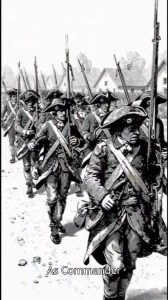
Today the author talks about some of the events of the week of February 22 – 28 1776. This was a busy week in the early history of our nation. The largest event was the first thing he will talk about, the Battle of Moore’s Creek in North Carolina. This an excerpt from my book, 1776.
Other events include the arrival of the favorable report by French Foreign Minister Julien Achard de Bonvouloir’s Report Reaches France.
The Continental Congress created the Southern Department on February 27, 1776.
The British House of Commons approved the treaty that authorized the use of German troops against the Americans.
Also, on February 29 the British began naval actions against Savannah.
To see the entire video, visit and subscribe to the Mossy Feet Books You Tube Channel.
Colonial American History Stories – 1215 – 1664
Colonial American History Stories – 1215 – 1664
Colonial American History Stories – 1753 – 1763
Colonial American History Stories – 1763 – 1769
Colonial American History Stories – 1770 – 1774
An American Revolution Timeline – 1775
Timeline of United States History
Transcript:
Greetings, today I will talk about some of the events of the week of February 22 – 28 1776. This was a busy week in the early history of our nation. The largest event was the first thing I will talk about, the Battle of Moore’s Creek in North Carolina. This an excerpt from my book, 1776.
I am still writing this book, which I hope to release in April or May of this year. It will be part of the
Timeline of United States History Series
Meanwhile, you can enjoy the book 1775, which is available on the website, http://www.mossyfeetbooks.com. Just click the “Timeline of United States History” on the lower left-hand side of the home page.
A box set that includes all six volumes of the series is available at that link at an economical price.
During the early morning hours of February 27, 1776, Patriot forces serving under Colonel James Moore of the Continental Army and militia leaders Alexander Lillington and Richard Caswell clashed with Loyalist forces led by Brigadier General Donald MacDonald. The short battle occurred at Moore’s Creek Bridge near Currie, North Carolina. The Patriot forces defeated the Loyalist forces after a short battle, scattering them and ending any British threat to North Carolina until late in the war.
Royal Forces in Motion
The Battles of Lexington and Concord on April 19, 1775 set off a series of recruitment efforts by both Loyalists and Patriots throughout the Colonies as both sides jockeyed for position. British Royal Governor Josiah Martin received word that a force of 2000 British Regulars led by General Henry Clinton would arrive in North Carolina in Mid February. He ordered Loyalist militia to muster and requested permission from the Crown to raise 1000 men. The Crown refused the request, but Martin continued his efforts. He worked Loyalist Scots which had served in the British Army during the French and Indian War and a group of people called the Regulators that were loyal to the Crown. Martin hoped to raise 6000 men from these two groups. The leaders of the Scots and Regulators met at Cross Creek on at Cross Creek on February 5. Disagreements about how to proceed arose immediately over when to move and how many men they expected to raise. The Scots wanted to wait until the arrival of British troops while the Regulators favored immediate action.
The Regulators won the argument, thinking they could raise 5000 men. The Scots thought 500 to 600 was more realistic. They agreed to muster on February 15, 1776. There were approximately 3500 men when they mustered. Many of these men believed that British troops would meet them and when the British failed to materialize, many of these men deserted. On February 18 the force, led by Brigadier General Donald MacDonald, moved out with around 1500 men. More men deserted during the march, further reducing the small army.
Patriots on the Move
The Patriots had also been active. During the fall of 1775 the provincial congress raised the 1st North Carolina Regiment of the Continental Army. The congress appointed Colonel James Moore commander of this Regiment, which consisted of about 650 men. Richard Caswell had raised around 800 militia and moved to unite with Moore. Moore learned that Loyalist forces were heading for Corbett’s Ferry. Caswell also marched towards the Ferry, arriving there first. He blockaded the area.
Upon arrival, MacDonald found his route blocked and prepared to do battle when a slave informed him that there was another crossing further upstream, at Moore’s Creek Bridge. MacDonald left a small force there to deceive the Patriots and marched towards the bridge.
Caswell, realizing that the enemy had slipped away, marched his men quickly towards the bridge. They arrived there first and crossed, forming defensive positions on the west side of the bridge. Upon arriving, MacDonald sent an officer under flag of truce to parley with Caswell and to spy out his positions. Upon his return he reported that the Patriot positions were hard to defend and that their only line of retreat was across the bridge. As night fell, MacDonald decided to attack at first light, taking advantage of the Patriot forces inadequate defenses.
Caswell realized that his force was poorly positioned and moved back across the bridge to the east side. During the night his men removed the bridges planking and greased the runners. They also dug semi-circular earthworks a short distance from the bridge. They had two cannon positioned to fire on any that might cross the bridge.
The Battle of Moore’s Creek Bridge
The next morning the Loyalists arrived, led by Colonel MacLeod and Captain John Campbell. After an exchange of gunfire, MacLeod and Campbell picked some men and crossed the bridge on horseback with some difficulty. They charged the Patriot position armed with only sabers. When the British had advanced to about thirty feet away the Patriots opened fire with muskets and cannons. MacLeod and Campbell fell dead and the remaining Scots retreated across the bridge. Loyalist forces had lost between thirty and fifty men, the Patriots one.
When the Loyalist retreated, the Caswell’s men replaced the planking and chased them, capturing about 850 men. They also confiscated about 1500 muskets, 300 rifles and around 15,000 dollars in gold Spanish coins.
Aftermath
The results of the battle included the closure of North Carolina’s ports to the British and the squelching of Loyalist support for the British in North Carolina. The colony was not threatened again until late in the War when General Charles Cornwallis passed through the area on his way to Yorktown. Memory of the battle dampened his efforts at recruiting Loyalist militia in the area.
The National Park Service maintains the site of the battle now.
Moores Creek National Battlefield
40 Patriots Hall Drive
Currie, NC 28435
Phone: 910-283-5591
http://www.nps.gov/mocr/index.htm
In other happenings, on February 27, 1776 – Julien Achard de Bonvouloir’s Report Reaches France. Mr. Bonvouloir was the French Foreign Minister, appointed by French king Louis XVI. When the outbreak of hostilities between Britain and her colonists, the French king saw an opportunity to tweak Britain’s nose. He sent Bonvouloir to Philadelphia to meet with members of the Continental Congress. After he arrived he had met with Ben Franklin and 6 other delegates. He had written his report and dispatched it to France in late December. On February 27, 1776 the report, which was favorable to the Americans, reached France. You can read about visits of the French foreign minister and the delegates and many other events of 1775 in my book, 1775.
The Continental Congress created the Southern Department on February 27, 1776. The Southern Department would include operations against the British in Virginia, North Carolina, South Carolina, and Georgia.
February 29, 1776 – Pierre Caron Beaumarchais Drafts Letter to French King
French playwright and confidante of the King Pierre Caron Beaumarchais drafted a letter that led to French support for the American colonies.
The British House of Commons approved the treaty King George had negotiated with Hesse-Hanau to provide thousands of troops to support Britain’s efforts to suppress the rebellion in the American colonies on February 29, 1776.
Also on February 29 the British began naval actions against Savannah.
I would encourage you to visit and subscribe to the Mossy Feet Books You Tube channel for more great content. If you like my videos, please hit the “Like,” button. The more likes I get the more You Tube will show it to other people, allowing me to grow the channel. I also entreat you to visit my website, http://www.mossyfeetbooks.com. There you will find sample chapters, podcasts, a slew of content and links to where you can buy my books. While visiting the web site you can subscribe to it and receive email notifications of when I publish a new book or other content, like this video and podcast. If you like what I am doing, please purchase a book, as it helps fund my work.
You can find my books locally at the at the Romweber Marketplace in downtown Batesville, Indiana.
I hope you enjoyed this podcast and thank you for listening.
February 27, 1776 – Julien Achard de Bonvouloir’s Report Reaches France
Julien Achard de Bonvouloir had met with Benjamin Franklin and other members of the Continental Congress three times in December 1775 to gauge the sentiment of American desire for support from France. He dispatched his favorable report to France on December 28, 1775. His report reached the desk of the French Foreign Minister, Charles Gravier, comte de Vergennes, on February 27, 1776.
Charles Gravier, comte de Vergennes (December 29, 1719 – February 13, 1787)
Charles Gravier de Vergennes and Anne Marie Françoise Chevignard de Charodon, Charles was native to Dijon, France. Born into a French aristocratic family, he received his education from the Jesuit priest in Dijon while living in the family’s townhouse there.
Lisbon
In 1729 he traveled with his uncle, Théodore Chevignard de Chavigny, to Lisbon Portugal as his assistant. The king had appointed Chavigny as ambassador to Portugal, with the express purpose of preventing Portugal from allying itself with Britain in the War of the Austrian Succession.
Bavaria
Chavigny was successful in this venture and next traveled to Bavaria to ensure that the Holy Roman Emperor, Charles VII, remained allied with France during this war. Again, he was successful, a feat for which both he and his young nephew gained favor in the French court. Chavigny lobbied the King to give Vergennes an independent appointment.
Congress of Hanover
The King responded by appointing Vergennes as his representative at the Congress of Hanover where the successor to the Holy Roman Emperor was being chosen. Vergennes task was to prevent Britain from having its choice from appointment to this important post. Vergennes proved equal to this task and upon his successful completion of forcing the British to back down from their proposal, he gained appointment at ambassador to the Ottoman Empire, an important French ally.
Ambassador to the Ottomans
During his tenure as ambassador to the Ottoman’s the Seven Years’ War (French and Indian in America) broke out between France and Britain. He dealt successfully with several crises dealing with Russia, Austria and Prussia. The 1763 Treaty of Paris ended the Seven Years War. The French lost significant territory in North America to the British under the terms of the treaty. The situation distressed Vergennes and left him itching for revenge against France’s traditional rival.
Disgrace
The King recalled Vergennes in 1768, who returned to France in disgrace when he married Anne Duvivier, a widow, without the King’s consent.
Foreign Minister
Louis XVI ascended to the throne in 1774. He appointed Vergennes as his Foreign Minister, a post he held during the entire period of the American War of Independence.
Back to Table of Contents
February 27, 1776 – Continental Congress Creates the Southern Department of Continental Army
The Continental Congress created the Southern Department on February 27, 1776. The Southern Department would include operations against the British in Virginia, North Carolina, South Carolina, and Georgia. This was the only department that would conduct year round operations against the British army, as the weather dictated that the other departments go into winter quarters.
The Congress placed General Charles Lee in command of the department.
Back to Table of Contents
February 29, 1776 – Pierre Caron Beaumarchais Drafts Letter to French King
French playwright and confidante of the King Pierre Caron Beaumarchais drafted a letter that led to French support for the American colonies.
Pierre Caron Beaumarchais (January 24, 1732 – May 18, 1799)
The son of André-Charles and Louise-Nicole Pichon Caron, Pierre was native to Paris, France. He attended two years of schooling as a child, after which he joined his father as an apprentice watchmaker in 1744. He learned his father’s trade, watch making, as well as learning how to play various musical instruments.
Inventor
Vexed by the inaccuracies of the pocket watches of that time, Pierre invented a new watch with a device he called an escapement in 1753. The escapement allowed the watch to be much more accurate. A rival watchmaker stole credit for the device; however Beaumarchais launched a successful legal battle against the man that brought the credit for the device back to its youthful inventor. The attention gained by his invention led to French King Louis XV to order a watch from him.
Marriage
He married a widow, Madeleine-Catherine Aubertin, who had been a wife of an official who had served on the French court. After their marriage, he took on the name Beaumarchais, a name he derived from a property owned by his wife, “le Bois Marchais.” His wife only lived for about a year after their marriage.
Music Teacher
His skill at playing musical instruments led to the King appointing him as the harp teacher responsible for teaching his four daughters to play the instrument.
Royal Titles
In 1759 French financier Joseph Paris Duverney befriended him after Beaumarchais used his position close the king to confer a favor on him. Duverney partnered with Beaumarchais on several business deals. The success in these ventures allowed Beaumarchais to purchase a title as Secretary-Councilor to the King in 1760.
Spain
José Clavijo y Fajardo had made promises to his sister, Lisette, which he had failed to honor. Thus, in 1764 Beaumarchais traveled to Spain to settle the affair and to conduct some business there. At first he tried to shame Clavijo into marrying his sister, however other nefarious conduct by the man came to light and Beaumarchais called off the wedding. Shortly afterward Clavijo disappeared from history. Beaumarchais business deals mostly came to naught, thus he returned to France in 1765.
Playwright
The stay in Spain had inspired him to write plays. After composing Eugénie and Les Deux amis, he wrote the two plays that made him famous, the Le Barbier de Séville, Le Mariage de Figaro, and La Mère coupable. During this period he married Geneviève-Madeleine Wettebled Lévêque in 1768. She passed away in 1770.
Spy for the French King
Beaumarchais traveled to London to deal with a personal situation for the King in 1774. During is stay in England the conflict between the American colonies and Britain broke out. Beaumarchais became a spy for the king, relaying information about the situation to the court. He developed support for the American colonial cause and, upon his return to France in 1776; he penned a letter which became one of the three documents that led to the French alliance with the United States. he penned a letter on February 29, 1776, which he sent to the French Foreign Minister, Charles Gravier, comte de Vergennes.
Back to Table of Contents
February 29, 1776 – House of Commons Approves Treaty Providing German Troops
The British House of Commons approved the treaty King George had negotiated with Hesse-Hanau to provide thousands of troops to support Britain’s efforts to suppress the rebellion in the American colonies.
Back to Table of Contents
February 29, 1776 – British Begin Naval Action against Savannah
By late February 1776 British naval forces off the coast of Savannah had grown to nine ships. These included:
HMS Scarborough – Complement of 145 men, 30 Guns
HMS Hinchenbrook – 8 guns
HMS Cherokee – Complement 50 men, 15 guns
HMS St. John
Transport Whitby – 16 guns
Transport East Florida Symmetry
3 Loyalist Schooners
British Royal Governor of Georgia James Wright had taken refuge on the HMS Scarborough after his flight from imprisonment. Three of his children and several members of his staff had accompanied him on board the ship. On February 29 the British commander of the assembled ships ordered the small fleet into action. They began moving the fleet up the Savannah River with the intention of confiscating the ships loaded with rice docked at Hutchinson Island, which lay across the river from the city.

 Mossy Feet Books - Author Paul R. Wonning