
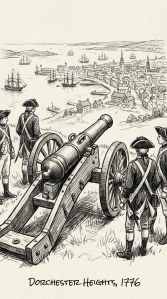
British General Howe’s Unpleasant Surprise
Today the author talks about the tumultuous week of March 1 – 7. It was during this week in 1776 that the British occupation of Boston and the tension caused by the thousands of colonial rebels that surrounded the city, effectively bottling up General William Howe’s British troops came to a head. Using stealth and cannon stolen from the British, General Washington moved cannons to the hills over looking Boston, concealing his movements from the British. General Howe awoke on a cold March morning to see dozens of rebel cannons looking down in the city.
The week of March – 7 was a buy week. American admiral Esek Hopkins carried out a successful raid in the Bahamas, The Battle of the Rice Boats took place in South Carolina and Colonel William Moultrie arrived at the site that would make him famous and began construction of the fort that would bear his name.
To see the entire video, visit the Mossy Feet Books You Tube Channel at this link.
This an excerpt from my book, 1776.
I am still writing this book, which I hope to release in April or May of this year. It will be part of the
Time Line of United States History Series
Meanwhile, you can enjoy the book 1775, which is available on the website, http://www.mossyfeetbooks.com. Just click the “Timeline of United States History” on the lower left-hand side of the home page.
A box set that includes all six volumes of the series is available at that link at an economical price.
Transcript:
Greetings, today I will talk about the tumultuous week of March 1 – 7. It was during this week in 1776 that the British occupation of Boston and the tension caused by the thousands of colonial rebels that surrounded the city, effectively bottling up General William Howe’s British troops came to a head.
This an excerpt from my book, 1776.
I am still writing this book, which I hope to release in April or May of this year. It will be part of the
Time Line of United States History Series
Meanwhile, you can enjoy the book 1775, which is available on the website, http://www.mossyfeetbooks.com. Just click the “Timeline of United States History” on the lower left hand side of the home page.
A box set that includes all six volumes of the series is available at that link at an economical price.
March 2, 1776 – Americans Begin Shelling British Troops In Boston
At the beginning of 1776 the situation at Boston in the early stages of the American Revolution was an uneasy draw. British troops controlled the city and the harbor. American troops surrounded the city. The high hills of Dorchester Heights commanded the city, but neither side wanted to occupy them. The British commander, General William Howe, remembered the results of the earlier battle, the Battle of Bunker Hill. Though the British won that battle, the results were horrendous. British losses had been high as they suffered 226 killed, 828 wounded, these mostly officers. Howe decided another victory like that would ruin him.
General George Washington wanted to take the hills, but his army was under equipped, having little artillery. About 2000 of his 9000-man army had no muskets. The Continental Army was not ready for such a maneuver.
American victories on Lake Champlain in New York changed the equation. With the fall of these two key British forts, the Americans captured a large quantity of cannon, shot and powder. Hearing of the victories Washington sent Colonel Henry Knox north to get the supplies. This the colonel accomplished. The feat is still considered one of the greatest logistical accomplishments of warfare. In three months he moved 800 tons of cannons, cannon balls and other paraphernalia over mud roads, semi-frozen rivers and through forests and swamps to get them to Boston. This accomplished during the dead of winter using only wagons, sledges, boats and human muscle. He arrived in late January, giving Washington just the thing he needed to capture Boston from the British.
On March 2, 1776 Washington positioned some of the guns on the west side of Boston at Lechmere’s Point and Cobble Hill and began shelling the city. He continued the shelling on March 3. The British returned fire, however neither side did much damage to the other. This action on Washington’s part served as a diversion of what he was really doing.
During the cannonade, which the British returned, he used the men that had no guns to begin construction of fortifications during the night of March 3 and 4. General Rufus Putnam had devised prefabricated fortifications that they could build out of sight of the British during the days before the occupation and haul into position quickly. That night Washington’s troops continued the cannonade while the other men labored at getting the cannon into position. The troops laid hay on the ground to muffle the sounds of their feet and wagon wheels. Towards morning on the 3rd, the Americans managed to conceal what they had accomplished and began after nightfall the night of the 4th. They hauled the cannon into place, built fortification and placed wooden stone filled barrels around the fortifications that they could roll down the hill to impede British troop movement up the hills. By around 4:00 AM on March 5 Washington had placed about 2000 troops, 59 cannons and an impressive system of fortifications on the heights. Anticipating that Howe might launch an attack on Dorchester Heights, Washington had also had the troops construct enough troop transports to carry 3,000 soldiers to launch an attack on Boston from his headquarters in Cambridge.
When General How awoke on the morning of March 5, he saw that Dorchester Heights bristled with Patriot guns and fortifications. After consulting with the British fleet commander, who told him that the guns threatened his fleet, Howe decided to take the Patriot positions and laid plans accordingly. He planned an assault with nearly 2400 men. Washington learned of these plans and increased the number of troops on the Heights to over 6000 troops. A fierce snow storm began as Howe’s troops began the assault, ending Howe’s plans.
During the snowstorm, Howe held a council of war with his officers, who recommended that they evacuate the city. Howe began immediate plans to move his troops from the city.
There were other events of note during this week. These were
Six ships of the Continental Navy arrived at Great Abaco Island in the Bahamas on March 1, 1776.
American Commodore Esek Hopkins began a bombardment of Fort Nassau in the Bahamas on March 2.
On March 2, 1776 Colonel William Moultrie arrived at Sullivan with 400 soldiers and began construction of the fort that Moultrie would command.
The Continental Congress appointed Connecticut’s Silas Deane as envoy to France to negotiate a treaty of alliance on March 2.
On March 3, Hopkins’s forces marched on Fort Nassau. The governor of the fort, perceiving that he was outnumbered and outgunned, surrendered the fort without a fight.
March 02, 1776 – British Land on Hutchinson Island
A number of of American boats loaded with rice had anchored just offshore from Hutchinson Island, South Carolina, which is a short distance north of Savannah in the Savannah River. At its widest point, Hutchinson Island is about a mile wide and about seven miles long. Late in the day on March 2 a British force landed on the island. The soldiers, under cover of darkness, made their way across the island and captured seven of the rice boats.
The Battle of the Rice Boats took place on March 3.
The stealthy approach and capture of the seven rice boats anchored just off Hutchinson Island kept their possession by British troops a secret until mid-morning on March 3. When the commander of militia forces learned of their capture, he assembled a battery of three four-pound cannon on Yamacraw Bluff, which towered over the spot where the rice boats were anchored. The Battle of the Rice Boats ensued.
Fearing the British would invade New York, aided by the Sandy Hook Lighthouse, the New York Provincial Congress ordered Major William Malcom to attack the lighthouse and render it useless on March 6.
I would encourage you to visit and subscribe to the Mossy Feet Books You Tube channel for more great content. If you like my videos, please hit the “Like,” button. The more likes I get the more You Tube will show it to other people, allowing me to grow the channel. I also entreat you to visit my website, http://www.mossyfeetbooks.com. There you will find sample chapters, podcasts, a slew of content and links to where you can buy my books. While visiting the web site you can subscribe to it and receive email notifications of when I publish a new book or other content, like this video and podcast. If you like what I am doing, please purchase a book, as it helps fund my work.
You can find my books locally at the at the Romweber Marketplace in downtown Batesville, Indiana.
I hope you enjoyed this podcast and thank you for listening.

 Mossy Feet Books - Author Paul R. Wonning