
Battle of Block Island
Greetings, today I will talk about the events of April 5 -11, which included the Battle of Block Island.
This an excerpt from my book, 1776.
I am still writing this book, which I hope to release in April or May of this year. It will be part of the
Time Line of United States History Series
Meanwhile, you can enjoy the book 1775, which is available on the website, http://www.mossyfeetbooks.com. Just click the “Timeline of United States History” on the lower left hand side of the home page.
A box set that includes all six volumes of the series is available at that link at an economical price.
Greetings, today I will talk about the events of April 5 -11, which included the Battle of Block Island.
This an excerpt from my book, 1776.
I am still writing this book, which I hope to release in April or May of this year. It will be part of the
Timeline of United States History Series
Meanwhile, you can enjoy the book 1775, which is available on the website, http://www.mossyfeetbooks.com. Just click the “Timeline of United States History” on the lower left-hand side of the home page.
A box set that includes all six volumes of the series is available at that link at an economical price.
https://mossyfeetbooks.com/2021/11/02/2658/
Commodore Essex Hopkins, on his mission to the British fort on Nassau, had captured the HMS Bolton and Hawke on April 5, 1776.
After capturing the HMS Hawke and Bolton, the ships of the Continental Navy were overloaded with spoils from Nassau. Since they had captured two British ships, Admiral Hopkins had taken crew members from the American ships and used them to man the captured ships. Thus, the Continental Navy’s ships were undermanned.
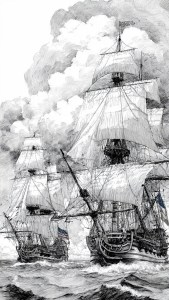
Hopkins had decided to search for more easy prizes as he headed back to Rhode Island, thus he divided his fleet into two columns, one headed by his flagship, the twenty gun USS Alfred and the other by the fourteen gun USS Cabot. The two columns of ships sailed in a southerly direction. As they neared Block Island, just off the coast of Rhode Island, the USS Andrea Doria spotted the HMS Glasgow as it was on its way south to take part in the invasion of Charleston. The Glasgow approached within hailing distance, at which time the commander of the British ship and the USS John Cabot exchanged hails. As they did, a member of the Cabot’s crew tossed a hand grenade onto the British ship. The explosion of the grenade spurred the Battle of Block Island.
The Cabot fired one broadside at the British ship, which had little effect. The Glasgow returned fire with two consecutive broadsides, killing the ships master and wounding Admiral Hopkins’s son, who was on the ship. It also damaged the ships rudder, destroying its ability to steer. The Alfred and the Andrew Doria joined the battle, however a broadside from the Glasgow disabled the Alfred’s lines leading to the tiller, rendering it powerless to steer. Their position made them vulnerable to the marines on the British ships as they raked the deck with fire. The two drifting ships made it difficult for the Andréa Doria to engage, as it had to maneuver in close quarters with the two damaged ships and avoid the fire of the Glasgow. The cannonade from the battle was intense, with people on shore able to hear it and see the cannon flashes. At this point, the commander of the Glasgow decided to break off the battle, as fire from three of the American ships endangered it. The battle counts as an American loss, as some of the fleet pursued the Glasgow for a short distance, however soon broke off. The Americans lost ten men dead in the battle with fourteen wounded. The British had one dead and three wounded.
Other events of the week include:
April 05, 1776 – General Charles Lee arrives in Williamsburg
The Continental Congress passed a resolution that opened Colonial ports to all nations except Great Britain on April 6.
The USS Lexington captures the HMS Edward.
Admiral Hopkins fleet returned to New London, Connecticut on April 8, 1776.
On April 11, 1776 the South Carolina Assembly passed a bill that established a Court of Admiralty to “have jurisdiction of all cases of the capture of ships and other vessels of the inhabitants of Great Britain, Ireland, British West Indies, Nova Scotia, East and West Florida; to establish trial by jury, in the Court of Admiralty, in cases of capture; and for the other purposes therein mentioned.”
In a letter to John Hancock on April 10, 1776, at Philadelphia, General Wooster reported that the troops taking part in the invasion of Canada were in poor condition. He noted that he had between two and three thousand troops to feed and that only about half were fit to fight.
The Lenape Chief White Eyes, or Koquethagechton, addressed the Continental Congress on April 11, 1776.
I would encourage you to visit and subscribe to the Mossy Feet Books You Tube channel for more great content. If you like my videos, please hit the “Like,” button. The more likes I get the more You Tube will show it to other people, allowing me to grow the channel. I also invite you to visit my website, http://www.mossyfeetbooks.com. There you will find sample chapters, podcasts, a slew of content and links to where you can buy my books. While visiting the web site you can subscribe to it and receive email notifications of when I publish a new book or other content, like this video and podcast. If you like what I am doing, please purchase a book, as it helps fund my work.

 Mossy Feet Books - Author Paul R. Wonning