
War Between the Colonies – The Yankee and Pennamite War
Greetings, in this episode I discuss a dispute over land erupted between the Yankees and Pennamites in 1775.
This is an excerpt from my book, 1776.
I am still writing this book, which I hope to release in April or May of this year. It will be part of the
Timeline of United States History Series
Meanwhile, you can enjoy the book 1775, which is available on the website, http://www.mossyfeetbooks.com. Just click the “Timeline of United States History” on the lower left-hand side of the home page.
A box set that includes all six volumes of the series is available at that link at an economical price.
Transcript:
Greetings, in this episode I discuss a dispute over land erupted between the Yankees and Pennamites in 1775.
The Wyoming Valley in the Appalachian area of northeastern Pennsylvania became the focus of warring factions from Connecticut and Pennsylvanians after the French and Indian War ended in 1763. The colonists had driven the Delaware tribe out of the coveted valley after the death of Teedyuscung, King of the Delaware in 1763. Problems among the white colonists arose because of a mistake made one hundred years earlier by King Charles II.
Conflicting Grants and Interests
King Charles II had granted the region to settlers in the region that became the colony of Connecticut in 1662. The King mistakenly granted the same region to William Penn in 1681. Neither colony felt pressure to settle the area immediately. To compound matters, the area had been the cause of conflict between the Iroquois League, Delaware and other tribes that lived in the area. The Iroquois had sold the region to parties in both Pennsylvania and Connecticut, an arrangement that led to more conflict. By 1753 Connecticut farmers had exhausted their soil and the population of the colony had tripled. Thus, that year they formed the Susquehanna Company to settle the Wyoming Valley area.
Susquehanna Company
It was formed in 1754 to purchase the Valley and settle it. The Company acquired the land from the Iroquois in 1754. When the French and Indian War broke out the same year, the settlement effort into the area paused. The war ended in 1763, and the company began resettlement efforts. Settlers from Pennsylvania, called Pennamites, had also begun settlement. On December 28, 1768 the Susquehanna Company met in Harford, Connecticut. During the meeting they divided the land into five townships of five square miles. This was room for forty settlers in each township. Thus, when settlers began moving into the Valley, they found that several Pennamites families had already located there. A conflict, known as the Yankee/Pennamite Wars, soon broke out and would continue intermittedly through the Revolutionary Wars and after.
After the Yankee/Pennamite War had simmered for several years. The Yankees of Connecticut had taken Fort Durkee, near present Wilkes-Barre, Pennsylvania, in 1769. The Pennamites constructed their own fort, Fort Wyoming, nearby and within eyesight. On December 25, 1775 a Pennamite force attack a Pennamite army of about 600 men. The Yankees defeated the Pennamites in the Battle of Rampart Rocks near West Nanticoke, Pennsylvania.
The Continental Congress appealed to both parties to cease their hostilities and join the fight against the British. The Yankees did cease fighting and formed a militia, which then joined the Connecticut Line. The Pennamites, however, were divided in their loyalties. Some chose the Loyalist route, others the rebel route. The Iroquois still wanted their lands in the region back and allied themselves with the British in the hopes of regaining it.
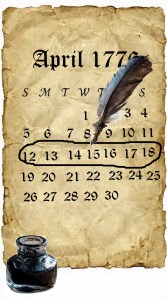
Other events during this week included the Fourth North Carolina Provincial took the first official step towards independence on April 12, 1776, when they adopted the Halifax Resolves.
General Washington arrived in New York on April 13 with his 20,000-man army to defend the city against attack.
The Georgia Provincial Congress passed document called the Rules and Regulations on April 15, 1776, which many consider Georgia’s first constitution.
Colonel Henry Knox had received orders on March 31, 1776, to begin moving the artillery to Norwich, Connecticut in anticipation of the expected British invasion of New York. He began moving the artillery on April 16, 1776.
Martha Washington had stayed with George during the winter of 1775 at Cambridge, Massachusetts. When the Continental Army moved to defend to New York, Martha followed George to that city a few days later, arriving on April 17, 1776.
Captain Tobias Furneaux, commanding the HMS Syren was the first British ship to arrive off the coast of Cape Fear with the HMS Mercury and two tenders on April 17, 1776.
I would encourage you to visit and subscribe to the Mossy Feet Books You Tube channel for more great content. If you like my videos, please hit the “Like,” button. The more likes I get the more You Tube will show it to other people, allowing me to grow the channel. I also invite you to visit my website, http://www.mossyfeetbooks.com. There you will find sample chapters, podcasts, a slew of content and links to where you can buy my books. While visiting the web site you can subscribe to it and receive email notifications of when I publish a new book or other content, like this video and podcast. If you like what I am doing, please purchase a book, as it helps fund my work.


