
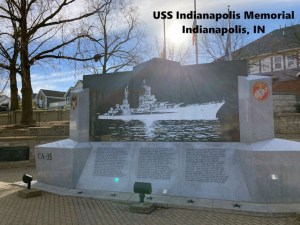
Memorial to the Sinking of the USS Indianapolis
Today we will visit the USS Indianapolis Memorial located on the Canal Walk near downtown Indianapolis.
From the Book
East Central Indiana Day Trips
Transcript
Greetings, today we will visit the USS Indianapolis Memorial located on the Canal Walk near downtown Indianapolis.USS Indianapolis
The USS Indianapolis belonged to a class of United States Warships called the Portland Class.
Portland Class ships were heavy cruisers that featured heavier armor than previous ships of similar class. The ships were 610 feet long and had a beam of 66 feet. The ships had 9 8″ guns and 8 5″ guns.
She also sported 5-inch/25-caliber anti-aircraft guns and 2 QF 3-pounder Hotchkiss guns. There were 4 airplanes and 2 catapults to launch them. Typically, the planes were fighter aircraft that were launched from the catapults for aerial reconnaissance. At the end of the mission the pilot had to either find a land-based air strip to land or ditch the plane in the water close to the ship and wait for rescue. The ships had a crew complement of 807 sailors. There were 2 ships in this class, the USS Portland and the USS Indianapolis.
Construction and Launch
Construction of the ship began on March 31, 1930, by the New York Shipbuilding Corporation. The ship was launched on November 15, 1932. In 1933 the ship received assignment as the flagship for Scouting Force 1.
Scouting Force 1
Created in 1922, Scouting Force 1 deployed first in the Atlantic Ocean, however it transferred service to the Pacific in 1932. The force consisted of battleships, cruisers, destroyers, submarines, and aircraft squadrons.
Service in World War II
The ship participated in the New Guinea campaign in 1942, and the Aleutian Islands campaign the same year. In 1943 the ship received assignment at Pearl Harbor and became the flagship for the 5th Fleet, commanded by Admiral Raymond A. Spruance. She took part in numerous bombardments and fought at the Battle of the Philippine Sea. Afterwards the ship took part in numerous island invasions and was sent for refitting in California at Mare Island Naval Shipyard in late 1944. On February 1, 1945, she joined a carrier force commanded by Vice Admiral Marc A. Mitscher. She took part in the April invasion of Okinawa. On March 31 a Japanese plane successfully penetrated the ship’s defenses and dropped a bomb before crashing into the port stern. The ship was extensively damaged and returned to the Mare Island Shipyard for repair. After the overhaul, the ship received its final assignment, transporting the components of the first atomic bomb.
The ship left Hunters Point Naval Shipyard in San Francisco on July 16, 1945. It carried the non-nuclear parts of the bomb, scientific instruments and two Manhattan Project scientists. The uranium enriched projectile was contained in a lead-lined container and chained to the floor of Captain Charles B. McVay III’s cabin.
The USS Indianapolis delivered the components to the first operational atomic bomb to the island of Tinian on July 26. After delivery, Captain McVay requested further orders from the naval headquarters at Guam. Headquarters ordered McVay to join the USS Idaho in the Leyte Gulf. The Navy was assembling a fleet to invade Japan.
Sub Infested Waters
The USS Indianapolis’ orders directed the ship to proceed without an escort, an unprecedented event during the war. Unknown to McVay, two Japanese submarines lay in his path. As the ship proceeded through the sea, one of the submarines sighted the unescorted, defenseless ship and fired two torpedoes. The first torpedo struck the bow of the ship, obliterating it. The second struck the hull near a fuel tank and powder magazine. The ship sank quickly. About 900 of the 1116 crewmen made it into the water. The radioman sent three distress calls before sinking. However, no one reacted. One receiving station commander had gotten drunk and was inebriated, so he did not answer the call. Another had ordered his radio operator not to disturb him. The third suspected a Japanese trap and sent no help.
Shark Infested Waters
The men remained in the water for almost five days, held aloft by their life vests. Sharks found the helpless survivors and began to feed. The horror lasted until a PV-1 Ventura Bomber on submarine patrol discovered the flotsam from the wreckage and survivors still clinging to life in the water. He radioed for help. A PBY seaplane was dispatched to aid the stricken survivors. Lieutenant R. Adrian Marks first over flew the target and alerted the USS Cecil Doyle, whose captain overlooked his orders and sailed to the scene. Meanwhile, Marks arrived and started deploying life rafts. He could see that sharks were devouring many of the men and, against Navy procedure, landed his plane and taxied about the water’s surface trying to pull as many as he could from the waters. He soon filled the plane and tied many others to the wings. Marks managed to save fifty-six of the men. The Doyle arrived at dark, and, seeing the PBY, stopped his ship to avoid harming any survivors. He pulled Mark’s survivors onto the ship. Knowing more ships were on the way, the captain of the Doyle shone his beacon light into the night sky, knowing this would alert any Japanese in the area to his presence. Only 317 men would survive the horror of hunger, thirst, shark attacks and exposure to the elements. It would go down as one of the greatest Navy disasters. It was the last Navy ship that sunk during the conflict.
The survivors of the Indianapolis gathered for their first reunion in 1960 in Indianapolis. The idea of a memorial honoring the men that died germinated during this reunion. The group met again in 1965 and the idea grew. The search for a suitable site for the memorial for the ship and crew ended when Indianapolis Mayor William Hudnut announced that it would be located on the banks of the Central Canal near downtown Indianapolis in 1990. The memorial was dedicated on uly 30, 1995. The black granite memorial lists the entire 1,197-member crew. The names of the survivors were marked by a star.


