
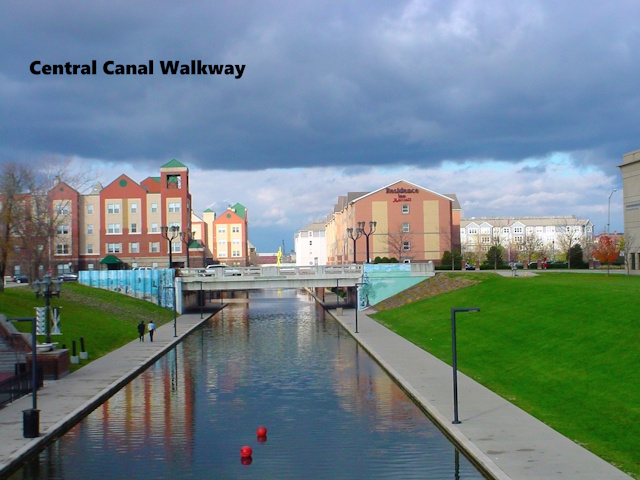
The Central Canal Walk in Indianapolis
Today we will travel along the Central Canal, located near downtown Indianapolis.
From the Book
East Central Indiana Day Trips
Transcript:
Greetings, today we will travel along the Central Canal, located near downtown Indianapolis.
In the dawning years of the Nineteenth Century, the quest for fast, cheap transportation of freight over long distances seemed in reach with the construction and economic success of the Erie Canal. The Erie Canal connected New York City with the Great Lakes. It spurred New York’s growth as a major commercial center. It also provided encouragement more canal construction across the United States. Landlocked states like Indiana seized on canals as the answer to open markets in inland cities that lacked navigable rivers. The Wabash and Erie was the first of these projects tackled by Indiana.
The proposed Wabash and Erie Canal would span 468 miles across Indiana and Ohio, connecting the Great Lakes with Evansville on the Ohio River. The Wabash and Erie actually consisted of four main canals, the Miami and Erie Canal, the Wabash and Erie Canal, the Cross Cut Canal and the Central Canal.
The Central Canal was supposed to start at a junction with the Wabash and Erie Canal at Peru, Indiana and travel through the central part of the state through Indianapolis, continuing southwest to Washington, Indiana where it rejoined the Wabash and Erie Canal.
The Canal was funded by the Massive Internal Improvements Act of 1836. This act funded several canal, road and railroad projects across Indiana. It proved to be too much at once. The Panic of 1837 caused a massive drop in land prices and since Indiana relied heavily on real estate taxes as revenue, the drop in prices caused a massive decrease in state revenue. This placed Indiana in a state of near bankruptcy, causing delays and cancellations of many of the projects funded by the Act.
Only 8 miles of the proposed 296 miles of the Central Canal was ever completed. This section was located in the city of Indianapolis.
An engineer named Jesse Williams surveyed the canal site and construction began in 1836. Financial difficulties halted the project in 1839. Work commenced on other sections of the Central Canal, however none were ever completed.
The canal failed as a transportation medium, however the current produced by the canal did have a use. During these years Indianapolis depended upon water wells near Washington Street for the city’s water supply. The Water Works Company of Indianapolis took over the operation of the canal in 1881. The company used the water power to drive the pumps that pulled water from the wells. This company eventually failed and the Indianapolis Water Company formed in 1881 to purchase it. The company constructed the White River Station Treatment Plant near 16th Street to pull water from the White River via the Canal. It treated the water at the treatment plant and used it as the city’s water supply.
The Water Company transferred ownership of the canal to the city in 1976. The city restored the canal beginning in 1985. The canal now features a walkway that extends from downtown Indianapolis to 11th Street. The canal traverses White River State Park. Many important area attractions are along the canal, including the Indiana Historical Society, the Indianapolis Zoo, the Indiana Museum, the Medal of Honor Memorial and the USS Indianapolis Memorial.
The episode is based upon my book, Central Indiana Day Trips, available on the web site, http://www.mossyfeetbooks.com. The book is the fifth book in the 9 volume Road Trip Indiana Series. The books include all the historical markers, as of 2022, in Indiana with the text and back story. The books also include a nearly complete listing of virtually every tourism destination in the state. The destinations include parks, museums, drive in theaters, bowling alleys, wineries and much, much more. I encourage you to visit the web site and subscribe to it. If you like what I am doing, please purchase a book, as it helps fund my work.
I hope you enjoyed this podcast and thank you for listening.
Brief History
See the previous article on the Central Canal.
Title of Marker:
The Central Canal
Location:
SR 37 & 191st Street, Noblesville. (Hamilton County, Indiana)
Installed by:
Erected 1994 Indiana Historical Bureau and Precedent Partner
Marker ID #:
29.1994.1
Marker Text:
These canal-bed earthworks are remnants of construction on the Central Canal from 1836-39. It was planned to link the Hoosier interior with interstate markets, via the Wabash & Erie Canal, as part of the 1836 Internal Improvement Act. Indiana’s bankruptcy in 1839 forced abandonment of the Central Canal project.
Brief History
In the dawning years of the Nineteenth Century, the quest for fast, cheap transportation of freight over long distances seemed in reach with the construction and economic success of the Erie Canal. The Erie Canal connected New York City with the Great Lakes. It spurred New York’s growth as a major commercial center. It also provided encouragement more canal construction across the United States. Landlocked states like Indiana seized on canals as the answer to open markets in inland cities that lacked navigable rivers. The Wabash and Erie was the first of these projects tackled by Indiana.
The Proposed Canal
The proposed canal was a grand project. It would span 468 miles across Indiana and Ohio, connecting it the Erie Canal via the Great Lakes with Evansville on the Ohio River. The Wabash and Erie consisted of four main canals, the Miami and Erie Canal, the Wabash and Erie Canal, the Cross Cut Canal and the Central Canal.
Miami and Erie Canal
The 274-mile Miami and Erie Canal connected Toledo, Ohio on Lake Erie with Cincinnati, Ohio on the Ohio River. Workers commenced construction in 1825 and finished in 1845. When complete, the canal had nineteen aqueducts, three guard locks, 103 canal locks and multiple feeder canals. The canal was profitable, but not as profitable as the state of Ohio hoped. Competition from railroads ended canal commercial operations by 1913.
Wabash and Erie
This canal began at Junction, Ohio and to Terre Haute. Junction received its name because the Wabash and Erie joined the Miami and Erie Canal in the town. The town flourished during the 1840’s through the 1850’s until the railroads began displacing the canals.
Cross Cut Canal
The Cross Cut Canal continued the Wabash and Erie route from Terre Haute to Worthington, Indiana.
Central Canal
The Central Canal completed the link from Worthington to Evansville. This was the last link completed in 1853.
Construction Begins
Because many credit George Washington with the suggestion that a canal be built through the region, the builders chose the 100th anniversary of his birth as the date to begin construction of the huge enterprise. Thus, on February 22, 1832, construction crews broke ground for the Wabash and Erie Canal.
The Indiana General Assembly passed what many hoped would be a financial boon for the developing state of Indiana. Instead, the Act led to financial ruin.
The State of the State in 1836
When Indiana became a state in 1816, the state was a vast network of forest, prairie, rivers and streams. White settlement clung to the southern counties along the Ohio River, with a sliver of settlement along the Wabash River in the west. Amerindian tribes still claimed the northern two-thirds of the state. By the 1830’s, the situation had not changed much. Indianapolis, the new state capital, was a muddy pioneer settlement along the White River. The southern counties had access to the Ohio River, the only good means of transportation. Since only the Wabash River was navigable, other parts of the state had no access to reliable transportation systems. The only roads were trails cut through the wilderness. The state had begun construction on the Michigan Road, slated to be a main artery between Lake Michigan and Madison on the Ohio River, but construction would not finish until the 1840’s. The Buffalo Trace provided a rough highway from Vincennes to Clarksville. By 1830, Indiana had a population of about 600,000 people. Tax revenues for the state totaled around $50,000.
Tax Revenue
Indiana had two sources of tax revenue in 1830, property taxes and poll taxes, each providing about half the state’s revenue. Indiana and other states admitted to the Union after 1803 were prohibited from taxing land purchased from the federal government for a period of five years. Thus, by the mid 1830’s, vast areas of land that it could not previously tax were entering the tax base. In addition, land sales remained high in the state during the period, so more lands would continually enter the revenue stream. Indiana expected to double its tax revenue in just a few years. Moreover, anything the assembly could do to increase land values would increase tax revenue. This was especially true if the state switched to a different tax system. The state used a per acre tax system, placing a greater tax burden on agricultural land. The state switched to an ad valorem system in 1835, which permitted the state to tax both land and personal property at a rate based on its assessed value. This system reduced the burden on farmers and increased it on merchants, homeowners and manufacturers.
The Geographic Quandary
Canals were the rising star of the Eighteenth Century. New York had great success with the Erie Canal and there were other examples. Railroads had not yet become mainstream. Thus, most states had canal construction projects. The problem with canals is that they are geographic specific in the benefits they bestowed and widespread in the taxing requirements to produce the revenue to finance them. The assembly struggled for years over this problem. How to tax everyone in the state for a canal that would only benefit one geographic region was the unanswerable question. The answer seemed to be, build them all at once and jump-start an economic boom everywhere in the state. This is what the Mammoth Internal Improvement Act of 1836 sought to do.
Mammoth Internal Improvement Act of 1836
Signed into law by Governor Noah Noble, the act was meant to be his crowning achievement. The law authorized the Indiana Central Canal, the Whitewater Canal, the Wabash and Erie Canal, the Madison and Indianapolis Railroad, paving the Buffalo Trace and Michigan Road. The bill provided for a Board of Internal Improvement, which was authorized to borrow up to ten million dollars, based on the good faith and credit of the State. Jubilant celebrations took place all over the state with the passage of the bill. Governor Noble was cautious because the Assembly had passed the spending portion of his program; but had not followed his tax increase recommendations.
Too Much at Once
The aims of the law, while noble, were much too ambitious. Construction of canals is an expensive, uncertain business. Construction of the Whitewater Canal was impaired by a flood that washed out much of the completed work. Many of the sites slated for canal construction were, in reality, not suitable sites. Then the Panic of 1837 set in.
Panic of 1837
This complex event created an economic depression that lasted from about 1837 until 1842. The multiple causes were questionable lending practices in the Western United States, restrictive lending policies enacted by Great Britain and falling agricultural prices. The period before 1837 had been a period of intense economic growth. During this time the prices of cotton and other commodities rose. Land prices also increased. The Bank of England noticed a decline in cash on hand in 1836. They raised interest rates in an attempt to attract more cash. When the Bank of England raised its interest, it forced banks in the United States and other nations to raise their rates. This, along with other events, caused land and cotton prices to fall. The chain of events this set off triggered a depression that caused profits, prices, and wages to fall and increased the unemployment rates. It was not until 1843 that the economies of the major countries rebounded.
Tax Revenues Fall, Then Disaster
The conditions induced by the Panic created an economic depression. Land values fell, as did tax revenues. Instead of having more revenue to work with, the State found itself with less. By 1841, tax revenues were $72,000 while interest payments on the debt reached $500,000. The State was bankrupt. The State had not completed any of the slated projects. It was left to Madison’s James F.D. Lanier to use his financial wizardry to convince creditors to take over the projects for a fifty percent reduction in the debt. Creditors were only able to complete two of these projects. Lanier also aided the state with two loans totaling one million dollars. The State managed to repay it by 1870.
Thus, what many consider the biggest legislative debacle of all time ended.


