
General Charles Cornwallis Arrives America
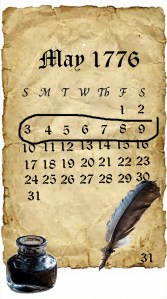
Today the author talks about General Cornwallis’ arrival in America and some of the other events of May 2 through May 9.
This an excerpt from his book, 1776.
The book is in the final edit phase and publishing will begin on May 11
It will be part of the
Time Line of United States History Series
Meanwhile, you can enjoy the book 1775, which is available on the website, http://www.mossyfeetbooks.com. Just click the “Timeline of United States History” on the lower left-hand side of the home page.
A box set that includes all six volumes of the series is available at that link at an economical price.
Transcript:
Greetings, today I will talk about General Cornwallis’ arrival in America and some of the other events of May 2 through May 9.
May 01, 1776 – Cornwallis Arrives America
General Charles Cornwallis, along with squadron of about ten warships accompanied by a fleet of thirty transports, arrived off the coast of Cape Fear on May 3, 1776.
Fleet Disbursed
The fleet had departed Cork, Ireland on February 12, but had run into storms five days after departure. The storms scattered the fleet, which included Ethan Allen, held prisoner below deck of HMS Soledad. The Fleet, commanded by Commodore Peter Parker, was still incomplete, as many ships were still at sea.
Charles Cornwallis – (December 31, 1738 – October 5, 1805)
The son of Charles Cornwallis, 5th Baron Cornwallis and Elizabeth Townsend, Charles was native to Governor Square in London, England. Cornwallis received his secondary education at Eton College and Clare College, Cambridge.
Military Career Begins
He enlisted in the army in 1757, receiving his first commission as an ensign. He gained permission to obtain further military education on the Continent. He studied at the Military Academy of Modena at Turin, Italy. During the Seven Years War he participated in the Battle of Minden in Germany, after which he purchased a commission in the English military, becoming a captain. He would receive a promotion to Lieutenant-Colonel. The regiment he commanded participated in several battles, mostly in Germany, during this conflict.
Politics and Marriage
In 1760 Cornwallis gained election to the House of Commons. A year later he succeeded to his father’s title of the 2nd Earl Cornwallis. Subsequently, he became a Member of Parliament’s House of Lords. He and Jemina Tullikens Jones married in 1768. The couple would have two children. During the early years of the rising tensions with the North American colonies, Cornwallis was a supporter of the colonial cause. He was one of only five peers in the House of Lords to vote against the Stamp Act in 1765. During these years, Cornwallis remained out of active military service but continued to support it as a Member of Parliament. Out the outbreak of war between the colonies and Britain, he sought, and received, active status. He gained promotion to major general on September 29, 1775. The following year Cornwallis received orders to deploy to the war in America.
The day before Alexander Hamilton, who commanded an artillery company, sent a letter to Congress.
Alexander Hamilton’s artillery company was understaffed and underpaid. On May 2, Hamilton tried to rectify both situations by writing the New York Provincial Congress a letter in which he compared the pay rates of other artillery companies with his own. The letter stated:
“You will discover a considerable difference. My own pay will remain the same as it is now, but I make this application on behalf of the company, as I am fully convinced such a disadvantageous distinction will have a very pernicious effect on the minds and behavior of the men. They do the same duty with the other companies and think themselves entitled to the same pay.”
The Congress complied with his request. The number of enlisted men rose to 69 which was twice as many as he needed.
Captain John Butler, a Canadian British Loyalist, held a conference with several hundred Iroquois tribesmen on May 1, 1776. Using liquor and stories of the glory of combat, he attempted to convince them to break the neutrality vows they had taken in the conflict between the colonies and Britain the previous year. Butler, who led some of the forces in play at the Battle of the Cedars, managed to convince some 50 warriors to join him; however, historians are unsure if any of these men participated in the battle.
Charles Gravier, comte de Vergennes had presented his plan to fund the American Continental Congress in mid-April to King Louis XVI. Vergennes would set up a front company, the Roderigue Hortalez et Compagnie. The Royal Treasury would loan one million livres to this company. The Royal Treasurer would make the check out to Vergennes’ fifteen-year-old son, who would endorse it and give it to the front company. This would conceal the French government’s role in the affair. He would use half of the money to purchase outdated arms the French had and convert the remainder to Portuguese currency to loan the Continental Congress to purchase the arms. the arms would first be shipped to the French West Indies. From there, The Americans were responsible for providing the ships to transport the arms to America.
King Louis XVI studied the plan for about two weeks, giving his final approval to the plan on May 2.
General Henry Clinton’s fleet with 2800 British soldiers lay offshore of North Carolina ready to begin an invasion. On May 5, he issued a proclamation that condemned the rebellion as wicked and counter to the British Constitution. He offered a full pardon to all that laid down their arms, for their own and their posterities happiness, excepting General Robert Howe and president of the North Carolina Provincial Council, Cornelius Harnett.
May 06, 1776 – Howe Brothers Given Authority to Pardon Rebels
King George issued letters to Admiral Richard Howe and General William Howe that authorized them to pardon all the Americans in rebellion and then to negotiate peace. The Howe brothers had both opposed the king’s policies as well as the war against the colonies. Both had displayed favorable intentions towards them. Admiral Howe was especially keen on reconciliation with the colonials; however, this desire would not interfere with his duty to obey the wishes of the king.
Richard Henderson arrived in Boonesborough on April 20, 1775, and began laying plans for his fourteenth colony, Transylvania. By May 8, he had gathered men from the surrounding settlements to form a government.
I would encourage you to visit and subscribe to the Mossy Feet Books You Tube channel for more great content. If you like my videos, please hit the “Like,” button. The more likes I get the more You Tube will show it to other people, allowing me to grow the channel. I also invite you to visit my website, http://www.mossyfeetbooks.com. There you will find sample chapters, podcasts, a slew of content and links to where you can buy my books. While visiting the web site you can subscribe to it and receive email notifications of when I publish a new book or other content, like this video and podcast. If you like what I am doing, please purchase a book, as it helps fund my work.


