
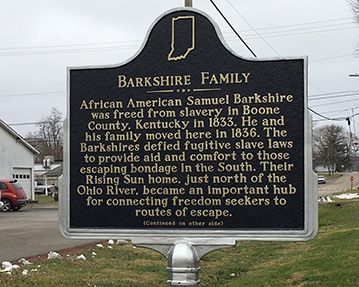
The Barkshire Family
Today we will visit an historical marker in Rising Sun, Indiana that notes the achievements of the Barkshire Family.
Excerpted From:
Southeast Indiana Day Trips
Transcript:
Greetings, today we will visit an historical marker in Rising Sun, Indiana that notes the achievements of the Barkshire Family.
The Barkshire Family
The Barkshire family was a family of former slaves that lived in Rising Sun, Indiana in Ohio County along the Ohio River. The members of this family were quite active in the Underground Railroad movement. Their former owner, Nancy Hawkins, though not a member of their family, was responsible for manumitting them as well as being closely associated with them after they moved across the river from Kentucky to Indiana.
Nancy Hawkins (C. 1776 – 1854)
History knows little of Nancy Hawkins before marriage to Joseph Hawkins around 1817. She was native to Virginia. She may have been married to, or at least the common law wife of, Dickey Barkshire, though the only evidence linking them is circumstantial. If so, she would possibly have known Samuel prior to his transfer to Hawkins while he was enslaved by Barkshire. Sometime after John’s death in 1836 she moved across the Ohio River to Rising Sun close to the same time as Samuel Barkshire and his family. Sometime after the move to Rising Sun Nancy filed papers that officially manumitted Samuel’s wife and children as well as other slaves she had brought to Rising Sun. Since there was a danger that manumitted slaves could be kidnapped and sold back into slavery, which often happened, Nancy ensured that their protections were filed prior to their manumission.
Samuel Barkshire (c. 1798 – April 11, 1875)
Born about 1798 as a slave to Dickey Barkshire in Harrison County, Kentucky. After Dickey’s death his son Felix acquired him. Felix sold him to Joseph Hawkins, who manumitted Samuel in 1833, for the sum of one dollar. Samuel married Frances Newman, who was owned by Hawkins. The couple would have six children. Barkshire purchased land next to Hawkin’s land, probably because Hawkins still owned his wife and children.
Underground Railroad Work
Before moving to Rising Sun, Samuel had been engaged in helping escaped slaves in their quest to find freedom while still living in Kentucky. The land he had purchased there bordered the Ohio River and proved a good conduit for slaves fleeing north. This was extremely dangerous for Barkshire, as if he was caught, subject to severe punishment.
Move to Rising Sun
Sometime before 1840 the Barkshire family moved across the Ohio River to settle in Rising Sun, Indiana. Barkshire worked as a cooper in Rising Sun making many of the barrels used to ship goods on the river. He also continued his work in the underground railroad, serving as a contact person. He and his family hid escaping slaves and passed along bits of valuable information. After the passage of the Fugitive Slave Act in 1850, slave owners and bounty hunters seeking escaped slaves in the north became much more aggressive. They frequently crossed the river in search of escapees. Many times, slave owners appeared at the Barkshire home angrily demanding that Samuel turn over their slaves. The family received threats of lynching and other forms of intimidation because of their activities. Barkshire’s wife and children were also intimately involved in the movement as was Samuel’s former owner, Nancy Hawkins.
Respected Town Figure
Samuel’s work in the Underground Railroad movement created many enemies, mostly across the river, but many pro slavery people in Rising Sun also disliked him. It also gained him many friends, both local and abolitionists living in Kentucky. The network of friends paid off when he received advance warning of a plot to kidnap him and his family and sell them into slavery. The threat did not materialize. He also gained notoriety nationwide, as noted suffragette, abolitionist and social reformer Laura Smith Haviland sought his help. Well known abolitionist Levi Coffin, whom many refer to as the President of the Underground Railroad, also knew of him.
After his death, Samuel was interred at Union Cemetery in Rising Sun, Indiana.
Arthur Barkshire (1825 – June 25, 1864)
The son of Samuel Barkshire and Frances Harriet Newman, Arthur was native to Boone County, Kentucky. During his early life he lived as a slave owned by Dicky Barkshire and later Joseph and Nancy Hawkins in 1836. Nancy Hawkins manumitted him in 1848 after she moved to Rising Sun in Indiana. Arthur, as well as his other siblings, became involved in the Underground Railroad movement as a conductor. He and Elizabeth Kuth married on June 18, 1854. Elizabeth lived in Ohio. When Arthur brought his new bride to Rising Sun, he violated Article 13 of the Constitution that Indiana had adopted in 1851, The provisions of this article are stated below:
Section 1. No negro or mulatto shall come into or settle in the State, after the adoption of this Constitution.
Section 2. All contracts made with any Negro or Mulatto coming into the State, contrary to the provisions of the foregoing section, shall be void; and any person who shall employ such Negro or Mulatto, or otherwise encourage him to remain in the State, shall be fined in any sum not less than ten dollars, nor more than five hundred dollars.
Section 3. All fines which may be collected for a violation of the provisions of this article, or of any law which ay hereafter be passed for the purpose of carrying the same into execution, shall be set apart and appropriated for the colonization of such Negroes and Mulattoes, and their descendants, as may be in the State at the adoption of this Constitution, and may be willing to emigrate.
Section 4. The General Assembly shall pass laws to carry out the provisions of this article.
The Indiana General Assembly passed a statute that read:
“Any person who shall employ a Negro or Mulatto who shall have come into the State of Indiana subsequent to the 31st of October 1851 or shall encourage such Negro or Mulatto to remain in the state shall be fined in any sum not less than $10 nor more than $500.”
Someone filed a complaint against him and he was charged with, “encouraging a Negro to remain in the State of Indiana.” The suit, filed in the Ohio County Common Pleas Court. The court found him guilty and fined him $10.00 and expelled him from the state. Barkshire appealed his case to the Indiana Supreme Court. The Supreme Court upheld the decision, contending that:
“All contracts made with Negros and Mulattos coming into the State contrary to the provisions of the 13th Article void.
“Because the marriage itself, solemnized in contravention of both must be regarded as void.”
Thus, Barkshire and Elizabeth had to leave Indiana. They migrated back to her home state of Ohio.
Barkshire enlisted in the 27th United States Colored Infantry Regiment when it organized in Delaware, Ohio on January 16, 1864. Barkshire would die of disease on June 25, 1864.
Garrett Barkshire (October 31, 1826 – May 11, 1894)
The son of Samuel Barkshire and Frances Harriet Newman, Garret was native to Boone County, Kentucky. During his early life he lived as a slave owned by Dicky Barkshire and later Joseph and Nancy Hawkins, beginning in 1836. Nancy Hawkins manumitted him in 1848 after he moved to Rising Sun in Indiana. Garret would marry twice, to Sarah Ellis and Frances Kennedy. He had one child. Garrett acted as a conductor in the Underground Railroad system. His job working on riverboats allowed him to travel to New Orleans, Louisianna. There he collected slaves wanting freedom and took then north to Rising Sun, where they used the network of stations that took then north to freedom. Garrett died in Terra Haute, Indiana and is interred at Highland Lawn Cemetery there.
Matilda Barkshire (July 19, 1828 – November 17, 1892)
The daughter of Samuel Barkshire and Frances Harriet Newman, Matilda was native to Boone County, Kentucky. During her early life she lived as a slave owned by Dicky Barkshire and later of Joseph and Nancy Hawkins, beginning in 1836. Nancy Hawkins manumitted her in 1848 after she moved to Rising Sun in Indiana. There is no documentation of the daughters participating in the Underground Railroad activities of their parents, however their presence in the home allows speculation that they were somehow involved. She married George W Kennedy on October 21, 1851, and later Willis Wade on December 10, 1871. She had two children. She passed away in Terre Haute and is interred there.
Emily Barkshire (1830 – June 24, 1899)
The daughter of Samuel Barkshire and Frances Harriet Newman, Emily was native to Boone County, Kentucky. During her early life she lived as a slave owned by Dicky Barkshire and later of Joseph and Nancy Hawkins, beginning in 1836. Nancy Hawkins manumitted him in 1848 after she moved to Rising Sun in Indiana. There is no documentation of the daughters participating in the Underground Railroad activities of their parents, however their presence in the home allows speculation that they were somehow involved. She and Samuel Washington Martin on December 5, 1853. The couple would have seven children. She and her husband migrated to Akron, Ohio. She is interred in Glendale Cemetery in Akron, Ohio.
Woodford Barkshire (1832 – August 25, 1868)
The son of Samuel Barkshire and Frances Harriet Newman, Woodford was native to Boone County, Kentucky. During his early life he lived as a slave owned by Dicky Barkshire and later Joseph and Nancy Hawkins, beginning in 1836. Nancy Hawkins manumitted him in 1848 after he moved to Rising Sun in Indiana. Woodford became a conductor on the Underground Railroad, helping his parents in their task of aiding escaped slaves seeking freedom in Canada. He and Virgina Sayers married on June 16, 1858. The couple would have three children. Woodford was interred in Union Cemetery in Rising Sun after his death.
Minerva Barkshire (September 15, 1836 – January 11, 1908)
The daughter of Samuel Barkshire and Frances Harriet Newman, Minerva was native to Boone County, Kentucky. During her early life she lived as a slave owned by Dicky Barkshire and later of Joseph and Nancy Hawkins, beginning in 1836. There is no documentation of the daughters participating in the Underground Railroad activities of their parents, however their presence in the home allows specualtion that they were somehow involved. Nancy Hawkins manumitted her in 1848 after she moved to Rising Sun in Indiana. She and Noah B. Tutt married on November 4, 1854. The family migrated to Muscatine, Iowa. After her death, Minerva was interred in Greenwood Cemetery in Muscatine, Iowa.
This is an excerpt from my book, Southeast Indiana Day Trips. You can find the book on my website, http://www.mossyfeetbooks.com. It is available in a number of formats including ebook, softbound and audio book on Amazon as well as many other online book retailers. You may also purchase the book direct from me, the author, on the website. The family also appears in my book, A History of Ohio County, Indiana, also available on the web site. I am also including it in a book I am currently working on which will be entitled Interesting Hoosiers in History, due to be published sometime this year.
I would encourage you to visit and subscribe to the Mossy Feet Books You Tube channel for more great content. If you like my videos, please hit the “Like,” button. The more likes I get the more You Tube will show it to other people, allowing me to grow the channel. I also invite you to visit my website, http://www.mossyfeetbooks.com. There you will find sample chapters, podcasts, a slew of content and links to where you can buy my books. While visiting the web site you can subscribe to it and receive email notifications of when I publish a new book or other content, like this video and podcast. If you like what I am doing, please purchase a book, as it helps fund my work.
I hope you enjoyed this podcast and thank you for listening.


