
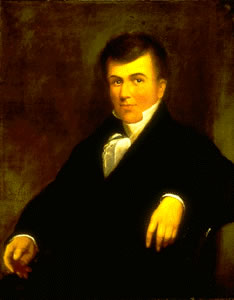
onathan Jennings
Indiana’s First Governor – Jonathan Jennings
Today the author talks about Indiana’s first state governor, Jonathan Jennings.
You can find his entire biography in my book, Indiana’s Governors – Book 1. Listeners will find a link to the book in the description of this podcast.
/
Transcript:
Greetings, today I will talk about Indiana’s first state governor, Jonathan Jennings.
You can find his entire biography in my book, Indiana’s Governors – Book 1. Listeners will find a link to the book in the description of this podcast.
Jonathan Jennings (March 27, 1784 – July 26, 1834)
Native to Readington Township, Hunterdon County, New Jersey, Jonathan’s parents were Reverend Jacob and Mary Kennedy Jennings. Both of his parents practiced medicine, as in addition to his ministerial duties Jacob was a doctor. Mary assisted him in his practice and may have possessed a medical degree. Sometime around 1790 the family migrated to Dunlap Creek in Fayette County, Pennsylvania, where Jonathan grew up. He attended the public schools in the area and received home schooling. His mother passed away in 1792 and his sister Sarah, and his brother, Ebenezer took over his care. He studied law at Washington, Pennsylvania. Sometime before 1806 he moved to Steubenville, Ohio, to join his brother’s law practice.
Move to Indiana.
He left Ohio for the Indiana Territory in 1806, where he settled in Jeffersonville. After a short time he moved to Vincennes, which was the Territorial Capital at the time. There were not enough clients for him to earn a living in Vincennes so he took jobs as clerk for the Territorial Assembly, the land office and Vincennes University. Using his position at the land office, Jennings speculated in land purchases, which allowed him to acquire wealth. A conflict with Territorial Governor William Henry Harrison, who was also the President of the University’s Board, led to Jennings resigning his position with Vincennes University. The two men remained political adversaries until Harrison resigned as governor in 1812. Sometime around 1809 he moved to Charlestown, in Clark County.
Harrison had been the governor of the Indiana Territory since its inception in 1800. He had acquired many supporters, mostly in the western part of the Territory. Many of the settlers in the west were from the slave holding states of Kentucky and Virginia. Harrison, a slave owner, had the support of these westerners, as most of them wanted the Territory to legalize slavery, which the Northwest Territory’s original charter had forbade. The eastern part of the Territory included mostly people that opposed slavery. Meanwhile, the Illinois Territory separated from the Indiana Territory in 1809. This weakened Harrison’s support as many of his supporters were in the newly formed territory.
Budding Political Career
Prior to 1809 territories were entitled to send a non voting representative to the United States House of Representatives. The legislature chose this delegate. Congress approved a law in 1809 that changed this and mandated that a territory wide election be held to fill this representative set. Jennings, fiercly anti-slavery, elected to run for this seat. Harrison favored a man named Thomas Randolph, who ran for the seat. Randolph was of an aristocratic nature and not very personable. Jennings, by contrast, was down to earth, friendly and quite personable. He campaigned extensively in the eastern part of the territory. Jennings won the election, becoming the first popularly elected representative of Indiana to the United States Congress. He would win reelection in 1811, 1812 and 1814.
Effective in the Push for Statehood
Jennings played a key role in the future of Indiana as he became an ardent supporter of statehood for the territory as well as a fierce opponent of those wishing to install the institution of slavery into the future state. He introduced the petition for statehood to Congress on December 28, 1815 and helped to get the petition approved. The Congress approved the law, known as the Enabling Act and President James Madison signed it on April 19, 1816. The law authorized the state to hold a convention to draft a constitution. The election to elect delegates for the Constitutional Convention took place on May 3, 1816. Jennings was elected as a member of this convention, which convened on June 10, 1816. The convention took place at the Territorial Capital of Corydon. 41 delegates gathered at Corydon from the 13 counties that existed at the time and met in the capital building. The weather was hot, so they moved the proceedings to a huge elm tree that stood near the building. The tree died in 1925 of Dutch Elm Disease. Workers coated the tree with tar and the tree still exists near the Old State Capitol. The delegates drafted a constitution and passed it. The constitution took effect on June 29, 1816. The first election took place on August 5, 1816. Jennings won election as governor of the new state with 5,211 votes to 3,934. The Congress officially approved statehood on December 16, 1816.
Jenning’s First Term
The 1816 Constitution set a governor’s term at 3 years and prohibited a person from serving more than 6 years in a 9 year period. His salary would be $1,000 per year. This would amount to about $22,400.00 in 2025 dollars. Jennings would live at the state capitol in Corydon during the extent of his terms. The governor’s powers under the constitution was extremely limited, as the delegates had vested most powers in the elected assembly. The governor could not set legislative agendas, though he did have veto power over legislation. He could appoint judges and other state officials. In his inaugural address he stressed the need for a strong educational system and the need to keep the practice of slavery out of the state. The first governor had many tasks to accomplish and limited fund with which to work. His agenda included improving roads and transportation, establishing an educational system, create a state banking system and preventing the establishment of slavery. His efforts at these projects met limited success. In 1818 he received appointment from President James Madison to join Michigan Territorial Governor Lewis Cass and Benjamin Parke, who was serving as a United States Federal Judge in Indiana to negotiate a treaty with the various Amerindian tribes in Indiana. Jennings had been pressuring the United States Government for a treaty early in his term. The census taken prior to statehood had shown that the population, which had been mostly along the Ohio and lower Wabash Rivers, was spreading into the new state’s interior. Further growth was difficult, due to the fact that Amerindian tribes occupied about the northern 2/3 of the state. The state capital at Corydon would be eventually unsuitable, as one was needed more central to the state. The desired site for the new capital was in tribal territory. To open more land for settlement in the state, the United States Government began negotiations for a new treaties with tribes in the state.
Coup Attempt
During Jenning’s absence at the treaty negotiations Lieutenant Governor Christopher Harrison initiated impeachment proceedings against him, using the newly minted Indiana Constitution as his guide. Under this constitution the governor and lieutenant governor did not run as a team, they ran separately. Under this system the governor and lieutenant governor might possess different agendas. Article IV of the 1816 Constitution stated:
ARTICLE IV
Sect. 5. No member of Congress, or person holding any office under the united States, or this State, shall exercise the office of Governor, or Lieutenant Governor.
Christopher Harrison (c. 1780 – 1868)
The son of Robert Harrison and Milcah Gale, Christopher was native to Cambridge, Dorchester County, Maryland. His parents were wealthy and owned a lot of land in Maryland. Harrison attended St. John’s College in Annapolis, Maryland. He later studied law and took a job as a clerk in the office of William Patterson who was the president of the Bank of Baltimore. Patterson appointed Harrison as the tutor of his teen age daughter, Elizabeth and the two fell in love. Elizabeth promised to marry Harrison, however her father put an end to the engagement. Shortly after she met Napoleon Bonaparte’s brother, Jérôme Bonaparte, who was visiting the French ambassador. The two married.
Heartbroken, Harrison left Maryland and migrated to the Indiana Territory sometime around 1807. He constructed a small cabin overlooking the Ohio River somewhere near the site of present Hanover, Indiana. He lived the life of a hermit for a number of years. A talented painter, he spent his time painting and reading. About 6 years passed and more settlers filtered into the area. He gradually emerged from isolation and formed a friendship with a man named James Lyon. These two men along with a man named John Paul platted the town of Madison in 1810.
Harrison sold his Hanover cabin and migrated to Salem, Indiana with Lyon and establish a general store in 1815.
In the waning years of the Indiana Territory he served as judge of Washington County on the circuit court of the Indiana Territory. When the Territory earned statehood, Harrison ran for lieutenant governor and won, serving with the state’s first governor, Jonathan Jennings.
Jennings received appointment as a commissioner to negotiate the Treaty of 1818 and left the capital to join the negotiations. Harrison served as temporary governor during that short time. When Jennings returned, Harrison claimed that Jennings had vacated the governorship when he took the post of agent and refused to vacate the governorship. He took the state seal and used it to attempt to run the state’s business from his office. He filed impeachment proceedings against Jennings. After an investigation that lasted a month, the legislature defeated the impeachment charge 15–13. He resigned as lieutenant governor on December 18, 1818.
He challenged Jennings in the 1819 election, however Jennings defeated him 9,168–2,088. It was decided in 1820 to move the state capital to a new location and Jennings appointed Harrison as part of the committee to choose and plat the new state capital. He arrived before the other commissioners and decided to hire Alexander Ralston to survey the site. He was later chosen to study the feasibility of building a canal around the Falls of the Ohio, however the project died when the canal was built on the Kentucky side.
His father had passed away in 1802 and Harrison had inherited the estate. In the meantime he had become a Quaker. He migrated back to Maryland after selling his Salem property in January 1834. He freed the slaves on the estate and ran it with his sister Elizabeth Harrison Skinner. During these years he continued painting. Some of his paintings are on display at the Indiana State Museum. He passed away in 1868 in Talbot, Maryland.
Second Term
By the end of Jenning’s first term Indiana’s population had grown from 63,500 in 1816 to 147,178 in 1820.
Jennings easily won his reelection bid in 1819. The state’s finances by this time were in poor shape and Jennings agreed to serve his second term without a salary. This put the governor in a severe financial bind. The Panic of 1819 struck, worsening the condition of both the state and the governor.
Panic of 1819
This was America’s first depression. The causes of it were complex, as is the case in most of these catastrophic events. Basically, the Napoleonic Wars in Europe from 1803 – 1815 had disrupted the economy and agricultural output of Europe. Additionally, the eruption of Mount Tambora in Indonesia had cast a large quantity of dust into the atmosphere, filtering out the sunlight. This led to the “Year Without a Summer in 1816, during which many European crops failed, as well as New England and Eastern Canada in North America. During these years American farmers in the United States Midwest, South and West had expanded their landholdings and production to export their crops to Europe. During these years manufacturers in Britain had expanded their industrial capacity to manufacture war goods. As the wars ended these manufacturers began producing consumer products in quantities greater than demand necessitated. They began to flood European and North American markets with goods priced cheaper than the other nations could produce them. By 1819 European farmers began to recover and produce more products. Banks had been lax in extending credit to farmers so they could expand production. When European farmers began to market their goods, prices fell. Manufacturers, finding no market for their products, began to lay off workers. As agricultural prices fell, farmers began having problems meeting their loan obligations and bankruptcies rose. Banks, also overextended, also went into bankruptcy. Falling prices and a decreasing supply of currency led to deflation. The Panic would last about 2 years before economies began to recover.
Financial Bind
The costs of being governor of Indiana became a serious burden for Jennings. He and his wife hosted several banquets for state officials and others at their home in Corydon, all at his own expense. During his second term he had agreed to serve with no salary. He had engaged in some land speculation earlier in the decade. When the Panic of 1819 hit, he was forced to sell these properties at a loss. His time in Corydon as governor did not allow him the time to manage his farm in Clark County, so his income from the farm fell. He had covered some of his expenses by mortgaging sections of his farm.
Election to Congress
Unable to run for another term as governor, Jennings decided to run for a seat in the United States House of Representatives. This would give him an income and allow him to continue to serve the state. He won the election to Congress where he would serve until 1831. During his time in Congress he would be influential in many internal improvements bills that would benefit his constituents. He was key to the building of the Wabash and Erie Canal in the state as well as the construction of many US Army forts throughout the Northwest. He helped get funding for other canals that benefited the state as well as roads. His influence led to the route of the National Road, now US 40, through the state.
Problem with Alcohol
Jennings was an alcoholic, a condition that worsened when his wife passed away in 1826. He had mounted two unsuccessful Senate campaigns when the Legislature still elected Senators. In 1827 his health suffered after part of the ceiling collapsed in his Congressional Boarding house, injuring his head. By 1831 his alcoholism had advanced to a degree that he had become largely ineffective in Congress. His friend, John Tipton, concerned for his friend, worked to prevent his reelection in 1830. Jennings subsequently lost the election and returned to his farm. Tipton thought that with the return to farm life, Jennings would curtail his drinking. The strategy did not work and Jennings continued to drink heavily. He did remarry, however he spent most of his time at a tavern. Tipton purchased his farm and allowed him to live there for the rest of his life. Many times he slept in the streets. He passed away of a heart attack on July 26, 1834. His estate could not afford a headstone, so for many years he lay in an unmarked grave. In 1893 the state legislature approved funds to move his grave to Charlestown Cemetery and have a memorial erected. Jennings County, the Governor Jonathan Jennings Memorial Highway and the Jonathan Jennings High School in Charlestown are named in his honor.
There are two historical markers honoring Governor Jennings
Title of Marker: Grave of Jonathan Jennings 1784-1834
Location:
Market/SR 3 at Pleasant Street, Charlestown. (Clark County, Indiana)
Marker Text:
Indiana Territorial Delegate to Congress, 1809-1816. President of Indiana Constitutional Convention, June, 1816. First Governor of Indiana, 1816-1822. Member of Congress, 1822-1830.
Jennings County, formed 1816, named in honor of Jonathan Jennings: territorial delegate to Congress, 1809-1816; president of Indiana Constitutional Convention, 1816; first governor of state, 1816-1822; member of United States House of Representatives, 1822-1831. The only Jennings County in the United States.
Erected 1995 by Indiana Historical Bureau and Jennings County Community donations; B.S.A. Troop 532 Eagle Project by Charles Edward Dale Bentz. (Marker Number 40.1995.1.)
The Marker is in Vernon, Indiana, in Jennings County. It is at the intersection of Jackson Street (State Road 7) and Perry Street, on the left when traveling east on Jackson Street. Located on the South/East lawn of the Jennings County Courthouse in Vernon, Indiana.
This is an excerpt from my book, Indiana’s Governors – Book 1. You can find the book on my website, http://www.mossyfeetbooks.com. It is available in a number of formats including ebook, softbound and audio book on Amazon as well as many other online book retailers. You may also purchase the book direct from me, the author, on the website. The family also appears in my book, A History of Ohio County, Indiana, also available on the web site. I am also including it in a book I am currently working on which will be entitled Interesting Hoosiers in History, due to be published sometime this year.
I would encourage you to visit and subscribe to the Mossy Feet Books You Tube channel for more great content. If you like my videos, please hit the “Like,” button. The more likes I get the more You Tube will show it to other people, allowing me to grow the channel. I also invite you to visit my website, http://www.mossyfeetbooks.com. There you will find sample chapters, podcasts, a slew of content and links to where you can buy my books. While visiting the web site you can subscribe to it and receive email notifications of when I publish a new book or other content, like this video and podcast. If you like what I am doing, please purchase a book, as it helps fund my work.
I hope you enjoyed this podcast and thank you for listening.


