Bridgeton, Indiana
today we will visit Bridgeton, Indiana and the grist mill and covered bridge found there.
West Central Indiana Day Trips
Transcript:
Greetings, today we will visit Bridgeton, Indiana and the grist mill and covered bridge found there.
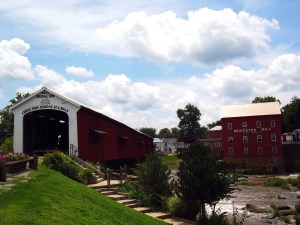
Bridgeton is on Bridgeton Road about nine miles south of its intersection with High Street in Rockville, Indiana.
Joseph Lockwood and Isaac J. Sillman built a sawmill just south of the 10:00 Line in 1823 on Raccoon Creek. They would later add a burrstone to grind grain. Daniel Kalley and a James Searing purchased the mill in 1837 and added a distillery. The mill and distillery burned down in 1845.By 1868 another mill, the current one, was built.
Historic Attractions include the
Bridgeton 1878 House
1822 Case Log Cabin
Conley Ford 1907 Covered Bridge
1892 Iron Bridge
For more information on the history, shops and dining in Bridgton, contact:
Bridgeton Covered Bridge Association
8227 S. Bridgeton Road
P.O. Box 77
Bridgeton, IN 47836
Phone: (765) 548-4095
http://www.bridgetonindiana.com/
Bridgeton Grist Mill
Perched on the banks of Raccoon Creek, Bridgeton Grist Mill is the oldest continually operating gristmill in Indiana. The mill has been open at some point in every year for over 180 years. It is not the oldest gristmill in Indiana, but no other mill has been in continuous operation for as long. The mill began as a log sawmill that eventually included a gristmill as well. It burned down in 1869. The mill reopened in a new building, after conversions to a roller mill in the 1880’s and to an electric mill in 1951. In 1969 new owners converted it back to a gristmill with the installation of 200-year-old, forty-eight inch French Buhr Stones. This family owned mill is continually being updated and improved. The picturesque mill stands beside the pretty Bridgton Covered Bridge that spans Raccoon Creek over the dam that provides the gristmills power.
The Bridgton Covered Bridge Festival occurs annually in mid-October and runs for ten days. There are other festivals throughout the summer. The mill is open daily through the summer months. Visitors may purchase over twenty different kinds of grain products ground in the mill.
For more information, contact:
Bridgeton Grist Mill
8104 Bridgeton Rd
Bridgeton, IN 47836
(812) 877-9550
http://bridgetonmill.com/
Bridgton Covered Bridge
The original 267 foot long, bridge was built by J.J. Daniels in 1868 for $10,200. The bridge was a 2-span covered Burr arch-truss design that spanned Little Raccoon Creek. The bridge closed to traffic in 1967. Bridgeton Covered Bridge Destroyed by Fire
On April 28, 2005, an arsonist set the bridge on fire, destroying it. The community of Bridgeton rebuilt the bridge, which reopened to foot traffic in 2006.
Joseph J. Daniels (May 22, 1826–August 1, 1916)
The son of bridge builder Stephen Daniels, Joseph was native to Marietta, Ohio. Joseph learned the craft of carpentry and bridge building from his father, who had sub-contracted for renowned army engineer and bridge builder Colonel Stephan Long. Long had developed the Long Truss design, for which he received patents in 1830, 1836 and 1839. Stephen employed the design, as did Joseph in his early bridges. Joseph assisted his father constructing many bridges in his native Ohio. Joseph would complete his first solo bridge contract at age nineteen.
In 1851 he married Clarissa Jane Blessing. The couple would have 4 children.
Indiana Bridge Builder
Joseph migrated to Indiana to begin his solo bridge building career. He constructed his first bridge on the Rising Sun/Versailles Pike in 1850. The next year he traveled to Parke County, Indiana to build a bridge. He moved permanently to Parke County in 1853 to build railroad bridges. His first railroad bridge was for the Evansville and Crawfordsville Railroad spanning the White River. The railroad company, impressed with his work, hired him as superintendent. He resigned the position 1856, but continued to build railroad bridges.
In 1861, Daniels moved to Rockville and began building covered bridges. He would build twelve covered bridges in Parke County. Nine of his Parke County bridges still survive. He built twenty-eight bridges in Indiana of which eighteen survive. Local lore suggests he build as many as sixty bridges during his lifetime, however historians can substantiate only fifty-three. In addition to his work in Indiana he built bridges in Ohio. Daniels also constructed railroad bridges. He built his last bridge, the Neet Bridge, in 1904. The National Register of Historic Places lists many of his bridges.
He had a work yard in Rockville where he precut many of the timbers he used on his bridges.
He used both the Howe and Burr trusses for most of his bridges. He developed a splice for the bottom chord members that he called the “double headed hook.”
After his death he was buried at Rockville Cemetery, Rockville, Parke County, Indiana.
His surviving bridges include:
Jackson
Mansfield
Bridgeton
Roseville
Mecca
West Union
Billie Creek
Big Rocky Fork
Melcher
Neet
Oakalla
Shieldstown
Medora
Deer’s Mill
Williams
Eugene
Newport
This podcast is based upon my book, West Central Indiana Day Trips. You can find the book on my website, www.mossyfeetbooks.com. It is available in a number of formats including ebook, softbound and audio book on Amazon as well as many other online book retailers. You may also purchase the book direct from me, the author, on the website.
I would encourage you to visit and subscribe to the Mossy Feet Books You Tube channel for more great content. If you like my videos, please hit the “Like,” button. The more likes I get the more You Tube will show it to other people, allowing me to grow the channel. I also invite you to visit my website, www.mossyfeetbooks.com. There you will find sample chapters, podcasts, a slew of content and links to where you can buy my books. While visiting the web site you can subscribe to it and receive email notifications of when I publish a new book or other content, like this video and podcast. If you like what I am doing, please purchase a book, as it helps fund my work.
I hope you enjoyed this podcast and thank you for listening.


