
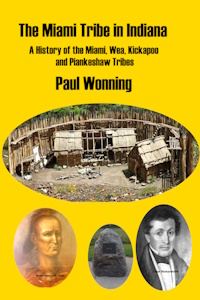
Sample Chapter
The Miami Tribe in Indiana
Chapter title – Miami Tribe History
Miami Tribe History
The Miami tribe belongs to the Algonquin linguistic group. The Miamis called themselves “Twightwees,” a name that refers to the call of a crane. The Chippewa called them “Omaumeg,” meaning “people of the Peninsula.” The Miami tribe included several bands, including the Piankashaw, Wea, Atchatcha, Kangouen, Kilatika, Mengakonkia, and Pepicokia. The Piankashaw and Wea later came to be recognized as separate tribes.
Settlements
Early Miami settlements in Indiana include the Piankashaws, most likely including the Pepicokia band, at Vincennes, Knox County; Choppatee’s Village on the west bank of the St. Joseph River, near Fort Wayne, Allen County; Kekionga on the east bank of the St. Joseph River, near Fort Wayne; Little Turtle’s village, 20 miles northwest of Fort Wayne; a Wea village called “Kenapacomaqua” on the Eel River near Logansport, Cass County; Kokomo in Howard County; Kowashikka, also called Thorntown, on Sugar Creek in Boone County; Meshingomesia, a reservation on the Mississinewa River, in Wabash County; Mississinewa, on the same river at its juncture with the Wabash River, in Miami County; Missinquimeschan, a Piankashaw village near Washington, Daviess County; Papakeecha (named for its chief), at Indian village, Noble County; Piankashaw, a village of Piankashaws, on the Wabash and Vermilion rivers, in Vermilion County; Seek’s Village, near Columbia City on the Eel River, Whitley County; and White Raccoon’s Village, near Aboite, Allen County.
Population
It is estimated that there were 4,500 Miami people (including Wea and Piankashaw) in 1650. Estimates from 1764 and 1765 were 1,750 and 1,250. An 1825 count totaled 1,400 Miami, Wea, and Piankashaw combined, 327 of whom were Wea. An 1885 count of Miami in the Indian Territory (not including Wea or Piankashaw) was only 57 individuals. The 1900 census enumerated 243 Miami (of both pure and mixed ethnicity) in Indiana. The 1910 census enumerated 90 Miami in Indiana and 123 in Oklahoma. In 1923, the U.S. Indian Office Report showed 125 Indians in Indiana. The 1930 census showed 47 Miami in Indiana. In 1937, there were 287 Miami reported in Oklahoma.
This information is from The Indian Tribes of North America, by John R. Swanton, which was reviewed last week. For more detailed information on the history and population of the Miami and allied tribes, visit http://www.dickshovel.com/mia.html.
Top of Page
Mossy Feet Books on Social Media
Twitter
Linkedin
YouTube
Pinterest
Online Sources for Mossy Feet Books
Paul Wonning’s Books on Amazon Page
Paul Wonning’s Books on Scribd Page
Paul Wonning’s Books on Apple
Paul Wonning’s Books on Kobo
Paul Wonning’s Books on Barnes and Noble
Paul Wonning’s Books on 24 Symbols
Paul Wonning’s Books on Google Play
Paul Wonning’s Books on Indigo
Paul Wonning’s Books on Playster
Paul Wonning’s Books on OverDrive
Search Paul Wonning on Ingrams
Table of Contents
© 2026 Paul Wonning


