Independence Day
Today the author talks about the evolution of the Declaration of Independence in honor of the nation’s 250th birthday.
From the Book
The American Revolution – 1776
Independence Day
On June 7, 1776, Richard Henry Lee Introduced Resolution for Declaration of Independence that helped lead to the Declaration of Independence almost a month later.
Richard Henry Lee (January 20, 1732 – June 19, 1794)
The son of Colonel Thomas and Hannah Harrison Ludwell Lee, Richard was native to Westmoreland County, Virginia. The Lee family had served as military officers and diplomats, which provided the growing boy with a template for his later political life. During his early years he received his education from a tutor at the family home in Stratford, Virginia in Stratford Hall. Lee voyaged to England in 1748 to attend the Queen Elizabeth Grammar School, in Yorkshire, England. After finishing school, he toured Europe and then returned to Virginia in 1753 to help his brothers settle his parents’, who had died in 1750, estate.
Political Career
He received appointment as a justice of the peace in 1757 and gained election to the Virginia House of Burgesses the next year. At his legislature he met Patrick Henry. During the turbulent years after the Stamp Act in 1765, he became an early supporter of independence for the colonies. He was one of the originators of the Committees of Correspondence in Virginia and receives credit for writing the Westmorland Resolution in 1766. He attended the First Continental Congress and later the Second Continental Congress. On June 7, 1776, he introduced the Resolution that helped lead to the Declaration of Independence less than a month later.
Text of the Resolution:
“That these United Colonies are, and of right out to be, free and independent States, that they are absolved from all allegiance to the British Crown, and that all political connection between them and the State of Great Britain is, and ought to be, totally dissolved; that measures should be immediately taken for procuring the assistance of foreign powers, and a Confederation be formed to bind the colonies more closely together.”
On June 11, 1776, the delegates of the Second Constitutional Congress appointed a committee of five to draft a Declaration of Independence. The committee Included:
Thomas Jefferson
John Adams
Benjamin Franklin
Roger Sherman
Robert R. Livingston
June 28, 1776 – Committee Submits Declaration of Independence Draft
As the Battle of Sullivan’s Island raged, another important development took place in Philadelphia. Thomas Jefferson had finished the initial drafts of a document that would become the most important document in the history of the emerging United States and presented it to the committee in charge of drafting it. The “Gang of Five” committee finished their first draft of the Declaration by June 28 and submitted it to the full Congress on the same day. They titled the document “A Declaration by the Representatives in General Congress Assembled.” Thomas Jefferson read the document before Congress and submitted it to the delegates for debate and revisions. John Dunlap of Philadelphia made printed copies of the Declaration.
Richard Henry Lee introduced his resolution declaring independence from Britain in June 1776, however at that time most delegates either did not favor it or were unsure of the desires of their state legislatures. The consensus among the delegates was that the vote should be unanimous. They had delayed the debate until July 1. Debate on the resolution began on July 1, as planned.
The Congress held the vote to adopt the independence resolution on July 2, 1776. Twelve states voted in favor of Independence. Only New York, whose state legislature had not informed the delegates of their stance, abstained from voting. John Adams wrote to his wife Abigail, predicting that July 2 would become a great holiday. However, that prediction proved wrong.
Richard Henry Lee, a delegate to the Continental Congress from Virginia, had introduced a resolution on June 7, 1776, that urged the Congress to declare Independence from Great Britain. Weeks of debate followed. Congress appointed a committee composed of Thomas Jefferson, John Adams, Benjamin Franklin, Roger Sherman, and Robert R. Livingston to write the Declaration. More debate followed and finally, on July 2, 1776, the Continental Congress adopted the resolution, thus declaring the United States free and independent of Great Britain. Twelve of the thirteen colonies voted in favor of independence, with the New York delegation abstaining from the vote. New York’s delegates claimed that the New York Provincial Congress had not authorized them to vote. This authorization came about a week later. The Congress then worked on the wording and draft of the final Declaration of Independence. Congress approved the final draft for the Declaration on July 4, 1776, and sent the document to the printers for publication. Thus, July 4 is regarded as the nation’s birthday.
After the delegates signed the approved Declaration of Independence, the Congress sent the document John Dunlap’s print shop on the corner of Second and Market Streets. Dunlap spent all night setting the print and running off copies. He printed approximately 200 copies. On the morning of the 5th, he delivered them to John Hancock, President of the Congress. Hancock, in turn, sent them out to the various state governors, assemblies, Committees of Safety and newspapers.
John Dunlap (1747 – November 27, 1812)
The son of James and Agnes Service Dunlap, John was native to Strabane, County Tyrone, Ireland. At age ten Dunlap migrated to Philadelphia and took a printing apprenticeship with his uncle William Dunlap. William’s wife was Debra Read’s niece. Debra Read was the wife of Benjamin Franklin. In 1766 William left the shop to pursue a life in the ministry, leaving John to take over the shop. In 1771 he began printing a weekly newspaper, The Pennsylvania Packet or The General Advertiser. John and Elizabeth Hayes Ellison married in 1773. The couple would have seven children. He enlisted as an officer in the 1st Troop of Philadelphia City Cavalry when it was organized in 1774 as an officer. In 1776 he signed contracts with the Philadelphia assembly and the Continental Congress, making him the official printer of both bodies.
August 2, 1776 The Congress engrossed the Declaration of Independence
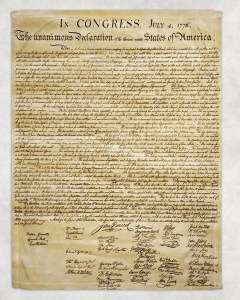
Engrossing is the act of preparing a document for signing. The engrosser did this by copying the text of the document in large, clear handwriting on new paper. The document that was passed by Congress on July 4, 1776, was not the same physical document that delegates began signing on August 2, 1776. On July 19, 1776, the Congress had decreed that the document be engrossed with the title, “the unanimous declaration of the thirteen united states of America.” The Congress also directed that, “be signed by every member of Congress.” Historical lore assigns an assistant to the Secretary of Congress Charles Thomson, Timothy Matlock, to this task. He copied the Declaration onto a sheet of parchment that was 24¼ by 29¾ inches in size. He would have used a quill pen and probably an ink made from iron-gall mix blended with charcoal. John Hancock, President of the Congress, was the first to sign the document. He signed with a large signature. Others followed. Not everyone signed the document that day. Others followed in the days following, however not everyone signed. The delegates signed, grouped by state, from north to south. New Jersey was first and Georgia last.
It would take until August 10 before the people of Georgia became the last state to receive the news.
Georgia President and Commander in Chief Archibald Bulloch received the manuscript of the Declaration of Independence on August 8, 1776. Bulloch presented the document, and accompanying letter from John Hancock to the board. The men agreed that a public reading would take place on Saturday, August 10. The men met again on the 10th, after which they read it publicly four times at four locations. In an era where only about half of the population was literate, public readings were an important way to impart news to the public.
I would encourage you to visit and subscribe to the Mossy Feet Books You Tube channel for more great content. If you like my videos, please hit the “Like,” button. The more likes I get the more You Tube will show it to other people, allowing me to grow the channel. I also invite you to visit my website, http://www.mossyfeetbooks.com. There you will find sample chapters, podcasts, a slew of content and links to where you can buy my books. While visiting the web site you can subscribe to it and receive email notifications of when I publish a new book or other content, like this video and podcast. If you like what I am doing, please purchase a book, as it helps fund my work.


